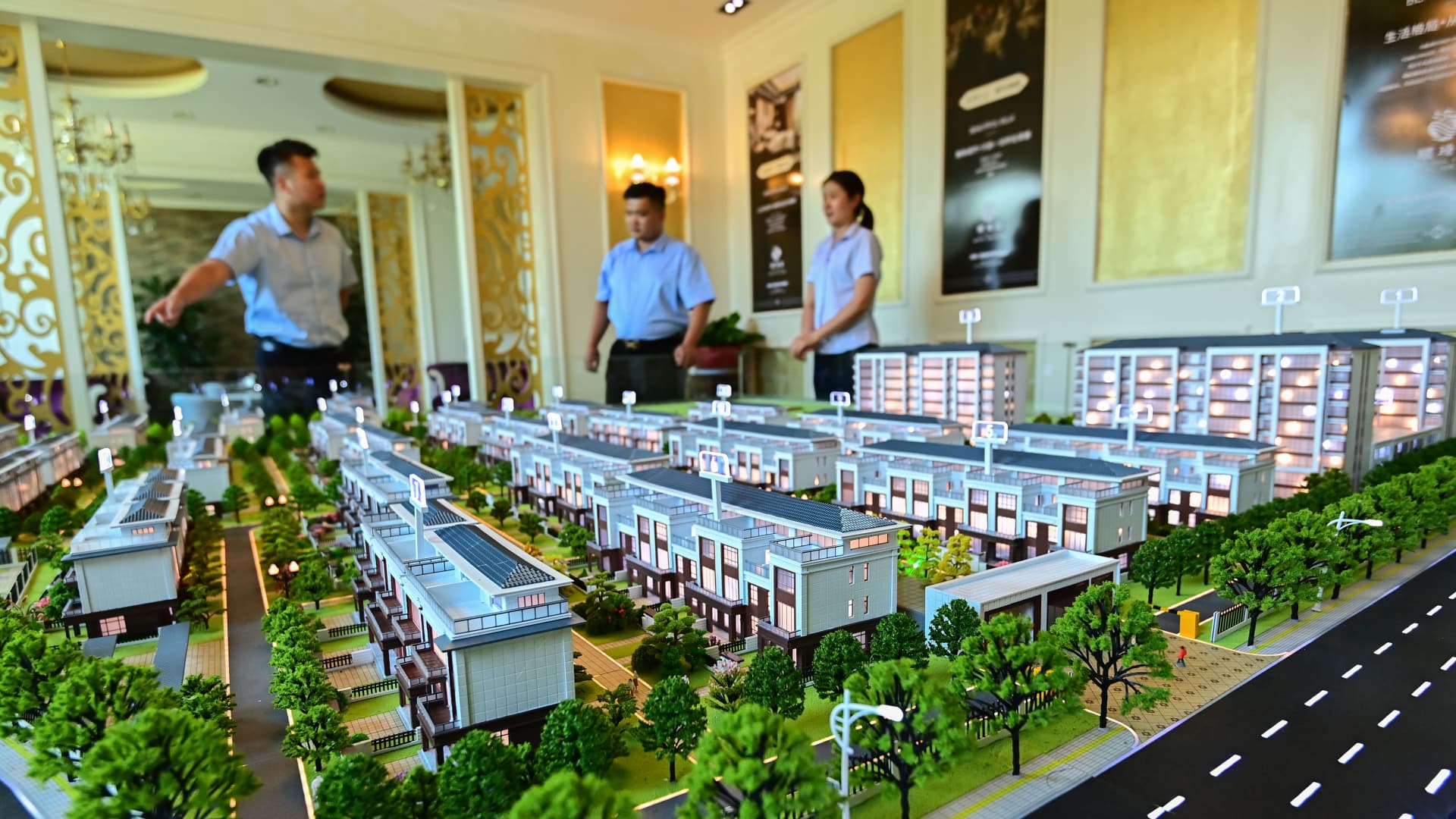

In Qingzhou City, Shandong Province, citizens gathered recently at a commercial residential property development to view a sand table of the project, highlighting a stark reality: China’s real estate sector is facing unprecedented challenges. Over recent years, the market has been mired in a downturn exacerbated by a shrinking population, which threatens to suppress housing demand even further.
According to Goldman Sachs, the demand for new homes in urban China is projected to remain below 5 million units annually, a staggering decline from the boom years when demand peaked at 20 million units in 2017. “The declining population and slow urbanization imply a decreased demographic demand for housing in the coming years,” the investment bank’s economists noted.
Recent estimates indicate that China’s population could dip below 1.39 billion by 2035, down from approximately 1.41 billion today. Tianchen Xu, a senior economist at the Economist Intelligence Unit, attributes this decline to a combination of fewer births and an aging populace, as both birth rates and life expectancy influence demographic trends. Goldman Sachs estimates that a shrinking population could result in a demand shortfall of 0.5 million housing units annually during the 2020s, worsening to a drop of 1.4 million units per year by the 2030s.
Despite the relaxation of the one-child policy in 2016 and various incentives aimed at encouraging childbirth, the fertility rate in China continues to fall. Young adults are deterred by stagnant incomes, job market instability, and an inadequate social security system, leading many to delay marriage and family planning. Xu emphasizes that these pro-natalist policies have “limited effect,” as they fail to tackle fundamental issues such as the high costs associated with raising children.
The impact of these demographic shifts is evident in educational institutions as well. Data from the Ministry of Education reveals that approximately 36,000 kindergartens have closed over the last two years, with preschool enrollment declining by over 10 million students. In parallel, the number of elementary schools dropped by nearly 13,000 between 2022 and 2024. This decline reverberates through housing markets previously buoyed by high demand for properties located near reputable schools.
William Wu, a property analyst at Daiwa Capital Markets, highlights that the premium once associated with such homes is diminishing as the local population shrinks and governments reassess district-based enrollment policies. A Beijing mother shared that the value of her apartment has fallen by roughly 20% since her purchase two years ago, made to secure a good school for her son.
The demographic challenges pose additional strain on an already struggling property market, which has faced a downturn since late 2020. Even with various government interventions aimed at stimulating recovery, prices for new homes experienced their sharpest decline in months as of May. New home sales in 30 major cities plummeted 11% year-on-year in the first half of June, worsening from a previous 3% drop.
Goldman Sachs anticipates that property investors are likely to continue selling to owner-occupiers, reflecting expectations of ongoing price reductions. While urbanization rates are expected to stabilize in the near term, Wu believes the demographic drag may not be immediately felt and could take decades to unfold. Still, he notes that impending market declines might be partly mitigated by ongoing urbanization and an increasing demand for housing upgrades.
As China’s property market navigates these turbulent waters, it is clear that demographic changes will play a crucial role in shaping the future landscape of residential real estate.
Original Source: https://www.cnbc.com/2025/06/21/china-population-decline-hurting-property-market.html
Category :
Tags:
Publish Date: 2025-06-21 11:39:00