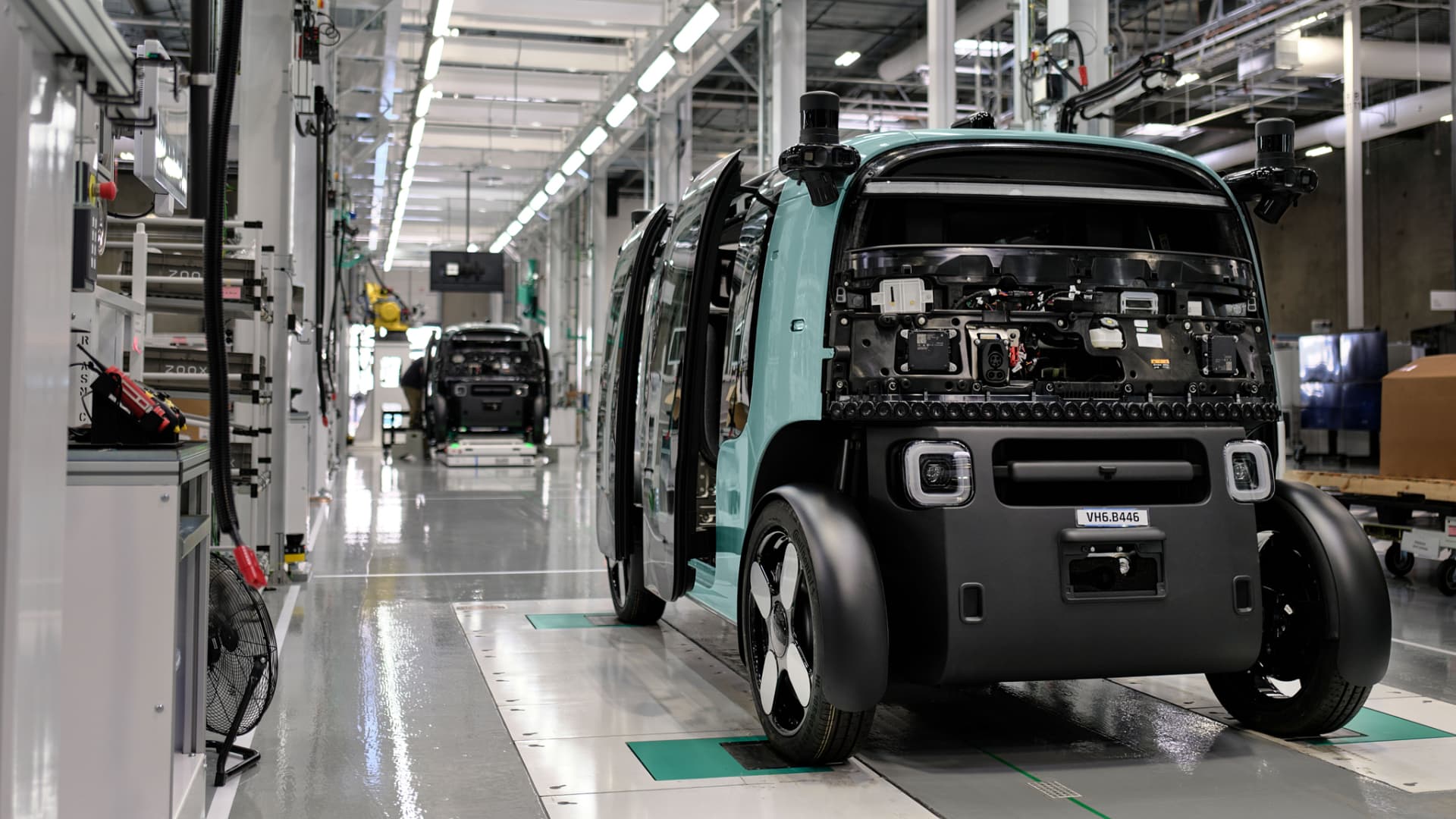

Amazon’s autonomous vehicle company, Zoox, has launched a new manufacturing facility in Hayward, California, marking a significant milestone in its push to ramp up robotaxi production ahead of a planned commercial rollout later this year. The facility, which spans approximately 3.5 football fields, is designed specifically for assembling Zoox’s unique robotaxi vehicles, which feature a “carriage-style” layout allowing up to four passengers to sit facing one another in a steering-wheel-free environment.
Currently, the new facility is producing one robotaxi per day, but the company has ambitious plans for expansion. Zoox aims to ramp up production significantly, with a capacity to assemble 10,000 robotaxis annually-approximately three per hour-though no timeline for reaching that level has been disclosed. “We don’t need to crank out a vehicle every minute because we’re not selling these things,” said Zoox CEO Aicha Evans during a facility tour.
Founded in 2014 and acquired by Amazon for $1.3 billion in 2020, Zoox began testing its robotaxis on public roads earlier this year, currently operating a small fleet in cities including Foster City, San Francisco, and Las Vegas. The company envisions rolling out between 500 and 1,000 robotaxis in select small- to medium-sized cities, offering a novel ride-hailing service.
In the competitive landscape of autonomous vehicles, Zoox is racing to catch up to market leader Waymo, the only company currently offering a fully public driverless ride-hailing service in the United States. With over 250,000 paid rides per week in cities like Phoenix and San Francisco, Waymo’s rapid expansion puts added pressure on Zoox. Evans acknowledged Waymo’s progress, stating that it validates the efforts of all players in the autonomous ride-hailing sector.
While competitors like Tesla also prepare to launch robotaxi services, Zoox is focused on its initial commercial market in Las Vegas, anticipating public rides will commence later this year, followed by expansions into San Francisco, Austin, and Miami.
What sets Zoox apart is its custom design for robotaxis. Unlike Waymo, which utilizes modified Geely Zeekr minivans, Zoox has engineered its compact vehicles with advanced technology that Evans described as “high-end computers on wheels.” The development costs of these bespoke vehicles have been substantial, but the company expects these costs to decrease as production scales up.
The Hayward facility, which was previously occupied by the bus manufacturer Gillig, currently employs around 100 technicians and integrates both human labor and robotic automation to streamline the assembly process. Automated systems assist with specific tasks, such as applying adhesive and transporting vehicles through the assembly line. Once assembled, each robotaxi undergoes rigorous testing, including calibration for sensors and cameras and stress tests for the powertrain, ensuring every vehicle meets Zoox’s stringent quality criteria before hitting the roads.
As Zoox prepares for its commercial debut, it is ramping up marketing efforts to raise awareness about its distinct robotaxi design. “Because the vehicle looks so different, we need to announce ourselves,” said Evans, underscoring the need for public education regarding the innovative service.
With its sights set on reshaping the future of urban transportation, Zoox is poised to carve out its place in the rapidly evolving autonomous vehicle market, ready to challenge established players while tapping into the growing demand for innovative ride-hailing solutions.
Original Source: https://www.cnbc.com/2025/06/18/amazon-zoox-robotaxi.html
Category :
Tags:
Publish Date: 2025-06-18 20:51:00