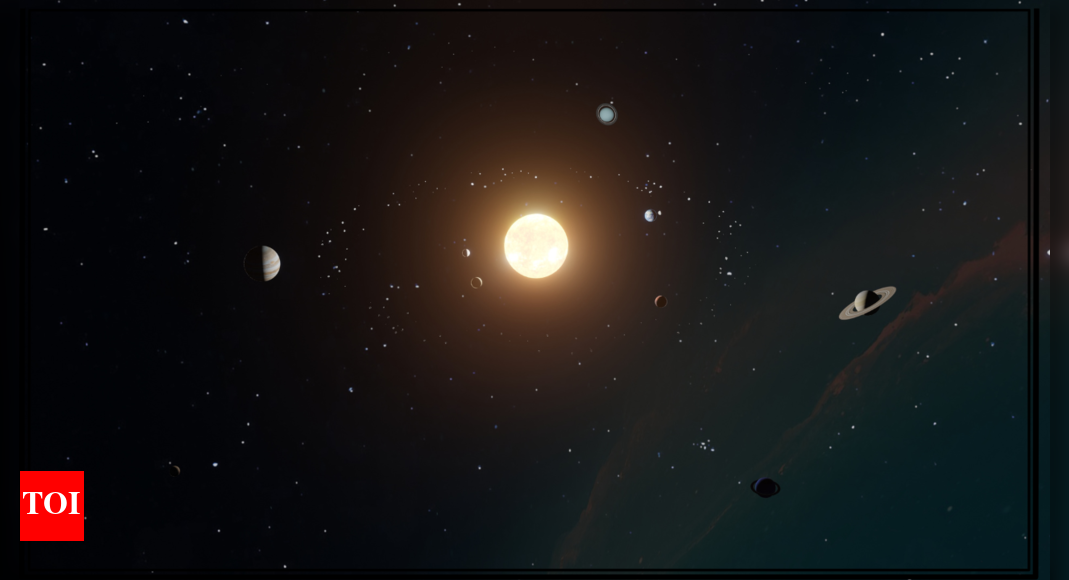

Water, a fundamental element for life, is increasingly found beyond Earth, reshaping our understanding of the universe. NASA’s Ocean Worlds initiative is at the forefront of this exploration, vigorously searching for liquid water-considered essential for extraterrestrial life. These findings challenge the long-held belief that Earth is the only “blue planet” in existence.
Recent research from NASA highlights that the Orion Nebula, located 1,300 light-years away, produces the equivalent of 60 Earth oceans daily. This estimate is based on observations of water vapor clouds drifting through interstellar space, remnants that may eventually contribute to the formation of stars and planets.
Closer to home, our solar system harbors numerous “ocean worlds,” where liquid water either exists today or suggests historical presence. Europa, one of Jupiter’s moons, contains a hidden ocean beneath its icy surface that may be twice the volume of all Earth’s oceans. This salty ocean is sustained by the moon’s internal heat, presenting possibly life-friendly chemical conditions. Meanwhile, Saturn’s Enceladus, smaller than Arizona, features a global subsurface ocean. NASA’s Cassini spacecraft detected plumes of water vapor erupting from its southern pole in 2005, containing organic compounds and hydrogen, indicative of possible hydrothermal activity below the surface.
Other celestial bodies, including Ganymede and Titan, as well as dwarf planet Ceres, are also believed to harbor liquid reservoirs. NASA has identified at least 15 ocean worlds within our solar system, a number that could grow as exploration continues.
Mars, often dubbed the “Red Planet,” once brimmed with water; ancient lakebeds and riverbeds bear testimony to this. A radar survey in 2018 suggested that liquid water might still lie beneath the South Pole’s ice cap, buried under layers of ice and rock. Although only 0.03% of Earth’s water is visible on Mars today, scientists tirelessly seek out underground aquifers that could still support microbial life.
Beyond our solar neighborhood, NASA’s space telescopes have confirmed the presence of water vapor in the atmospheres of over ten exoplanets, some located in the “Goldilocks Zone,” where conditions might support liquid water. The James Webb Space Telescope is primed to enhance our ability to analyze these distant worlds, potentially identifying signs of biological processes.
Water is more than just a molecule; it is a vital ingredient for advanced chemistry and the cradle of life. NASA’s guiding principle, “Follow the water,” underscores its significance in the search for extraterrestrial life. Upcoming missions like the Europa Clipper, slated for launch in 2024, and the Dragonfly mission to Titan in the 2030s, aim to explore these ocean worlds using advanced technologies to analyze surface chemistry and even sample water plumes.
In summary, the existence of water in our solar system and beyond is firmly established. From ancient Martian lakes to vapor-filled moons, water shapes both planetary landscapes and the trajectory of space exploration. NASA’s Ocean Worlds program exemplifies the profound quest for understanding not just the universe, but also our place within it. As we journey further into space, the discovery of water stands as a beacon of hope for the existence of life beyond Earth.
Original Source: https://timesofindia.indiatimes.com/etimes/trending/everything-you-need-to-know-about-water-in-the-solar-system-and-beyond/articleshow/121861350.cms
Category :
Tags:
Publish Date: 2025-06-15 20:00:00