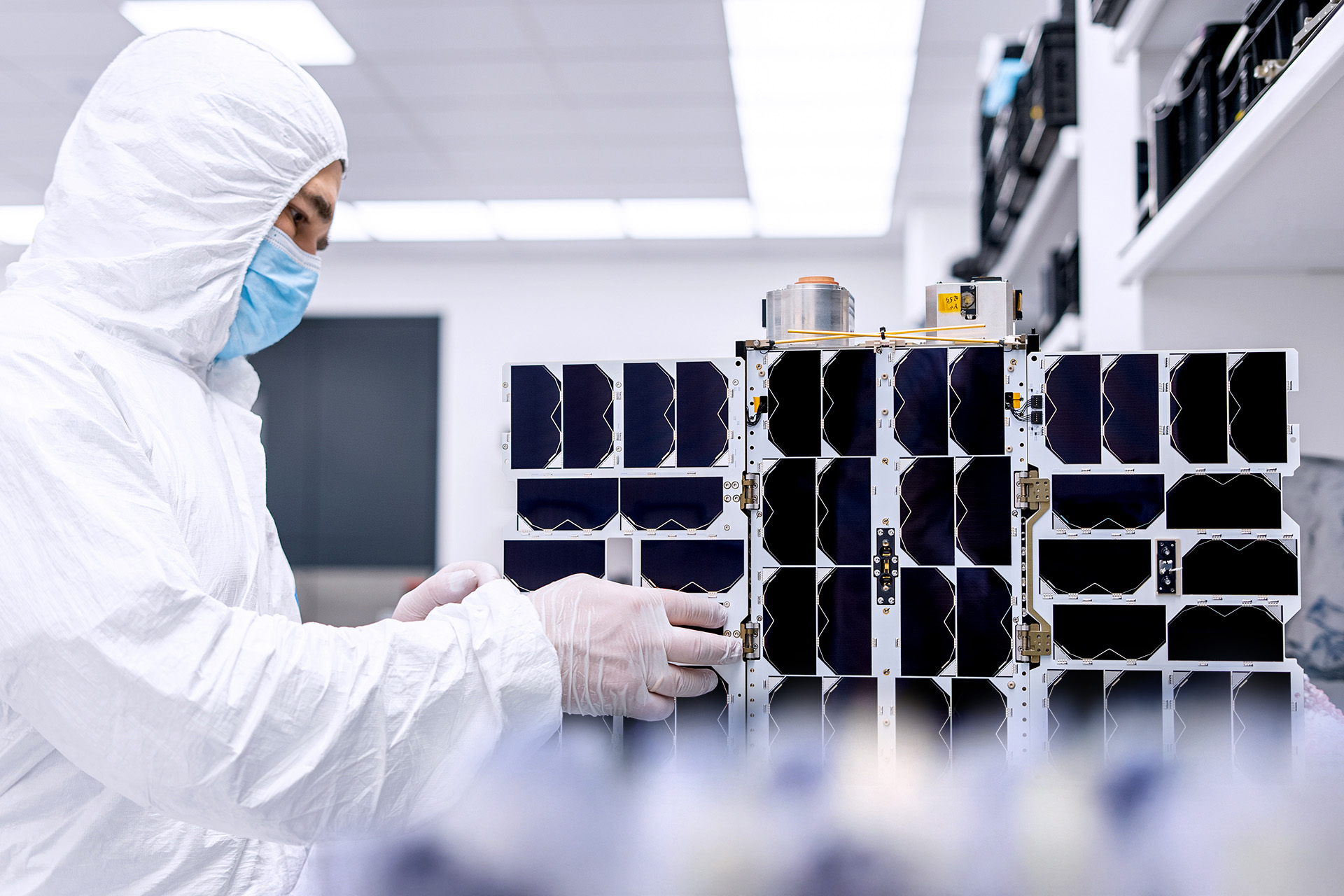

TAMPA, Fla. — South Korea’s Institute for Basic Science (IBS) is set to launch its first of five cubesats to study Venus from low Earth orbit (LEO) starting next year. This initiative is a key part of ongoing planetary research, particularly as flagship missions navigate budget challenges. Lithuania-based NanoAvionics announced on June 2 that it has secured a contract to provide an 8U satellite for the CLOVE mission, which stands for Chasing the Long-term Variability of Our Nearest Neighbor Planet Venus. The satellite, equipped with ultraviolet and near-infrared sensors from IBS, will monitor the dynamics of Venus’ atmosphere.
IBS plans to deploy a new CLOVE satellite every three years for the next 15 years, aiming to cover at least one entire 11-year solar cycle. This extensive data collection is intended to enhance our understanding of why Venus evolved into the inhospitable planet it is today. “This mission reflects a growing trend in space science, where small satellites play an increasingly important role in complementing larger-scale missions,” said Atle Wøllo, CEO of NanoAvionics. To date, the company has supported over 20 research missions across areas such as materials science, Earth observation, and astrophysics. CLOVESat-1 will mark NanoAvionics’ first foray into planetary research.
The orbital position of Venus makes LEO missions particularly advantageous; satellites in this orbit can observe the planet during daylight for about half of each orbit. “LEO has a clear advantage over many launching opportunities,” explained Lee Yeon Joo, chief investigator of the Planetary Atmospheres Group at IBS. “This means we don’t have to restrict follow-up satellites to specific launch windows.” Moreover, operating small satellites in LEO is cost-effective, avoiding the complexities and risks that come with interplanetary missions.
Repeated satellite deployments can also mitigate the effects of instrument aging, allowing for the collection of more consistent data over time. Lee emphasized that the CLOVESats will provide a valuable time series of Venus’ disk reflectivity, enhancing data collection beyond what a single, long-duration mission could achieve. However, he acknowledged that while planetary missions can offer high spatial resolution with sophisticated instruments, cubesats like those in the CLOVE mission will complement these efforts rather than replace them.
The future of three major upcoming Venus missions, including NASA’s DAVINCI and VERITAS programs, is currently uncertain due to proposed budget cuts to NASA’s science initiatives under the 2026 fiscal year request from the Trump Administration, pending Congressional approval. The DAVINCI program, which aims to explore Venus’ atmosphere, is targeted for a launch around the end of 2030, while VERITAS, which focuses on mapping surface features of the planet, has already faced delays. Meanwhile, NASA is also expected to cease its involvement in the European Space Agency’s EnVision mission, which is set for launch in November 2031. ESA recently awarded a 367 million euros ($420 million) contract to Thales Alenia Space for the development of the EnVision spacecraft.
The CLOVE mission marks a significant step for ongoing planetary research, particularly as larger missions grapple with funding challenges. As space science advances, missions like CLOVE may play an essential role in unraveling the mysteries of Earth’s enigmatic neighbor, Venus.
Original Source: https://spacenews.com/south-koreas-venus-focused-cubesat-advances-as-larger-missions-face-nasa-cuts/
Category :
Tags:
Publish Date: 2025-06-03 02:49:00