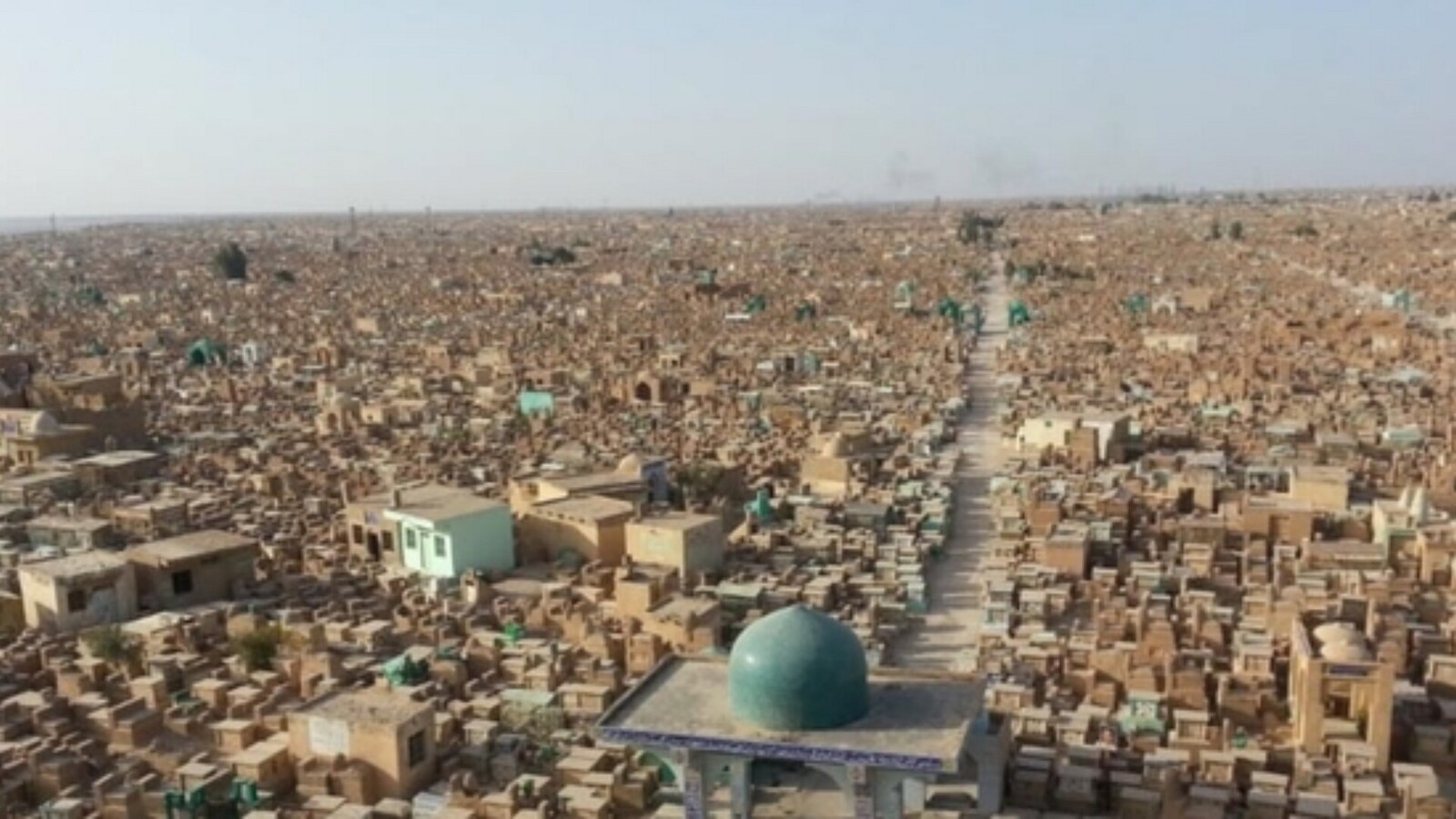

A video by Indian travel influencer Ankita Kumar, widely recognized as monkey.inc on Instagram, has brought renewed attention to Wadi Al-Salam, the world’s largest cemetery, located in Najaf, Iraq. In her striking video, a sprawling landscape filled with beige box-like structures unfolds, resembling an urban skyline. What initially appears to be a densely populated cityscape is revealed to be a vast necropolis, the final resting place of over six million people and one of the most revered sites in the Shia Muslim world.
Covering more than 917 hectares-equivalent to over 1,700 football fields-Wadi Al-Salam holds the Guinness World Record for the largest burial ground. This expansive cemetery occupies approximately 13 percent of Najaf’s land and is experiencing a significant growth rate, reportedly expanding at twice its usual pace, as noted in a Reuters report from 2021. Its cultural and spiritual significance is profound; the cemetery houses the graves of numerous prophets, scientists, and royalty, with origins dating back to antiquity.
The cemetery’s historical lineage includes figures from various dynasties and eras, such as rulers from the Al-Hira kingdom and leaders from the Al-Sassanian period. Notably, the tomb of Imam Ali Ibn Abi Talib, a revered figure in Shia Islam and cousin to the Prophet Muhammad, lies within its grounds, transforming Wadi Al-Salam into a global pilgrimage site. Each year, nearly 50,000 individuals from the Shia community are laid to rest here, underscoring its enduring spiritual importance.
UNESCO characterizes Wadi Al-Salam as a “unique example of a cultural tradition” and a testament to traditional land use, showcasing centuries of religious devotion and architectural design. The uniformity of its beige tombs and mausoleums gives the cemetery a dreamlike appearance from above. On the ground, the layout resembles a labyrinth, featuring both lower graves and towering tombs, contributing to the eerie sense of depth and density.
Despite its monumental significance, burial in Wadi Al-Salam remains accessible. AFP reports that the cost of digging a grave is approximately $100, while tombstones typically range from $170 to $200, providing a cost-effective option for families seeking to honor their loved ones.
Kumar’s viral video captures the stark beauty and complexity of this sacred place, offering viewers a poignant glimpse into a city of the dead that is rich in history and cultural significance. As Wadi Al-Salam continues to expand, it serves not only as a burial ground but as a lasting symbol of faith and heritage for the Shia Muslim community. The interplay of architectural density, spiritual reverence, and social tradition makes Wadi Al-Salam an extraordinary study of life and death, drawing visitors and pilgrims from around the globe.
Kumar’s observation of this extraordinary necropolis invites reflection on the profound relationship between culture and death, emphasizing Wadi Al-Salam’s role as more than just a cemetery-it is a vibrant tapestry of shared human experience and religious devotion that resonates across generations.
Original Source: https://www.livemint.com/news/wadi-al-salam-worlds-largest-graveyard-that-looks-like-a-living-city-video-11748415536459.html
Category :
Tags:
Publish Date: 2025-05-28 13:04:00