Unlock the Wonders of the Universe: How New English School’s Planetarium Inspires Generations of Stargazers Since 1954

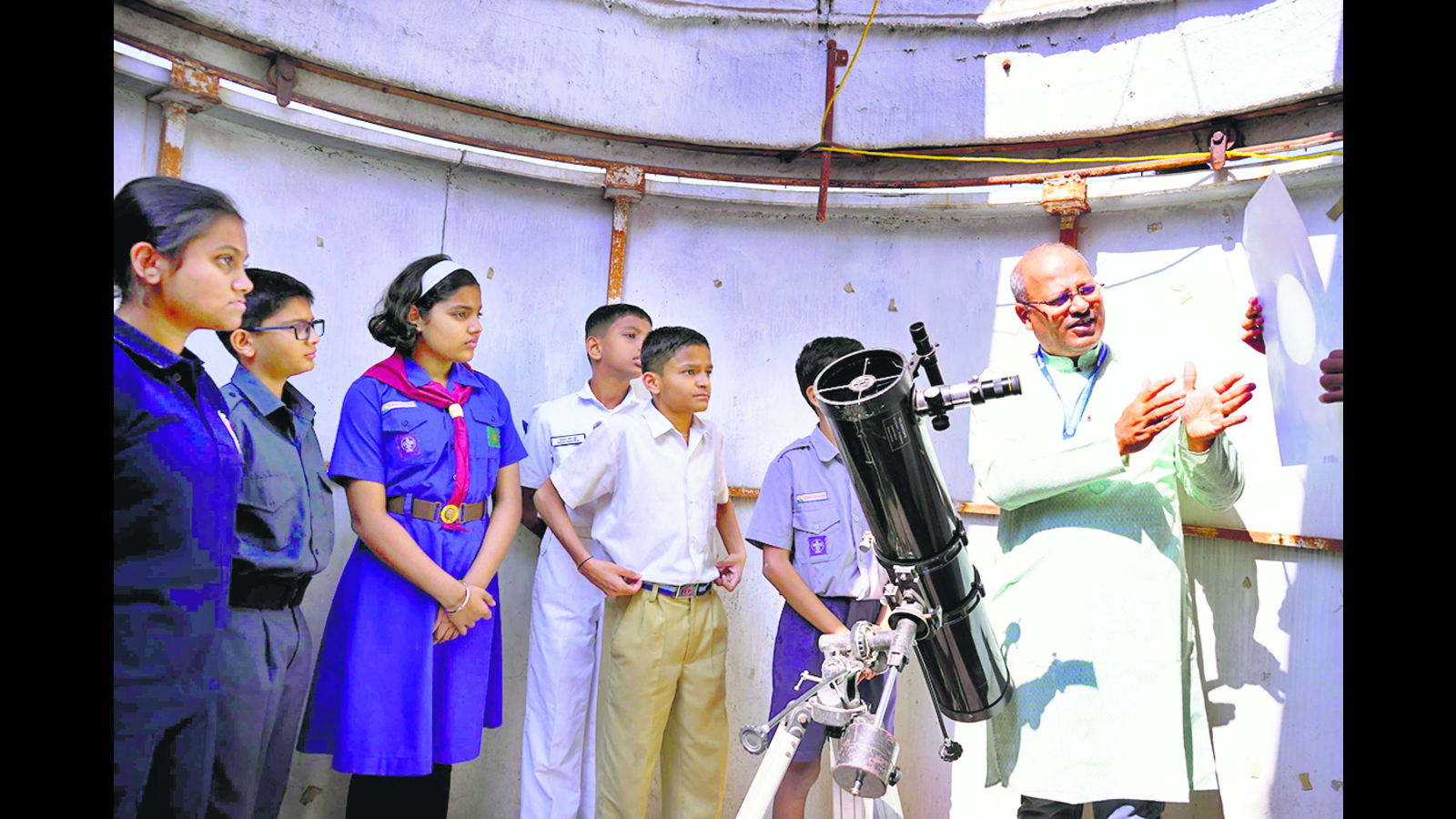
At the heart of Pune’s Sadashiv Peth, the New English School hosts a remarkable relic of space education: the Kusumbai Motichand Planetarium. Since its establishment in 1954, this operational marvel has captivated generations of students, transporting them to distant galaxies with its vintage Spitz A1 projector, a testament to 1950s science education. Vinayak Ramdasi, the school’s dedicated science educator, has been instrumental in revitalizing the planetarium since 2012, emphasizing its role as a bridge between heritage and hands-on learning.
“The planetarium isn’t just a tool for science; it ignites questions, wonder, and curiosity,” Ramdasi states. With its modest 9-meter dome, the planetarium might appear unassuming, yet it offers an extraordinary educational experience that few others can match. The Spitz A1 projector, designed by American engineer Armand Spitz with input from Albert Einstein, remains one of the only functioning models in the world today, providing an authentic glimpse into the cosmos as it was long ago.
Notably, the planetarium can recreate the night sky from any location and date. When astronaut Rakesh Sharma visited in 2017, Ramdasi showcased the sky above Russia precisely at the moment of Sharma’s historic launch, evoking a nostalgic smile on the astronaut’s face. “This place connects personal moments with the cosmos,” he adds, showcasing the planetarium’s ability to inspire awe and curiosity among its visitors.
The astronomy program extends beyond the confines of the dome. Through regular night sky observation camps and a unique initiative called Roj Ek Prashna Khagolshastracha, which translates to “A question on astronomy every day,” students from Class 7 to Class 9 delve deep into the wonders of space. Inspired by renowned astrophysicist Jayant Narlikar, who recently passed away, this initiative has prompted over 2,400 meaningful discussions about astronomy in classrooms in just seven years.
Practical experience is central to the program. Students engage in solar observations, track planets, and identify deep-sky objects such as the Andromeda Galaxy and the Crab Nebula. “We don’t just teach astronomy; students learn to operate and calibrate telescopes themselves,” Ramdasi emphasizes. On Friday and Saturday evenings, the school grounds turn bustling with nearly 200 students participating in various observation activities, contributing to over 1,000 shows conducted since 2010, reaching more than 40,000 students.
Parents often express amazement at their children’s enthusiasm for astronomy, noting that students who typically sleep early remain wide-eyed during night camps. As one student, Arnav Khaparde from Class 9, shared, “I’ve developed observational skills to study planets and stars within just a year. I remember my first glimpse of a planet through a telescope-it felt like we’d become one.”
Backed by support from eminent scientists such as Vijay Bhatkar, Arvind Gupta, and Govind Swarup, the program fosters a culture of inquiry, echoing Narlikar’s belief that “asking questions is the true foundation of science.” In an age where digital planetariums are becoming increasingly common, the Kusumbai Motichand Planetarium’s enduring legacy stands as a powerful reminder that true science thrives on passion and curiosity, needing only a clear sky and inquisitive minds.
As the New English School continues to inspire and educate future astronomers, it cements its position not only as a beacon of historical significance but also as a bastion of modern learning, fostering a love for the cosmos in generations to come.
Original Source: https://www.hindustantimes.com/cities/pune-news/stargazing-since-1954-new-english-school-s-planetarium-lights-up-young-minds-across-generations-101748110179367.html
Category :
Tags:
Publish Date: 2025-05-25 05:36:00