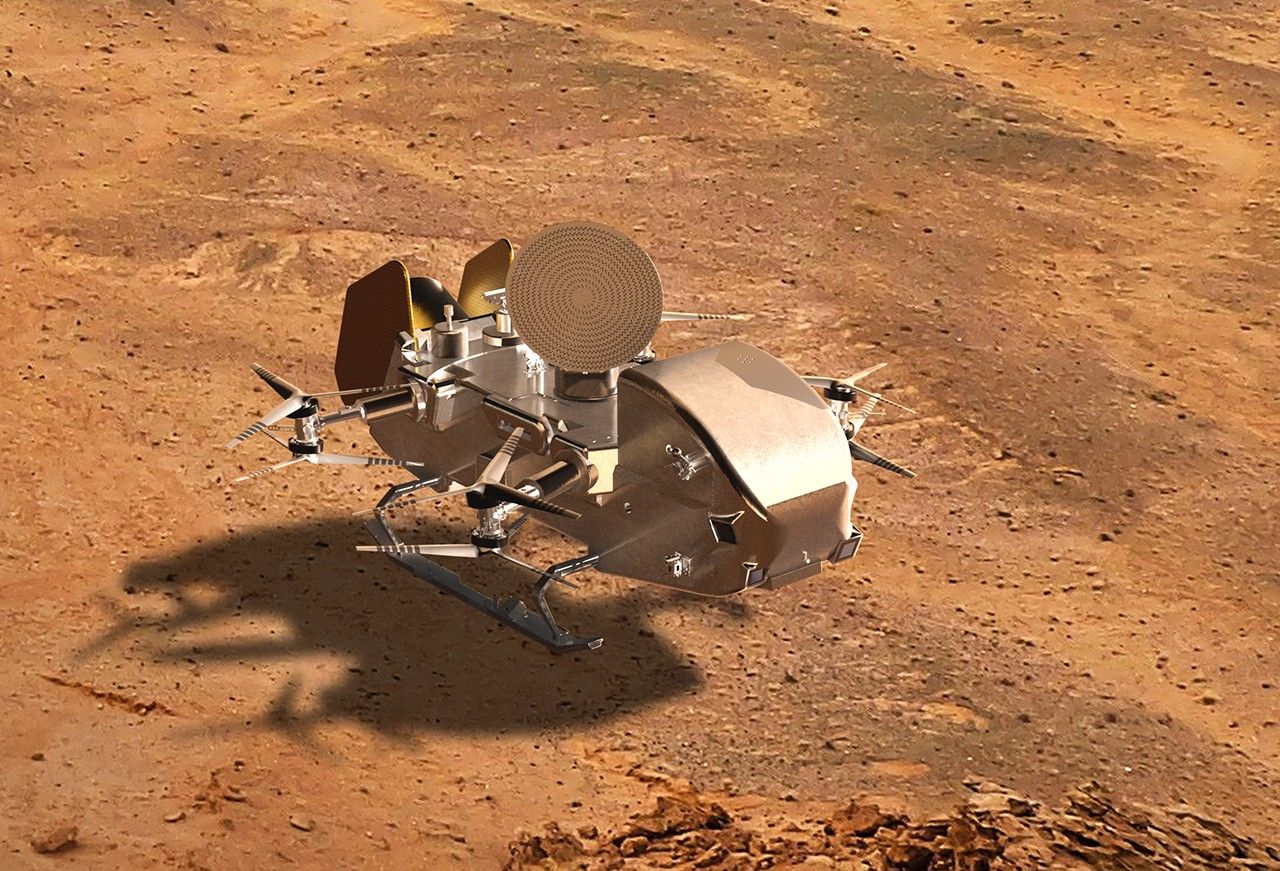

NASA’s upcoming Dragonfly rotorcraft is set to embark on an extraordinary mission to Saturn’s moon Titan, a world that, while eerily reminiscent of Earth, harbors extremely different conditions. Streaked with organic materials, Titan’s surface features dunes, clouds, and flowing rivers, but at a chilling minus 292 degrees Fahrenheit, its landscapes are shaped by liquid methane and ethane instead of water. Scheduled for launch no earlier than 2028, Dragonfly aims to uncover crucial insights into the origins of life itself.
As odd as it may seem to explore a moon where life cannot survive, researchers see it as an opportunity to examine the prebiotic chemistry that could have led to life on Earth. “Dragonfly isn’t a mission to detect life — it’s a mission to investigate the chemistry that came before biology here on Earth,” explained Zibi Turtle, principal investigator for Dragonfly at the Johns Hopkins Applied Physics Laboratory. He emphasized that Titan provides a unique environment where scientific exploration can occur without the complications introduced by existing life forms.
Unlike Earth, where evolution has obscured life’s chemical origins, Titan serves as a pristine chemical laboratory. It boasts all the essential building blocks for life-organic compounds, a liquid medium, and energy sources. Discoveries made by Dragonfly will help scientists piece together a history lost on our planet and assess whether the building blocks of life are a cosmic rarity or a universal phenomenon.
The Cassini-Huygens mission previously revealed Titan’s rich organic chemistry, finding a buffet of molecules such as ethane, propane, and benzene. These compounds accumulate on Titan’s icy crust, potentially laying the groundwork for life-related chemical reactions-especially in locations like Selk Crater, a significant landing site for Dragonfly. This 50-mile-wide impact crater, rich in organics, might have harbored liquid water for extended periods, possibly creating a primordial soup essential for chemical processes.
The impact that created Selk Crater melted the ice, forming temporary pools that any liquid water could have sustained for millennia under insulating layers of ice. With the addition of natural antifreeze like ammonia, these pools could mix water with organics and elements from the impacting body, potentially facilitating the emergence of complex chemistry. “It’s essentially a long-running chemical experiment,” said Sarah Hörst, an atmospheric chemist and co-investigator on the Dragonfly mission.
Several decades of Earth-bound experiments have simulated early conditions by mixing simple organics with water. However, these tests typically last only weeks, while the melt pools at Selk might have persisted for tens of thousands of years, providing ample time for significant chemical reactions. “We don’t know if Earth life took so long because conditions had to stabilize or if the chemistry itself needed time,” Hörst noted, emphasizing the importance of Titan’s extended timeline.
Upon arriving at Selk, Dragonfly will traverse the region, conducting analyses to reveal the planet’s frozen chemical history. One focal point will be the Dragonfly Mass Spectrometer, or DraMS, designed to identify complex chemical patterns rather than specific molecules. “We’re not looking for exact molecules, but patterns that suggest complexity,” highlighted Morgan Cable, a research scientist at NASA’s Jet Propulsion Laboratory.
While Titan is not considered habitable due to its extreme cold and lack of liquid water, the mission is profound. If Titan proves inhospitable for complex chemistry, it may alter our understanding of life’s origins, indicating that these steps may be rarer than once thought. “We need to go and look,” Cable said, underlining the investigative spirit of exploring such a remarkable world.
Dragonfly, developed under the Johns Hopkins Applied Physics Laboratory, exemplifies the collaborative efforts of multiple NASA centers. For ongoing updates about the mission, further information can be found on NASA’s official channels.
Original Source: https://science.nasa.gov/solar-system/nasas-dragonfly-mission-sets-sights-on-titans-mysteries/
Category :
Tags:
Publish Date: 2025-05-22 21:29:00