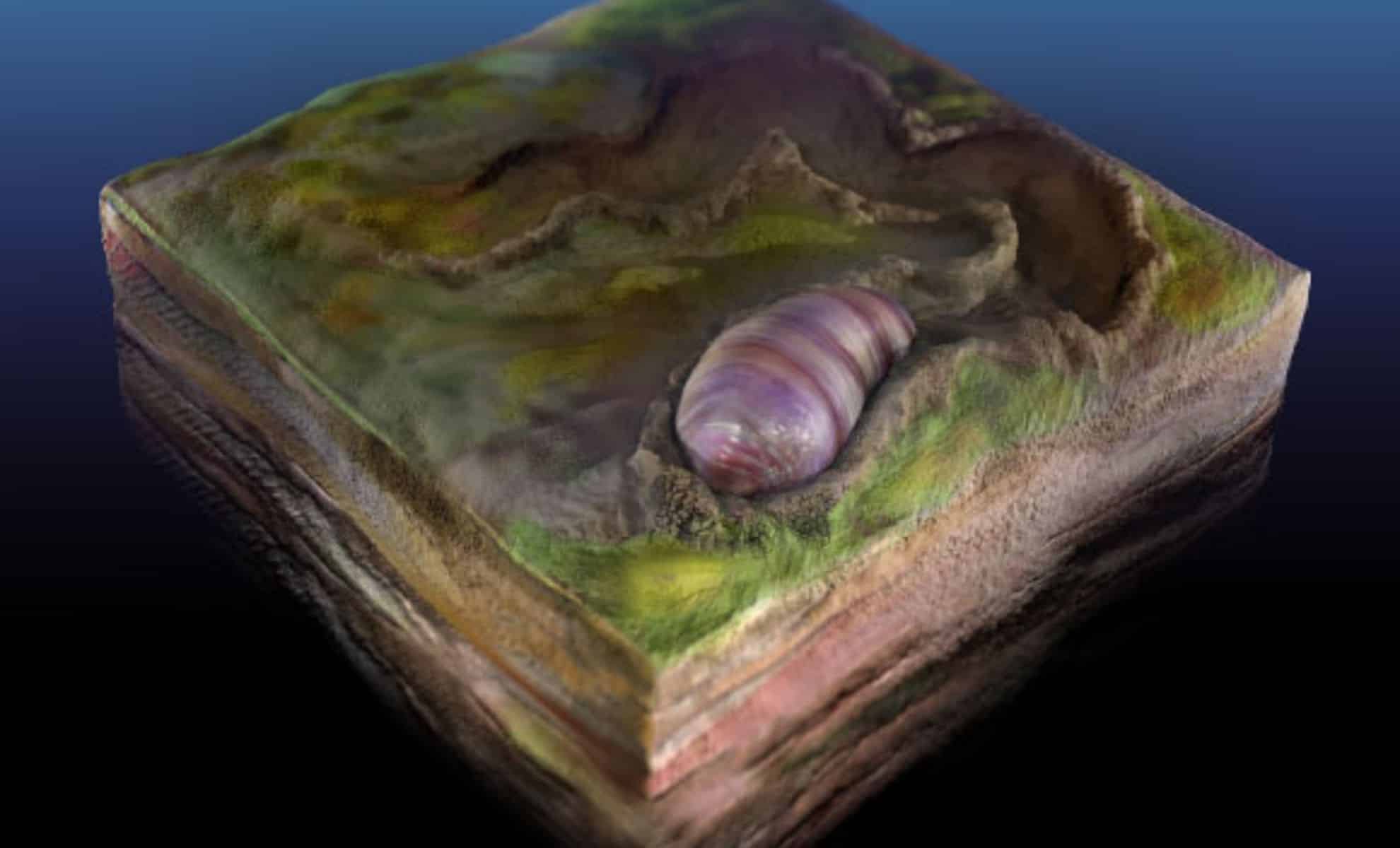

New research has unveiled Ikaria wariootia, a minuscule wormlike organism that lived over 555 million years ago, as the oldest known bilaterian animal. Detailed in a recent study published in the Proceedings of the National Academy of Sciences, this groundbreaking discovery shines a light on a pivotal juncture in animal evolution during the Ediacaran period. Unearthed in South Australia, this fossil offers crucial insights into the development of bilateral symmetry, a feature that defines the majority of today’s animals, including humans.
Bilaterians are animals characterized by bilateral symmetry, featuring distinct left and right sides that mirror each other. This body structure entails a defined head, tail, back, and belly, facilitating purposeful movement and sophisticated organization. Until now, scientists speculated that the common ancestor of bilaterians would be small and simple, equipped with rudimentary sensory organs, yet fossil evidence to support this hypothesis was lacking. Measuring between 2 to 7 millimeters, Ikaria wariootia resembles a grain of rice and effectively fills this critical gap in our understanding.
Dr. Scott Evans from the University of California, Riverside, remarked on the significance of their findings. “We thought these animals should have existed during this interval, but always understood they would be difficult to recognize. Once we had the 3D scans, we knew that we had made an important discovery.” The research team employed advanced 3D laser scanning technology to uncover the fossil’s cylindrical body with distinct bilateral symmetry and signs of musculature, marking a significant advancement in identifying early bilaterians.
Notably, the discovery of Ikaria wariootia is intricately linked to fossilized burrows known as Helminthoidichnites, found within the same geological context at Nilpena, South Australia. For more than 15 years, paleontologists speculated that these burrows were created by bilaterians, but the specific organism responsible remained unidentified. The size and shape of Ikaria match these burrows perfectly, lending credence to the hypothesis that this creature actively burrowed in oxygen-rich ocean-floor sand in search of organic matter.
“Burrows of Ikaria wariootia occur lower than anything else. It’s the oldest fossil we get with this type of complexity,” stated Professor Mary Droser. The fossil evidence also reveals V-shaped ridges within the burrows, suggesting that Ikaria moved through peristaltic locomotion, contracting its body muscles much like modern worms. This mode of movement implies a level of coordination and sensory ability that had not previously been documented in such early life forms.
This finding prompts a reevaluation of how scientists perceive other Ediacaran organisms. While large, iconic beings like Dickinsonia have often been viewed as evolutionary dead ends, smaller and simpler organisms such as Ikaria could represent the earliest roots of all bilaterians, from which most modern animals descended. Professor Droser emphasizes this perspective, saying, “Dickinsonia and other big things were probably evolutionary dead ends. We knew that we also had lots of little things and thought these might have been the early bilaterians that we were looking for.” The discovery of Ikaria wariootia effectively bridges the gap between genetic projections and fossil evidence, confirming that early bilaterians possessed the anatomical structure and capabilities necessary for advanced behavior like directed movement and burrowing.
This remarkable discovery not only adds depth to our understanding of animal evolution but also underscores the intricate life forms that existed in an era long before the dinosaurs, refining our knowledge of the evolutionary milestones that shaped life as we know it today.
Original Source: https://indiandefencereview.com/meet-ikaria-wariootia-ancestor-of-animals/
Category :
Tags:
Publish Date: 2025-05-20 00:00:00