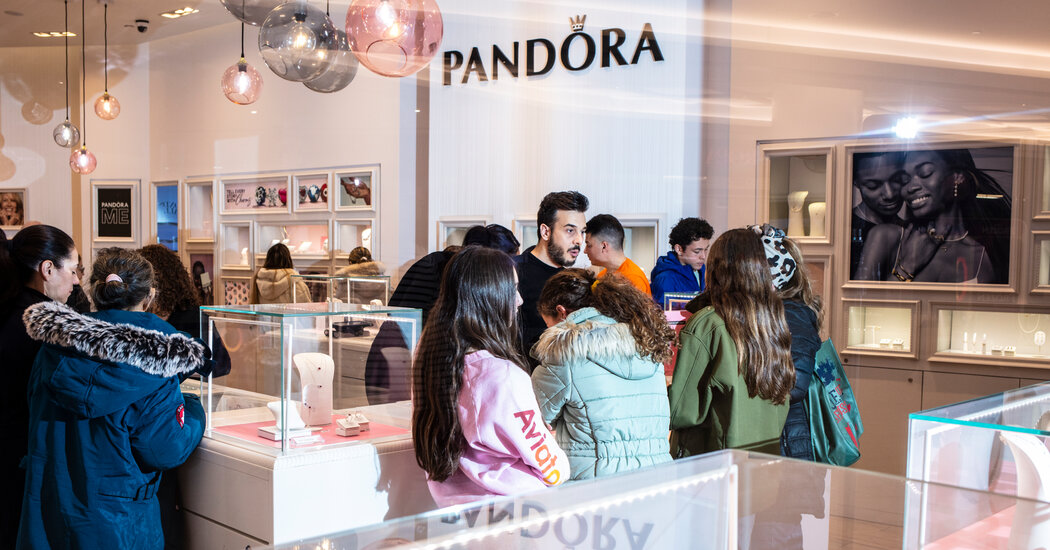

Pandora, the world’s largest jewelry company, headquartered in Denmark, boasts nearly 500 stores across the United States—its most significant market. Yet, its heart lies in Thailand, where the company has manufactured its exquisite jewelry for nearly four decades. Utilizing a global supply chain has allowed Pandora to offer affordable luxury worldwide. However, this advantage recently transformed into a vulnerability when President Trump threatened to impose a 36% tariff on goods entering the U.S. from Thailand.
Following the announcement of these “reciprocal” tariffs, Pandora’s stock plummeted, ranking among Europe’s worst-performing shares. A week later, Trump deferred the tariffs until early July, providing a brief respite, but the uncertainty persists. CEO Alexander Lacik expressed that without clarity on tariff levels, the next year could be unpredictable. “With the information at hand today, I would be crazy to make big strategic decisions,” Lacik stated, highlighting the paralysis gripping many businesses facing similar challenges.
Lacik, like many global executives, is navigating the tumultuous waters of Trump’s fluctuating trade policies. While there are signs of potential tariff reductions, initial agreements with Britain and China have left more questions than answers, keeping tariffs significantly elevated compared to just months ago. Despite some aspects of the trade war being paused, Pandora and its multinational counterparts remain in a holding pattern, awaiting further trade agreements.
Pandora has been crafting jewelry in Thailand since 1989, employing thousands across its three factories. While the company is in the process of constructing a fourth facility in Vietnam, Trump’s recent tariff threats on Vietnamese imports have introduced additional challenges, with potential tariffs hitting 46%.
Last year, Pandora sold an astonishing 113 million pieces of jewelry, establishing itself as the largest jewelry brand by volume with a presence in over 100 countries. Notably, one-third of its sales—9.7 billion Danish kroner, approximately $1.4 billion—came from the U.S. Despite these pressures, Lacik has no plans to retreat from this lucrative market. However, he acknowledges that prices are likely to rise due to tariffs, posing the difficult question of whether to pass costs on to U.S. consumers or adjust prices globally. “The big question is, am I going to pass on everything to the U.S. consumer, or am I going to peanut butter it out and raise the whole Pandora pricing globally?” he remarked.
Currently, Pandora maintains several months’ worth of inventory, allowing time to monitor competitors’ pricing strategies before deciding on any price adjustments. They have begun streamlining aspects of their supply chain, including a shift in distribution processes as of the day after the tariff announcement. This adjustment will see products sold in Canada and Latin America bypassing the Baltimore distribution hub— a transition expected to take six to nine months.
However, relocating production to the U.S. is not viable due to higher labor costs. Pandora employs about 15,000 craftspeople in Thailand and plans to hire 7,000 additional workers in Vietnam. In an earnings report, the company projected potential costs from the ongoing trade war: a staggering 500 million Danish kroner, or $74 million, unless current tariff levels change, escalating to 900 million Danish kroner, or $135 million annually thereafter.
Despite the looming challenges, Lacik remains composed. His focus is clear: “We are battle ready.” When he took over as CEO in 2019, Pandora was in crisis, having seen its share price drop over 70% in three years. Lacik’s ambitious overhaul included revamping branding, store designs, and reinforcing Pandora’s reputation for “affordable luxury.” His leadership saw the company resilient through the pandemic, where drastic measures were crucial for survival.
Nevertheless, the share price has since declined over 20%, indicating ongoing market pressures. Following initial U.S. tariff increases, Pandora had previously diversified its supply chain by ceasing the sourcing of showroom furniture from China, anticipating market shifts. “We had some readiness,” Lacik said, acknowledging their proactive approach to an unpredictable economic landscape.
Original Source: https://www.nytimes.com/2025/05/13/business/trump-tariffs-pandora-jewelry.html
Category : Jewels and Jewelry,International Trade and World Market,Customs (Tariff),Prices (Fares, Fees and Rates),Supply Chain,Factories and Manufacturing,Relocation of Business,Pandora A/S,Lacik, Alexander
Tags:
Publish Date: 2025-05-14 03:51:00