European Leaders Unite to Demand Immediate 30-Day Cease-Fire in Ukraine: A Bold Stand Against Aggression

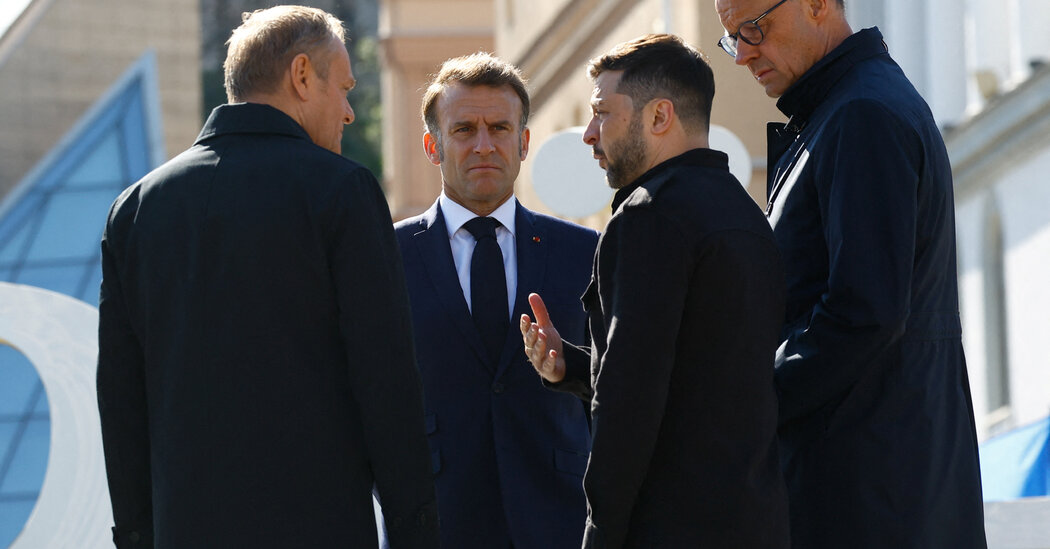
In a historic first joint visit to Ukraine, leaders from Britain, France, Germany, and Poland announced plans for significant new sanctions against Russia’s banking and energy sectors if President Vladimir Putin does not agree to an immediate, unconditional 30-day ceasefire. The announcement was made during a press conference in Kyiv, where British Prime Minister Keir Starmer emphasized the urgency of the situation. “All of us are calling Putin out. If he’s serious about peace, then he has a chance to show it now,” he stated.
The proposed European ceasefire initiative, set to commence on Monday, has been closely coordinated with the White House. A senior U.S. official revealed that President Trump had been in consistent communication with European leaders throughout the week, signaling his support for the sanctions should a truce not materialize. Trump is also open to U.S. involvement in monitoring the ceasefire, though specifics remain unclear.
Ukraine’s Foreign Minister, Andrii Sybiha, affirmed the readiness of Ukraine and its allies for a complete ceasefire across land, air, and sea starting Monday, contingent on Russia’s agreement and effective monitoring. “If Russia agrees, a durable ceasefire and confidence-building measures can pave the way to peace negotiations,” Sybiha shared on social media.
As the European leaders conveyed their commitments, Kremlin spokesman Dmitri S. Peskov dismissed the sanctions threat, asserting that Russia is accustomed to such measures and prepared to mitigate their effects. Peskov reiterated Russia’s stance against any ceasefire unless Western nations cease military support to Ukraine.
The meeting in Kyiv occurred just after Russia’s commemoration of the 80th anniversary of the end of World War II, an occasion marked by a military parade in Moscow attended by foreign dignitaries, including Chinese President Xi Jinping. This juxtaposition underscored the shifting dynamics of the war in Ukraine and the broader geopolitical landscape since Trump took office, with many observers noting a weakening of trans-Atlantic ties that had previously fostered European stability post-World War II.
Currently, Ukraine finds itself caught between a bolstered Russia, supported by allies like China and North Korea, and a European leadership striving to fill the void left by U.S. policy shifts. It’s been over 120 days since the U.S. announced new military aid for Ukraine, raising questions regarding the utilization of the remaining $3.85 billion authorized by Congress from the Defense Department’s stockpiles.
Amid this backdrop, Ukraine is ramping up domestic arms production while European allies continue to increase military assistance. Many believe that, even if a ceasefire is agreed upon, military strength will be essential for lasting peace. The next few weeks will be critical in determining whether European resolve can match the urgent challenges ahead.
As tensions escalate, the pressure from Washington has largely focused on Kyiv, although frustrations with Moscow appear to be bubbling to the surface. Daniel Fried, a former top U.S. diplomat, remarked that the “moment of truth” will arrive if Putin rejects the proposed ceasefire, followed by a critical test if Russia violates any truce established. “What, then, will be the U.S. response?” Fried pondered.
This evolving situation continues to highlight the complexities surrounding the Russian invasion of Ukraine, as the international community watches closely for signs of progress or further conflict.
Original Source: https://www.nytimes.com/2025/05/10/world/europe/ukraine-war-visit-starmer-macron-zelensky-merz.html
Category : Russian Invasion of Ukraine (2022),Merz, Friedrich,Macron, Emmanuel (1977- ),Putin, Vladimir V,Starmer, Keir,Europe,Ukraine,Russia
Tags:
Publish Date: 2025-05-10 23:45:00