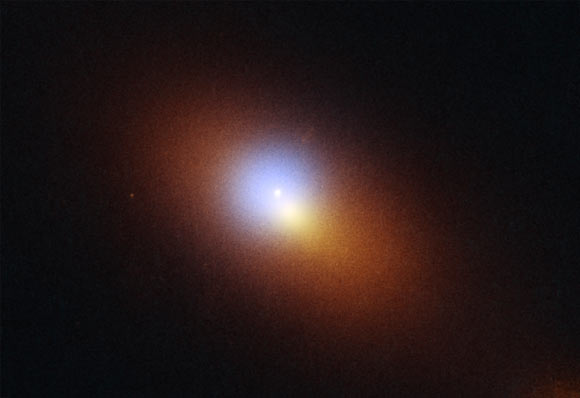

A recently identified tidal disruption event, AT2024tvd, has led astronomers to discover a wandering supermassive black hole. This phenomenon occurs when a star ventures too close to a black hole, causing it to be torn apart by the extreme gravitational forces, leaving behind elongated streams of stellar material. Dr. Yuhan Yao from the University of California, Berkeley, explained that “a tidal disruption event (TDE) happens when an infalling star is stretched or ‘spaghettified’ by a black hole’s immense gravitational tidal forces.” After the star is shredded, its remnants are drawn into a circular orbit around the black hole, generating shock waves and high-temperature outflows detectable in ultraviolet and visible light.
Using data from the NASA/ESA Hubble Space Telescope, along with complementary observations from NASA’s Chandra X-Ray Observatory and the NRAO’s Very Large Array, astronomers pinpointed this particular black hole, which interestingly resides not at the center of its host galaxy, where most supermassive black holes typically are found. This black hole, weighing one million solar masses, deviates from the conventional location and behavior expected of such celestial giants. It does not actively consume surrounding material like its much larger counterpart, which has a mass of 100 million times that of the Sun and is located at the galaxy’s center. The distance between AT2024tvd and this central black hole is about 2,600 light-years, a mere tenth of the distance between our Sun and the Milky Way’s supermassive black hole.
The surprising coexistence of these two supermassive black holes raises questions, as they are not gravitationally bound as a binary pair. The smaller, wandering black hole may eventually spiral in and merge with the larger black hole, although currently, they are too far apart for such a gravitational bond. Dr. Yao emphasized the significance of AT2024tvd, noting, “This is the first offset TDE captured by optical sky surveys, and it opens up the entire possibility of uncovering this elusive population of wandering black holes with future sky surveys.” He pointed out that previously, theorists had not focused on offset TDEs, but this discovery is likely to shift that perspective and encourage the search for more such phenomena.
The black hole linked to AT2024tvd is located within the bulge of its massive galaxy and becomes visible only every few tens of thousands of years when it consumes a star. Theories regarding how this black hole became offset suggest it could have been ejected from the galaxy’s center due to three-body interactions, where the lower-mass black hole is propelled away. This possibility seems plausible given its close position to the central black hole. An alternative theory posits that the black hole could be a remnant from a smaller galaxy that merged with the host galaxy over a billion years ago, which might one day lead it to the central active black hole.
Dr. Erica Hammerstein, also from the University of California, Berkeley, noted that mergers between galaxies likely increase TDE rates, reinforcing the idea that a merger has occurred in the history of this galaxy. The findings from this research will be published in the Astrophysical Journal Letters.
Original Source: https://www.sci.news/astronomy/wandering-supermassive-black-hole-13891.html
Category:
Tags:
Publish Date: 2025-05-09 02:11:00