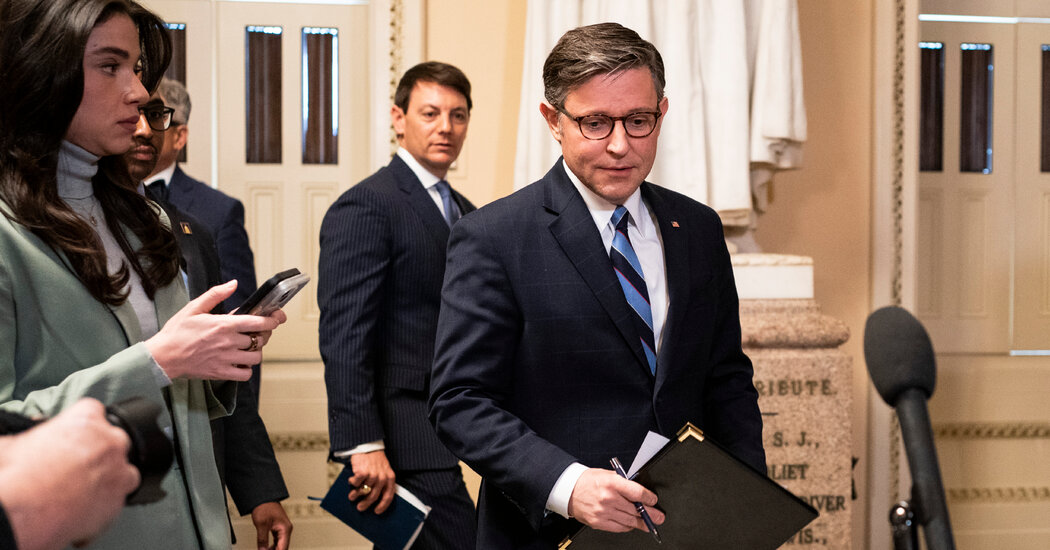

For months, Republicans have grappled with ways to trim Medicaid spending as part of President Trump’s domestic agenda. However, options for significant cuts are dwindling. House Speaker Mike Johnson recently announced that major reductions to the Affordable Care Act’s Medicaid expansion are off the table, leaving a more limited list of strategies that could disproportionately affect states that backed Trump in the upcoming 2024 election.
Republicans have explored various Medicaid adjustments for their budget bill, yet they primarily focus on two major proposals to achieve the targeted $880 billion in spending cuts mandated by the House committee overseeing Medicaid. One approach entails significantly reducing funding for the Affordable Care Act’s Medicaid expansion, a move estimated by the Congressional Budget Office (CBO) to save $710 billion over the next decade. However, this plan would primarily impact wealthier, Democratic-led states. After discussions with moderate Republican members, Johnson ruled out this option.
The remaining major proposal is to limit the use of a tax loophole that states exploit to increase federal Medicaid spending. This strategy could save $668 billion, primarily affecting poorer Southern states. The consequences for these states could be severe, potentially resulting in budget shortfalls that lead to cuts in Medicaid coverage for low-income adults, reduced hospital payments, or adjustments to other vital government services. Morgan Henderson, a health economist at The Hilltop Institute, remarked, “The headline reduction in federal spending may be similar, but the implications for the states are vastly different.”
The financing system under Medicaid is crucial to understanding these cuts. The federal government typically subsidizes a larger portion of medical costs in poorer states, while wealthier states receive less financial support due to their ability to fund Medicaid through state taxes. For example, New York receives a 50 percent match for Medicaid, while Mississippi gets a 77 percent match, underscoring the disparity in federal assistance.
The GOP’s first proposed policy to roll back funding for the Medicaid expansion would hit richer states hard, as they are more likely to participate in the program and face lower matching rates. An analysis from the Urban Institute indicates that states like California, New York, and Washington would experience some of the steepest cuts under this plan. Conversely, the ten states that opted out of Medicaid expansion would not be affected.
Despite abandoning cuts to the expansion, Johnson hinted at considering an alternative plan: replacing the matching system with a fixed payment for each enrollee. The CBO estimates this change could yield around $225 billion in savings over a decade but could lead to more significant funding reductions in the long run.
The second proposal on the table seeks to close a loophole that allows states to inflate their Medicaid spending through taxes on medical providers, enabling them to garner extra federal funds. This loophole is particularly vital for poorer Southern states, where Medicaid funds are significantly boosted by federal matching. According to Henderson’s analysis, states like South Carolina, Alabama, Mississippi, and Tennessee could see their federal Medicaid funding reduce by 30 percent if Congress opts to eliminate this loophole.
The potential fallout from either major cut would vary by state. Responses may include slashing payments to medical providers, increasing taxes, or curtailing other state services. Some states might even reduce Medicaid enrollment by cutting optional populations, as some laws necessitate that expansions are withdrawn if the match rate declines.
Experts emphasize that states will likely devise various strategies to handle budget shortfalls, creatively addressing the inevitable gaps. “You’re looking at every single thing,” said Alice Middleton, interim executive director at The Hilltop Institute. As the Republican agenda unfolds, the future of Medicaid funding remains uncertain, with significant implications for American health care access.
Tags: Medicaid, Federal-State Relations (US), United States Politics and Government, Health Insurance and Managed Care, States (US), Federal Budget (US), Poverty, State Legislatures, Johnson, Mike (1972- ).
Original Source: https://www.nytimes.com/2025/05/09/upshot/republicans-medicaid-states-plans.html
Category : Medicaid,Federal-State Relations (US),United States Politics and Government,Health Insurance and Managed Care,States (US),Federal Budget (US),Poverty,State Legislatures,Johnson, Mike (1972- )
Tags:
Publish Date: 2025-05-09 14:32:00