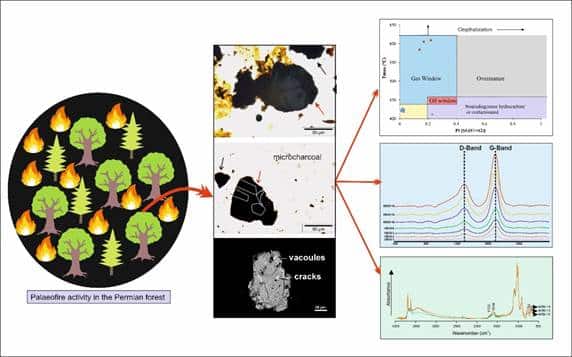

In a significant breakthrough, researchers from the Birbal Sahni Institute of Palaeosciences have unearthed a remarkable record of ancient wildfires in the Godavari Basin of peninsular India, dating back approximately 250 million years to the Permian period. By employing advanced microscopic techniques and chemical analyses, these scientists are reshaping our understanding of Earth’s geological and climatic history, particularly regarding the impact of ancient fires on ecosystems and carbon storage.
The study primarily targets the Late Silurian to Quaternary periods, illustrating how ancient wildfires affected vegetation, climate, and coal formation. Previous research identified macroscopic charcoal within coal formations across the Gondwana supercontinent, suggesting widespread wildfire activity. The Raniganj Coalfield in India was one of the initial locations where fossilized charcoal was discovered, linking ancient mire systems to fires ignited by seasonal droughts. Historically, it’s been believed that elevated atmospheric oxygen levels during the Permian intensifies these wildfires; however, whether the charcoal was a result of local fires or transported by environmental factors remained uncertain.
To clarify these ancient phenomena, the research team meticulously analyzed shale samples from the Godavari Basin, which are rich in organic material that records past environmental conditions. Using palynofacies analysis, the scientists categorized tiny particles preserved in the rock, including translucent organic matter and palaeofire-induced charcoal. Techniques such as Raman Spectroscopy, Rock-Eval Pyrolysis, and FTIR Spectroscopy were utilized to unveil the fire history embedded within these ancient sediments. Doctor Neha Aggarwal led the team in their groundbreaking study, which has been published in the journal ACS Omega, significantly enhancing our understanding of palaeofires by distinguishing between in situ (on-site) and ex situ (transported) charcoal.
A particularly important finding from the study is how stratigraphy influences the deposition of charcoal. Researchers observed that during regressive phases—when sea levels fell—well-preserved fire signatures emerged, whereas during transgressive phases—when sea levels rose—charcoal appeared mixed and oxidized. This indicates dynamic environmental changes during the Permian, shedding light on how ancient ecosystems adapted to varying conditions.
Understanding these transformations in organic matter during palaeofires is essential for comprehending long-term carbon storage in Earth’s crust, which holds vital implications for carbon sequestration strategies relevant to contemporary climate change. The innovative findings provide geologists with new insights into past ecosystems, shifts in vegetation, and fire dynamics, enhancing the accuracy of palaeoclimate reconstructions and geological dating methods.
The implications of this research extend beyond ancient history, offering valuable tools for current climate science. By revealing the interactions between palaeofires, carbon storage, and ecosystem dynamics, researchers are better equipped to tackle the implications of fire activity amid today’s climate change challenges. The insights gained from the Godavari Basin study could serve as a springboard for future investigations into the intricate relationships among fire, vegetation, and climate throughout Earth’s history.
This pioneering research highlights the depths of our planet’s past, laying the groundwork for future explorations into the long-term effects of fires on ecosystems and climate. By delving into the ancient wildfires of the Godavari Basin, we gain crucial understanding that may influence our approach to modern environmental challenges.
Original Source: https://observervoice.com/research-explores-fire-history-in-permian-india-115596/
Category :
Tags:
Publish Date: 2025-05-07 13:00:00