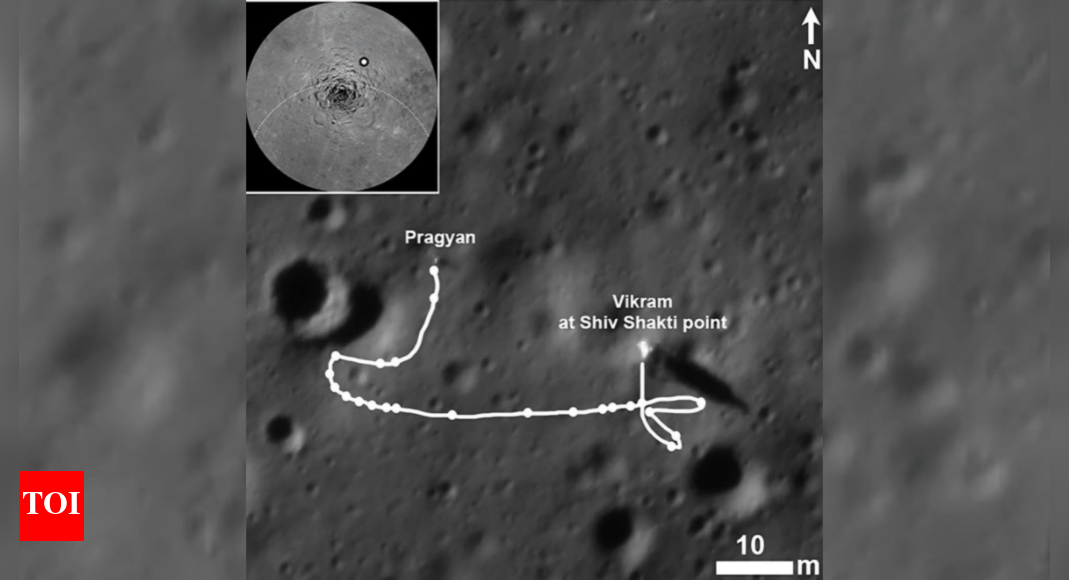

In a groundbreaking development for lunar exploration, India’s Chandrayaan-3 and China’s Chang’e-6 missions have independently reported significant findings from the Moon’s South Pole-Aitken (SPA) basin. Published in the journal Nature, both studies unveil primitive lunar mantle materials, pivotal to understanding the Moon’s and terrestrial planets’ formation.
India’s Chandrayaan-3 utilized in-situ analysis to detect these materials, while China’s Chang’e-6 returned samples to Earth. Despite varying methodologies, both missions underscore the scientific significance of the Moon’s southern polar region, a window into ancient lunar history.
The study led by the Indian Space Research Organisation’s Physical Research Laboratory (PRL) reveals that the Pragyan rover, operating in the southern highlands of the Moon, identified soil with unusual elemental composition. The Alpha Particle X-ray Spectrometer (APXS), mounted on Pragyan, detected surfaces with low sodium and potassium but high sulfur content. These findings suggest the presence of materials from the Moon’s deep mantle, hinting at minimal impact from “KREEP-rich materials,” products of late-stage magma crystallization. This discovery at the Chandrayaan-3 landing site could reflect primitive lunar mantle exposure caused by the SPA basin’s formation.
PRL scientists believe these surface sulfur levels, likely originating as iron sulfide (FeS), support the assertion that Chandrayaan-3’s site retains original lunar interior signatures. “The chemical profile detected by Pragyan diverges significantly from previous lunar landing sites, suggesting minimal crustal influence, with a substantial hint towards deep mantle origins,” ISRO stated.
In a parallel discovery, China’s Chang’e-6 mission returned samples including rare magnesian olivine grains with high nickel concentrations, marking the most primitive mantle materials yet recovered from the Moon. Found within the SPA basin, these grains align with theoretical models predicting early olivines crystallizing from the lunar magma ocean. Researchers suggest that these mantle fragments, distinguished by high magnesium and nickel levels, were brought to the surface by high-magnesium lavas and preserved in impacts within the SPA basin.
Analysis indicated that the olivines’ oxygen isotope ratios adhere to the terrestrial fractionation line, confirming their lunar origin. Such unique compositions provide direct insight into early mantle differentiation processes, contributing to the broader understanding of planetary formation and evolution.
These findings reinforce the growing scientific interest in polar exploration as a means to explore planetary interiors. The Moon’s SPA basin, in particular, stands out as a repository of historical lunar and planetary evolution. The collaborative efforts of India and China, leveraging advanced technology and scientific acumen, spotlight the Moon’s South Pole as a prime location for future exploration. By digging deeper into these revelations, scientists hope to unfold the stories embedded in lunar rocks, offering a glimpse into the early processes that shaped not only our Moon but the rocky planets, including Earth.
This research marks a new chapter in lunar exploration, emphasizing international collaboration and scientific discovery. The insights gained will likely influence future missions and the pursuit of unraveling the mysteries of our solar system’s origins.
Original Source: https://timesofindia.indiatimes.com/science/india-china-find-ancient-moon-mantle-materials-key-to-early-formation/articleshow/120810721.cms
Category :
Tags:
Publish Date: 2025-05-02 09:25:00