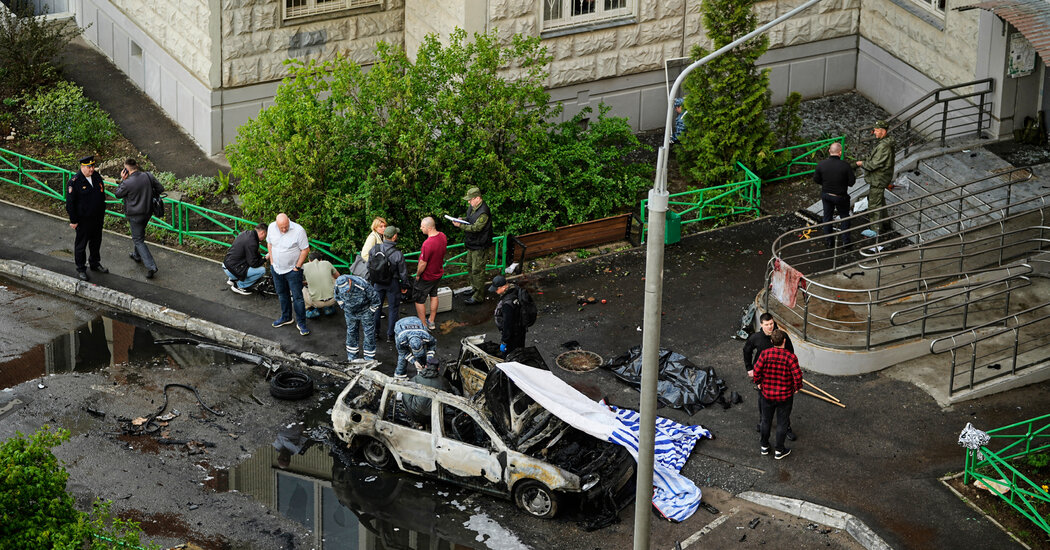
Shocking Tragedy: Esteemed Senior Russian General Tragically Killed in Explosive Car Blast Near Moscow

A high-ranking Russian military official, Lt. Gen. Yaroslav Moskalik, was killed in a car explosion in the Moscow suburb of Balashikha on Friday, in what authorities describe as a deliberate act amid a series of assassinations targeting figures opposing Ukraine. The Russian Investigative Committee, analogous to the FBI, identified Moskalik and initiated a criminal investigation into the incident, which occurs against a backdrop of ongoing, strained cease-fire negotiations between Russia and Ukraine.
The explosion coincided with a meeting in Moscow between Steve Witkoff, special envoy under the Trump administration, and Russian President Vladimir Putin. The negotiations aimed to address the prolonged conflict in Ukraine and mend U.S.-Russia relations. Despite international pressure, including calls from former President Trump for a swift resolution, Russia remains unswayed, with aggressive airstrikes on Ukrainian civilian areas intensifying.
General Moskalik, formerly deputy head of the main operational department of the Russian General Staff, was involved in military strategic planning. His career included participation in the 2015 peace talks in Minsk, Belarus, which failed to resolve tensions in eastern Ukraine. The explosion that claimed his life was captured on social media in footage verified by The New York Times, showing a car engulfed in flames with subsequent secondary blasts nearby, sparking swift emergency response.
The Investigative Committee released a video depicting the aftermath: a charred Volkswagen Golf near a residential building. No suspects have been named yet, and Ukrainian authorities have yet to comment on this incident. The killing is one of several targeted attacks on individuals aligned against Ukrainian interests. Earlier victims include Armen Sarkisyan, a pro-Russia separatist figure, who died in a February bombing in Moscow, and Igor Kirillov, a general over Russian nuclear and chemical defense forces, who was also killed in a December bomb attack.
Further incidents include the April 2023 death of Maksim Fomin, known widely as Vladlen Tatarsky, a pro-Russian blogger. His assassination in a St. Petersburg café, via a bomb hidden in a statuette, injured over 40 attendees during his public talk. Officials attributed this attack to Ukrainian orchestration. The pattern of high-profile bombings extends to the August 2022 killing of Daria Dugina, a conservative activist, a crime U.S. intelligence agencies partially attribute to Ukrainian government elements.
The episode of General Moskalik’s death heightens tensions and reflects the deadly tit-for-tat environment leaving military and political figures vulnerable in what has become a proxy battleground in Russia. As investigations continue amidst calls for diplomacy, the geopolitical landscape remains fraught, demanding close observation of the developments and responses from international stakeholders.
The latest developments in the Russian invasion of Ukraine underscore the tenuous nature of security and diplomacy in the region, as global eyes remain fixed on Russia’s internal and external maneuvers. Efforts to reach a settlement continue to meet formidable obstacles, projecting uncertainty onto a landscape already marred with violence and political machinations.
Original Source: https://www.nytimes.com/2025/04/25/world/europe/russian-officer-explosion-moscow-ukraine.html
Category : Russian Invasion of Ukraine (2022),Deaths (Fatalities),Investigative Committee (Russia),Moscow (Russia)
Tags:
Publish Date: 2025-04-25 21:36:00