
The Hubble Space Telescope, an icon of astronomical discovery, is celebrating its 35th anniversary by unveiling a captivating set of images that highlight the wonder of our universe. Since its launch on April 24, 1990, aboard the space shuttle Discovery, Hubble has redefined our understanding of space by observing celestial phenomena with unparalleled clarity, free from the distortion of Earth’s atmosphere. Its contributions over the last three and a half decades have been monumental, resulting in nearly 1.7 million cosmic observations and more than 22,000 scientific papers. The Hubble mission, a joint venture between NASA and the European Space Agency (ESA), has generated over 400 terabytes of data, continuing to be a vital resource for astronomers around the globe. As ESA officials express in a statement, “Hubble’s legacy is the bridge between our past and future knowledge of a universe that is unbelievably glorious, as well as rambunctious.”
In honor of this milestone, the latest collection showcases diverse celestial features, selected specifically to commemorate the telescope’s significant anniversary. These images are not solely a visual feast but also provide invaluable insights into cosmic activities. Among these, Hubble’s fresh captures of Mars reveal a frosty landscape under a veil of thin water-ice clouds, observable in ultraviolet light. Captured in December when Mars was about 60 million miles from Earth, the images coincide with the arrival of spring in Mars’ northern hemisphere, a period when the winter ice on the polar caps sublimates to reveal new geological formations. In these images, the Tharsis plateau with its dormant volcanoes, including Olympus Mons, is prominently displayed, as are high-altitude evening clouds and the characteristic “shark fin” shape of Syrtis Major.
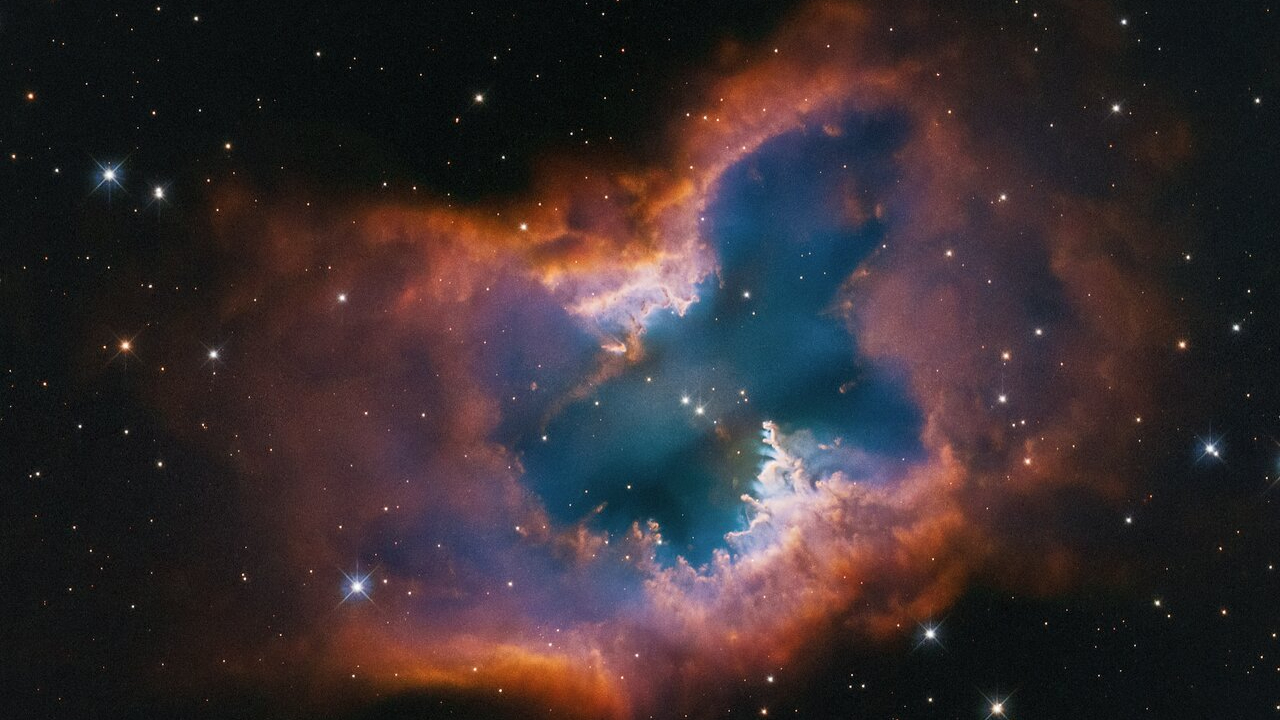
Another image spotlights a dying star in the planetary nebula NGC 2899, located roughly 4,500 light-years away in the Vela constellation. This “celestial moth” is vibrantly colored by hydrogen and oxygen gases, sculpted by the intense winds of the central dying star. The nebula’s gaseous features seem to converge on two companion stars, hinting at a potentially dynamic formation process. Meanwhile, Hubble’s close-up of a segment in the Rosette Nebula, a stellar nursery about 5,200 light-years from Earth, reveals dark, dense clouds being transformed by potent radiation from a cluster of massive stars. These interactions produce striking red hues as high-speed jets from embedded stars collide with the nebula’s cold materials.
Further afield, the telescope captures the mesmerizing sight of NGC 5335, a barred spiral galaxy approximately 225 million light-years away in Virgo. Unlike many spirals, NGC 5335’s structure is “flocculent,” dotted with star-forming patches rather than prominent arms. A central bar channels interstellar material to birth new stars, capturing the dynamic and temporary nature of galactic features. These recent snapshots not only underscore the Hubble Space Telescope’s ongoing prowess in capturing the marvels of the universe but reaffirm its role as an indispensable bridge between generations of astronomical knowledge, inspiring ongoing exploration beyond our earthly confines.
Original Source: https://www.space.com/space-exploration/hubble-space-telescope/hubble-telescope-snaps-stunning-portraits-of-mars-a-celestial-moth-and-more-in-spectacular-35th-anniversary-photos
Category :
Tags:
Publish Date: 2025-04-25 04:05:00