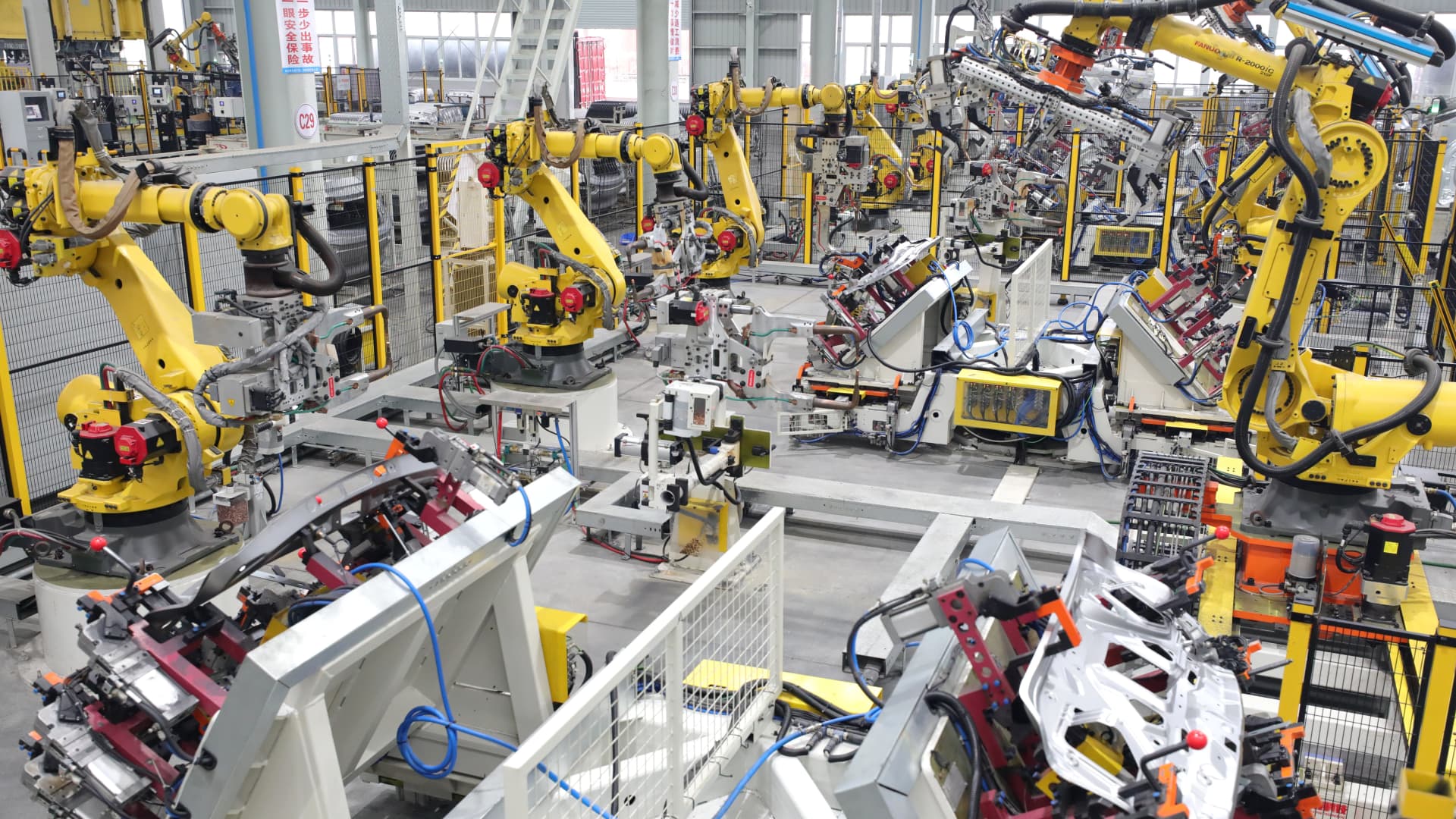

China has faced significant challenges in meeting its ambitious self-sufficiency goals in technology, according to a recent report by the European Chamber of Commerce in China. The “Made in China 2025” initiative, launched in 2015, sought to prioritize domestic industries, prompting backlash as it perceived to encourage Chinese technological advancement at the expense of foreign competitors. Over the years, while China has excelled in some areas like shipbuilding, high-speed rail, and electric vehicles, it lags in others such as aerospace and high-end robots.
The chamber highlighted that the C919 aircraft, emblematic of China’s aviation ambitions, still relies heavily on Western components. Industrial automation has seen growth, but primarily driven by foreign technology. Additionally, the growth rate of the manufacturing value add has slowed to 6.1% in 2024 from 7% in 2015, well short of the 11% goal. “Everyone should consider themselves lucky that China missed its manufacturing growth target,” said Jens Eskelund, president of the European Union Chamber of Commerce in China. Had China met its aggressive targets, global competitors would have faced intensified pressure, he noted.
Despite these setbacks, China has undergone a transformation to account for 29% of global manufacturing value added, rivalling the combined figures of the U.S. and Europe. However, America’s stepped-up restrictions on China’s access to high-tech components, including export licensing requirements for AI chips, has spurred China to enhance its domestic capacity. Lionel M. Ni of the Hong Kong University of Science and Technology emphasized, “The U.S. restrictions have pushed us to make things that previously we would have bought.” Huawei, notably affected by these restrictions since 2019, has made headway by introducing smartphones with advanced chips using domestic resources.
Huawei’s recent devices feature a substantial number of Chinese-sourced components, underscoring the country’s ability to adapt under pressure. The company’s revenue surged by 22% in 2024, buoyed by renewed momentum in consumer products. However, high research and development spending underscores a doubling down on innovation, with Huawei dedicating over 20% of its revenue to R&D last year.
Yet, as the report underscores, high expenditure does not guarantee efficiency. China’s rigorous competition in sectors like electric vehicles has led to a price war, a situation described locally as “neijuan” or involution, exacerbating economic strains. Eskelund remarked on the unsustainable nature of China’s rapid industrial advancements, emphasizing the need for balance between manufacturing output and domestic absorption.
China’s government acknowledged these challenges, with Premier Li Qiang stressing the importance of halting involution while boosting consumption – a newfound priority over sheer manufacturing prowess. This shift comes as 20% of China’s 2,825 listed companies reported a loss for the first time in 2024. Such financial strains emphasize the urgency to align production with market needs, amid a backdrop of slowing economic growth.
As China approaches its next five-year plan, the focus will continue to shift towards sustainable practices and increasing domestic consumption. As policymakers deliberate on balancing the scales, the global community watches with anticipation, bearing witness to China’s journey toward technological and economic self-reliance.
Original Source: https://www.cnbc.com/2025/04/18/where-made-in-china-2025-missed-the-mark.html
Category :
Tags:
Publish Date: 2025-04-18 09:25:00