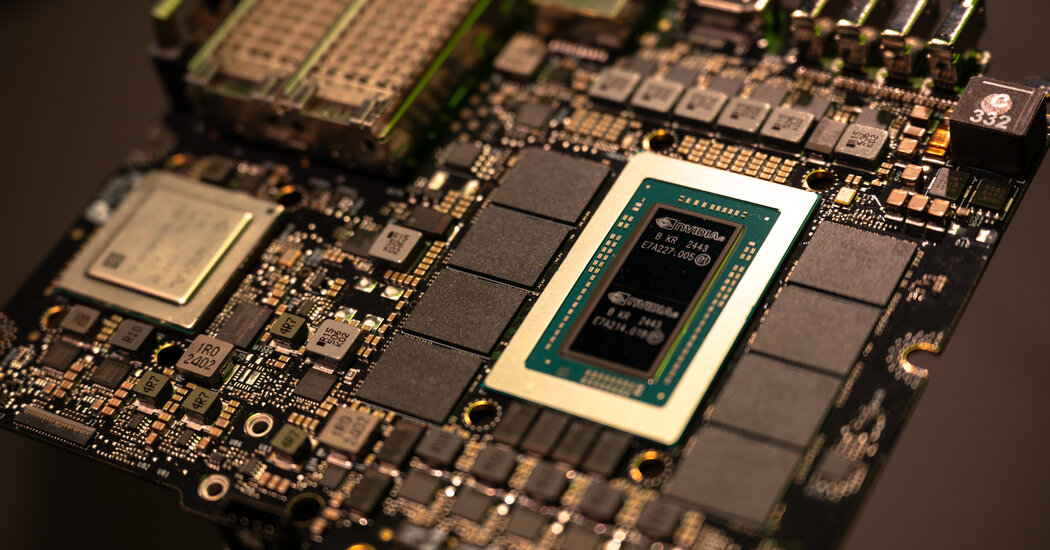

The U.S. government has moved to block the sale of certain Nvidia artificial intelligence chips to China, introducing new licensing requirements that could significantly impact Nvidia’s operations in one of its most crucial markets. This development marks a significant step by the Trump administration to impose restrictions on semiconductor sales abroad, creating a challenging business environment for companies like Nvidia, which have been fighting to maintain a foothold in the Chinese market amid increasing restrictions.
In response to previous U.S. government measures under the Biden administration, which limited export capabilities of Nvidia’s top AI chips, the company engineered a custom product—the H20—specifically for China. However, the recent regulatory shift now includes the H20 under the new export licensing requirements, along with a chip from Advanced Micro Devices, the MI308, and their equivalents. Nvidia stated it will incur a $5.5 billion charge this quarter due to unsellable H20 inventory, commitments, and reserves, which illustrates a strategic setback more than a financial loss. Nvidia’s dominance in the AI semiconductor market, particularly in China, is seen as crucial to maintaining its global leadership. With these restrictions, Nvidia risks losing ground to China’s own leading AI chip manufacturer, Huawei, which could capture Nvidia’s market share in both domestic and international endeavors.
The company’s stock took a hit, dropping over 5 percent in after-hours trading. Industry analyst Patrick Moorhead noted, “This kills Nvidia’s access to a key market, and they will lose traction in the country.” With Chinese companies potentially shifting allegiance to Huawei, Nvidia’s concerns are amplified.
Commerce Department spokesman Benno Kass underscored the administration’s stance, emphasizing the need to protect national and economic security through these licensing requirements. Interestingly, Nvidia disclosed this development a day after pledging a $500 billion investment towards AI infrastructure within the U.S., which included plans to manufacture servers in Houston and collaborate with semiconductor packaging companies based in Arizona. This promise came despite private communications from the Trump administration indicating a trajectory towards restricted sales to China.
Adding to the complexity, Nvidia’s Chief Executive, Jensen Huang, recently attended a high-profile dinner with President Trump at Mar-a-Lago, sparking speculation about possible relaxed restrictions, rumors that have not materialized. Concurrently, Senator Elizabeth Warren wrote to Commerce Secretary Howard Lutnick, urging swift action on the H20, highlighting concerns over Chinese tech giants like Tencent, Alibaba, and ByteDance hoarding AI chips amidst limited U.S. availability. She stressed the importance of immediate action, stating that delay could threaten U.S. national security.
Amid these geopolitical tensions, the licensing requirements’ long-term impact on Nvidia’s future sales remains uncertain. The company hints at a limited H20 inventory due to its modified production demands, while its unaltered H100 chips remain available to U.S. and European markets. As Nvidia navigates these regulatory challenges, the broader narrative of U.S.-China technological competition and regulation in the AI sector continues to unfold, shaping the industry’s global dynamics.
Original Source: https://www.nytimes.com/2025/04/15/technology/nvidia-h20-chip-china-restrictions.html
Category : Artificial Intelligence,Regulation and Deregulation of Industry,Computer Chips,Commerce Department,NVIDIA Corporation,Huang, Jen-Hsun,China
Tags:
Publish Date: 2025-04-16 07:07:00