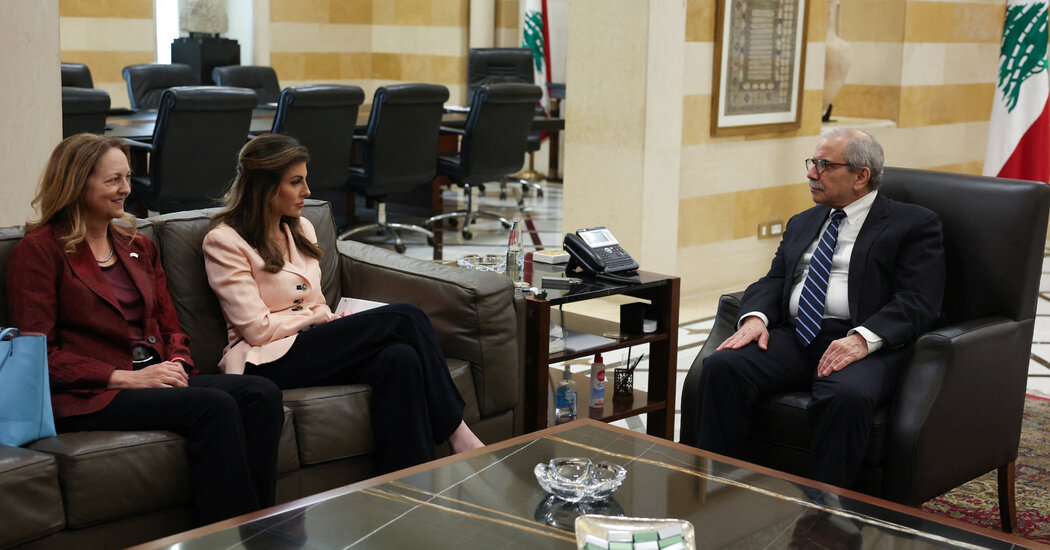

Amid rising tensions in the Middle East, a leading U.S. diplomat visited Lebanon on Saturday to reinforce American pressure on the nation to curb the influence of Hezbollah, while the fragile cease-fire with Israel faces new challenges. Morgan Ortagus, serving as President Donald Trump’s deputy Middle East envoy, engaged in talks with top Lebanese officials following recent military actions that threaten the truce originally brokered by the U.S. in November.
The meeting between Ms. Ortagus and Lebanon’s newly appointed President, Joseph Aoun, centered on ongoing conflicts in southern Lebanon. According to a statement from Aoun’s office, discussions emphasized the Lebanese military’s responsibilities in the region as per the cease-fire agreement. The Lebanese government has been striving to rebuild following the catastrophic war with Israel, where approximately 4,000 Lebanese fatalities were recorded and nearly a million people were displaced. Although Hezbollah, the Iran-supported militant group, suffered significant losses, it retains substantial influence within Lebanon.
Tensions have been mounting after militants launched rocket attacks on Israel last week, prompting Israeli military retaliation on Beirut’s peripheries and southern regions of Lebanon. An Israeli strike later targeted the Dahiya sector, south of Beirut, allegedly to hit a Hezbollah official, sparking fears of a cease-fire collapse. Hezbollah denied any involvement in the rocket attacks initiative. Despite this hostility, neither Israel nor Hezbollah has exhibited an eagerness to reignite full-scale warfare, preserving the cease-fire’s tentative stability.
The strategic dialogue between Ms. Ortagus and Mr. Aoun also delved into the series of financial reforms being orchestrated by Lebanon’s new government. Lebanese leaders are hopeful that these reforms will secure enhanced foreign aid, particularly from the United States, crucial for the nation’s reconstruction efforts. The World Bank estimates the war’s financial toll at $14 billion, with Lebanon requiring $11 billion for recovery, marking it as the most devastating conflict since the conclusion of Lebanon’s long civil war in 1990.
Experts predict that international financial support will largely depend on whether the Lebanese government can extend its authority across the nation by potentially disarming Hezbollah. Before the conflict, Hezbollah was so influential that it was often described as a state within a state.
The ongoing situation in Lebanon remains delicate, with international and regional stakeholders closely monitoring the developments. As the Lebanese government attempts to navigate the path to recovery and stability, the role and influence of groups like Hezbollah will be critical in shaping the country’s future. Building stronger governmental control and utilizing foreign aid effectively could help Lebanon on its path to rebuilding and maintaining peace in a region fraught with complexities.
Original Source: https://www.nytimes.com/2025/04/05/world/middleeast/lebanon-us-israel-hezbollah.html
Category : Lebanon,United States International Relations,Morgan Ortagus,Hezbollah,Israel,War and Armed Conflicts,Iran-Israel Proxy Conflict,Defense and Military Forces,Middle East
Tags:
Publish Date: 2025-04-05 15:51:00