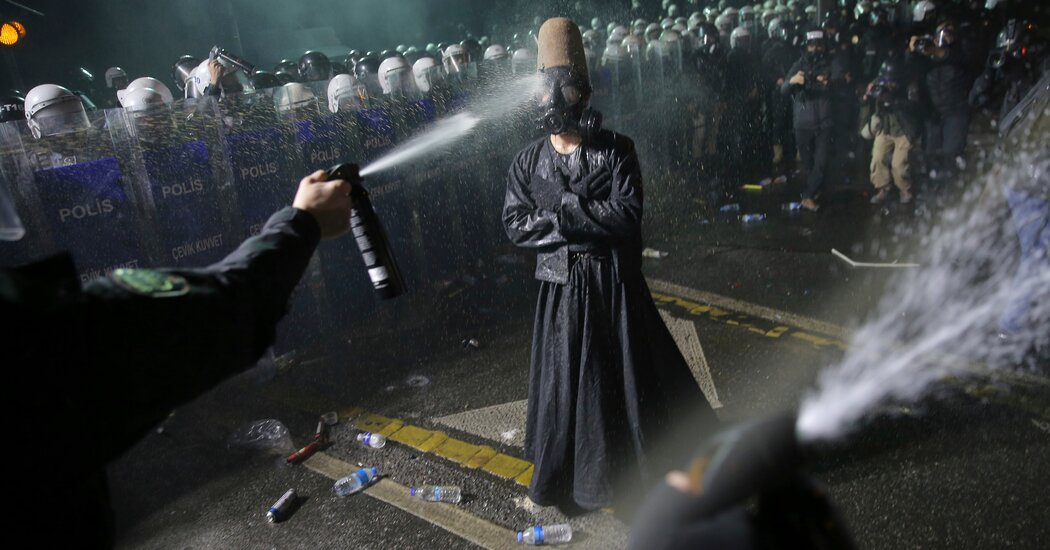

In 2021 and 2023, President Joseph R. Biden Jr. convened democracy summits at the White House, notably excluding Turkey’s President Recep Tayyip Erdogan, whom he described as an “autocrat.” In contrast, a more favorable perspective of Erdogan is being expressed by President Donald Trump, who recently praised Erdogan as a “good leader” during a White House meeting with ambassadors, ignoring the protests and unrest in Turkey following the detention of the Istanbul mayor, Erdogan’s primary political adversary.
Since his inauguration, President Trump has shifted a traditional tenet of U.S. diplomacy: advocating for democratic values worldwide. Instead, he has embraced leaders who lean toward autocracy. Notably, Trump’s rhetoric and actions, which include targeting political adversaries and questioning judicial authority, are influencing leaders in Serbia and Israel to test the boundaries of their democratic institutions.
Rosa Balfour from the Carnegie Endowment for International Peace illustrates this evolution, asserting that Trump’s lack of condemnation for anti-democratic actions from other countries gives rise to emboldened autocratic behaviors abroad. Jane Harman, former president of the Woodrow Wilson International Center for Scholars, remarked that Trump’s return has intensified global skepticism of authoritarianism, albeit not initiating it. Harman pointed to Germany’s elections as a case where Trump’s influence may have curbed far-right ascendance.
While Biden’s tenure did not completely estrange undisputed figures, such as Narendra Modi of India or Mohammed bin Salman of Saudi Arabia, his cautious approach contrasts with Trump. Israel’s Prime Minister Benjamin Netanyahu, unencumbered by Biden’s former resistance to judicial alterations, embodied heightened assertiveness. Under Trump, Netanyahu faces less scrutiny, recently terminating a chief intelligence officer and altering judge selection processes, raising alarms about the potential erosion of a balanced judiciary.
In Serbia, President Aleksandar Vucic has empowered law enforcement to suppress political opposition. Following USAID retraction under Trump, Vucic justified raids on organizations formerly funded by the agency, claiming to combat improprieties. Donald Trump Jr.’s visit amplified Vucic’s narrative, aligning Serbia’s government actions with the themes of “law and order” while targeting shared liberal opposition.
Concurrently, Erdogan’s jailing of the Istanbul mayor sparked criticism, but no censure from Trump, whose senior envoy Steve Witkoff acclaimed recent interactions with Erdogan. These endorsements, lacking critique of Turkey’s internal repression, convey an implicit U.S. alignment with autocratic tendencies. As Ruth Ben-Ghiat of NYU notes, Trump’s words and absence of rebuke bolster authoritarian leaders internationally, underscoring the U.S.’s new stance.
This changing climate reveals a U.S. that, under current leadership, refrains from wielding its influence to foster democracy globally, profoundly affecting international politics and reinstating concerns about the balance of democratic principles.
Original Source: https://www.nytimes.com/2025/03/29/world/europe/trump-authoritarians-inspiration.html
Category : United States Politics and Government,United States International Relations,Authoritarianism (Theory and Philosophy),Foreign Aid,Courts and the Judiciary,Democracy (Theory and Philosophy),International Relations,United States Agency for International Development,Ben-Ghiat, Ruth,Biden, Joseph R Jr,Netanyahu, Benjamin,Vucic, Aleksandar,Witkoff, Steven,Trump, Donald J Jr,Belgrade (Serbia),Europe,Israel,Istanbul (Turkey),Turkey,Serbia,United States
Tags:
Publish Date: 2025-03-29 09:31:00