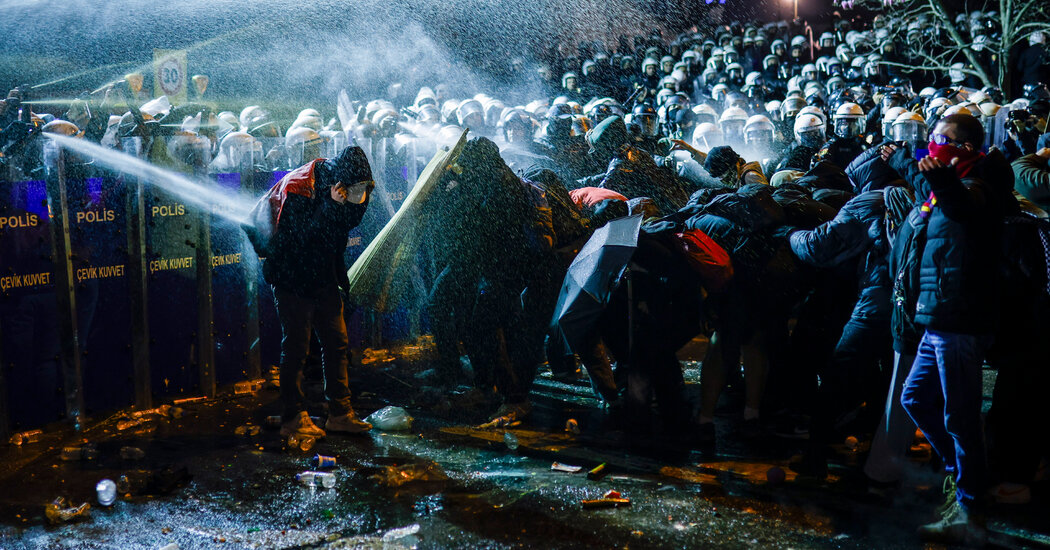

In recent years, nations like Turkey, Hungary, Venezuela, and India have served as cautionary examples of how democracies can devolve into “competitive authoritarianism,” a system where elections exist but are manipulated by leaders to undermine civil liberties. The implications of even these partial democracies posing a threat to those in power are becoming increasingly clear. A stark illustration of this unfolding dynamic is Turkey, where the arrest of Istanbul’s mayor, Ekrem Imamoglu, has ignited protests nationwide. Accusations of bribery, bid-rigging, and misuse of personal data have been leveled against him, all of which he denies. This arrest, experts suggest, is a preemptive strike by President Recep Tayyip Erdogan to stifle a formidable challenger ahead of the presidential elections, particularly since Istanbul University has rescinded his diploma—a requirement for presidential candidates.
Imamoglu’s rising popularity posed a credible challenge to Erdogan’s hold on power. According to Lisel Hintz, a political scientist specializing in Turkish politics at Johns Hopkins University, the situation marks a shift from competitive to full authoritarianism. Turkey’s trajectory seems to echo Russia’s, where meaningful political opposition to President Vladimir Putin is virtually non-existent, suggesting Erdogan may no longer tolerate the risk electoral competition entails.
Elections present a dual-edged equation for authoritarian leaders. On one hand, they can offer legitimacy and international validation. On the other, as seen in Venezuela and India, they pose significant risks when manipulated. Venezuela’s Nicolas Maduro, despite his attempts to rig the electoral process, saw his opponent win decisively, though the victory was later overruled by Maduro’s controversial claim to power. In India, Prime Minister Narendra Modi’s attempts to weaken opposition did not prevent his party from losing its parliamentary majority, albeit he retained his position as prime minister.
In Turkey, the calculus of holding semi-open elections has become less advantageous for Erdogan, particularly as Imamoglu’s appeal grows in the face of Turkey’s economic woes—including high inflation, exacerbated by Erdogan’s own policies. External geopolitical factors compound this shift. As Asli Aydintasbas, a visiting fellow at the Brookings Institution, notes, the Trump administration’s lukewarm stance on promoting democracy abroad and strained U.S.-NATO relations have reduced external pressure on Erdogan to maintain democratic façades, thus encouraging his authoritarian leanings.
Turkey’s economic struggles and rising inflation have eroded government popularity, revealing an inherent flaw in competitive authoritarianism: the tendency to value loyalty over competence. Selim Erdem Aytac from Koc University in Istanbul notes this incompetence complicates effective governance, intensifying public dissent. The backlash following Imamoglu’s arrest underscores this, with protests evolving into the largest demonstrations in Turkey in a decade, despite government crackdowns.
However, the protests’ potential impact remains uncertain. Years of democratic backsliding have fortified Erdogan’s regime against immediate consequences, highlighting the incremental nature of democratic erosion. As institutions like the judiciary and media have already been compromised, reversing such entrenched autocracy is daunting. Aytac underscores the lack of tools to counteract these trends once they reach a tipping point, leaving Turkey at a critical crossroads in its political evolution.
Original Source: https://www.nytimes.com/2025/03/28/world/middleeast/for-some-autocrats-even-rigged-elections-can-be-too-much-of-a-threat.html
Category : Demonstrations, Protests and Riots,Authoritarianism (Theory and Philosophy),Democracy (Theory and Philosophy),Istanbul University,Erdogan, Recep Tayyip,Imamoglu, Ekrem,Turkey,International Relations,Politics and Government
Tags:
Publish Date: 2025-03-28 09:31:00