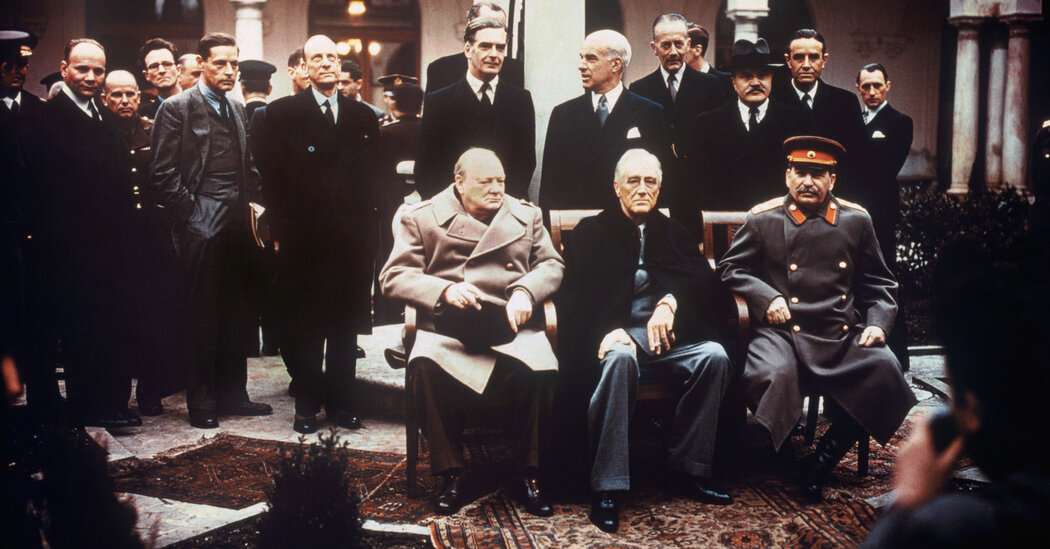

In a development drawing global attention, former President Donald Trump suggested a diplomatic negotiation with Russian President Vladimir Putin echoing historical parallels to the geopolitical maneuvering seen at the Yalta Conference of 1945. Speaking to reporters on Air Force One, Trump indicated that an upcoming call with Putin would focus on defining Russian territorial control resulting from the ongoing conflict in Ukraine. Trump’s approach suggests negotiation over Russia’s territorial gains since its annexation of Crimea in 2014 and continued aggression in Ukraine, a trajectory he hopes to cap off with a ceasefire agreement.
The conversation, exclusively between Trump and Putin, could determine the extent of territory Russia will retain. White House officials have hinted at Crimea’s retention by Russia, with speculation about potential surrounding areas also being ceded. Despite assurances of ongoing communication with Ukrainian and European leaders, uncertainty lingers about whether they will support any conclusions reached by the two leaders.
Trump’s administration has shared few details about the terms being discussed, but his remarks underscore concerns over Ukraine’s territorial sacrifices. Particularly controversial is the potential inclusion of strategically important locations such as the Zaporizhzhya nuclear power plant, Europe’s largest nuclear site, and possibly Odessa. Michael Waltz, Trump’s national security adviser, emphasized the pragmatic nature of talks, sidestepping implications that Russia is being rewarded for its aggression. Waltz, once a staunch advocate for Ukraine, now focuses on achieving peace to end the prolonged and deadly conflict, pointing out the alternative could be prolonged warfare akin to former President Biden’s commitment to Ukraine’s defense.
The Trump-Putin dialogue emerges amid debates on the potential deployment of European troops in Ukraine as part of a peacekeeping effort. However, the deployment’s success seems contingent on approval from Russia and support from the U.S., casting doubt on its viability.
Additionally, the Trump administration is scaling back initiatives launched under his predecessor to address war crimes accountability. This pivot away from pursuing justice for war crimes committed during the Ukrainian invasion marks a significant shift in U.S. policy, seemingly aimed at easing tensions with Russia in pursuit of a broader settlement.
Monica Duffy Toft, an international politics professor at Tufts University, commented on the current geopolitical landscape, drawing comparisons to the post-World War II period. She expressed concerns over leaders expanding territorial control, highlighting the implications for global dynamics, particularly if China sees this as a green light to assert its claims over Taiwan.
In essence, this potential realignment orchestrated by Trump and Putin could redefine European borders, sparking debates about sovereign rights and international law adherence. As the world watches this high-stakes negotiation unfold, the geopolitical ripple effects could extend far beyond Ukraine, potentially shaping future international relations paradigms.
Original Source: https://www.nytimes.com/2025/03/17/us/politics/trump-putin-ceasefire-negotiation-ukraine-concessions.html
Category : Russian Invasion of Ukraine (2022),United States International Relations,Putin, Vladimir V,Trump, Donald J,Zelensky, Volodymyr
Tags:
Publish Date: 2025-03-18 04:01:00