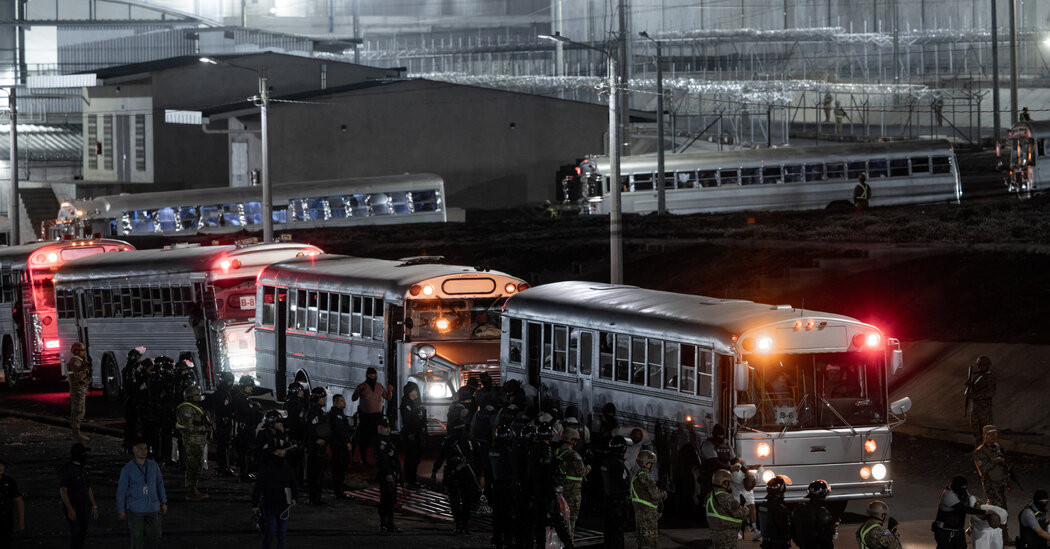

In a move drawing sharp criticism and potential legal challenges, the U.S. Trump administration deported hundreds of Venezuelan immigrants over the weekend, allegedly defying a federal judge’s order. These individuals, accused of gang affiliations, were sent to a prison in El Salvador. The administration defended its actions, claiming the president possesses extensive authority to expedite deportations under an 18th-century statute originally designed for wartime emergencies. White House press secretary Karoline Leavitt emphasized that federal courts lack jurisdiction over the president’s foreign affairs decisions and his authority to expel foreign nationals deemed threats.
The timeline of the events is crucial in understanding the sequence. The judge issued the order late on Saturday in Washington, D.C., aiming to halt the deportations. However, videos from El Salvador, which is two hours behind Washington, show deportees already arriving at night. El Salvadoran President Nayib Bukele added fuel to the fire by posting a screenshot of the judge’s order on social media with the comment, “Oopsie… Too late.”
The executive order evoking the Alien Enemies Act of 1798, signed by President Trump on Friday, bases its legality on the two nations being in a state of conflict, a point aggressively contested by the Venezuelan government. A spokesperson from Venezuela labeled the U.S. action as a “crime against humanity,” underscoring the potential for heightened diplomatic tensions.
Meanwhile, in Israel, Prime Minister Benjamin Netanyahu announced his intention to dismiss Ronen Bar, the head of Shin Bet, Israel’s domestic intelligence agency. This development has fanned the flames of an already volatile internal political landscape, with critics arguing that Netanyahu is attempting to erode the agency’s independence. Netanyahu’s decision aligns with calls from coalition members who accuse Bar of undermining the prime minister, particularly concerning the handling of conflicts in Gaza and internal investigations into Netanyahu’s close associates.
In Ukraine, the ongoing conflict with Russia has seen a strategic withdrawal of Ukrainian forces from much of Russia’s Kursk region. This withdrawal marks the waning phase of Kyiv’s ambitious campaign to secure and occupy Russian territory, bowing to consistent air assaults and drone attacks. According to military analysts, Ukraine’s focus has shifted to fortifying defensive positions near the Sumy region as a buffer against advancing Russian forces. With tensions still simmering, Steve Witkoff, the U.S. special envoy to the Middle East, anticipates a conversation between President Trump and Russian President Vladimir Putin to discuss a potential ceasefire.
In other news, the Costello family faces an emotional farewell to Brendan Costello, whose compassionate and witty nature leaves a lasting impact. Additionally, the late Roy L. Prosterman is remembered for his pivotal role in advocating for land reforms in developing countries, a legacy that endures following his passing at age 89.
On the pop culture front, Spider-Man’s evolution through animated television has captured audiences for generations. Since its inception in the 1960s, the character and his series have transformed significantly. As documented by Maya Phillips, the original show featured rudimentary animation. Recent adaptations, especially the latest series “Your Friendly Neighborhood Spider-Man,” beautifully blend nostalgia with modern animation techniques, paying homage to the classic “Amazing Spider-Man” comics.
This array of developments across geopolitics, entertainment, and personal stories provides a poignant snapshot of the interconnected world landscape, engaging readers in the ever-evolving narrative of global affairs.
Original Source: https://www.nytimes.com/2025/03/17/briefing/venezuelans-trump-ukraine.html
Category :
Tags:
Publish Date: 2025-03-17 10:30:00