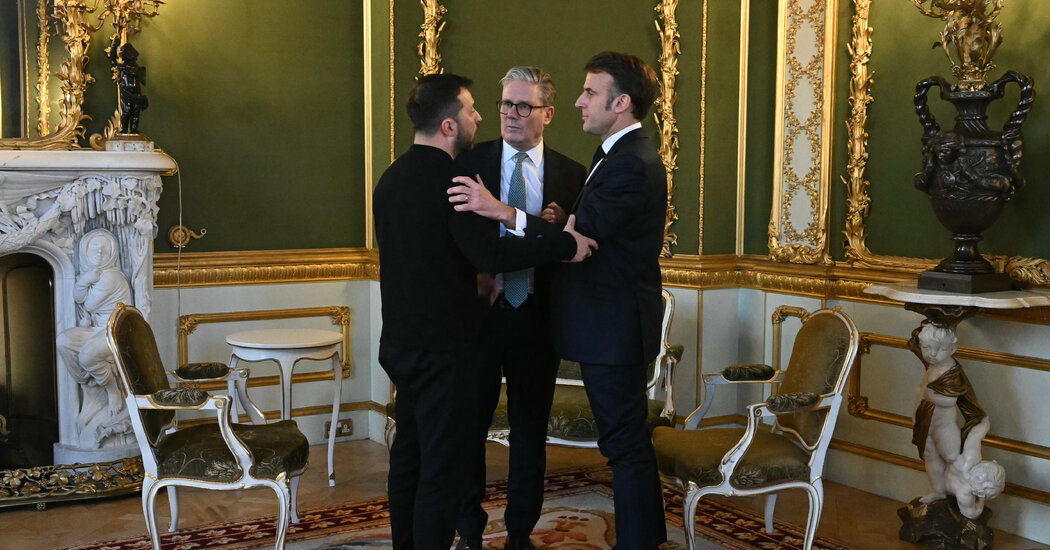

Five years after the United Kingdom’s exit from the European Union, Prime Minister Keir Starmer seems to be charting a familiar course on the international stage, reminiscent of Britain’s historical role as a trans-Atlantic mediator. As tensions simmer following President Donald Trump’s unexpected overtures to Russia and discord with Ukraine, Starmer has positioned himself as a crucial link between Europe and the United States.
Amid this diplomatic whirlwind, Starmer has engaged directly with Ukraine’s President Volodymyr Zelensky, offering guidance over the phone and in person on mending strained relations with Trump. In Washington, Starmer has lobbied Trump for security assurances to deter Russian aggression under President Vladimir Putin’s leadership.
Starmer’s diplomatic approach mirrors that of former Prime Minister Tony Blair, who similarly sought to mediate between President George W. Bush and European leaders during the buildup to the Iraq War in 2003. As Blair’s efforts eventually led to fractured alliances, primarily with France and Germany opting out of the coalition against Iraq, Starmer faces a similar tightrope in maintaining ties with both America and Europe.
To bolster support for Ukraine, Starmer is organizing a virtual summit with up to 25 leaders from Europe, NATO, and other allies like Canada, Australia, and New Zealand. This coalition aims to fortify Ukraine’s defenses post-peace settlement and seeks to gain further commitments, including potential troop and logistical support from additional countries.
The British Prime Minister’s initiatives are not without challenges, largely due to Trump’s unpredictable stance toward Ukraine and his fluctuating policies on Russia. Despite these uncertainties, seasoned British diplomat Peter Ricketts believes Starmer perceives an unchecked risk of conflict as a more significant threat than navigating Trump’s volatility.
Key to Starmer’s strategy is his national security adviser, Jonathan Powell, who has a history of successful negotiations, including his vital role in the Good Friday Agreement. Powell’s diplomatic experience aids Starmer’s efforts in Kyiv and Washington, underscoring the continuity of British diplomatic involvement in global affairs despite Brexit.
Brexit has, paradoxically, afforded Starmer a distinct position outside the EU, which may facilitate his role as a mediator. Analysts like Mujtaba Rahman suggest that this positioning is an asset, provided international tensions remain manageable. However, should these tensions escalate into deeper trans-Atlantic divisions, the U.K. might face tougher choices.
Starmer’s recent efforts for re-engagement with Europe, particularly in defense and trade, signal a potential shift toward renewed cooperation, even though rejoining the EU’s single market or customs union remains off the table. Changes in the geopolitical landscape, fueled by Trump’s actions, have expedited dialogue between the U.K. and European nations, with increased defense coordination emerging as a new focus.
British diplomat Ivan Rogers notes that Starmer’s active engagement has positively altered European perceptions, potentially paving the way for joint military initiatives outside existing EU frameworks. However, Rogers warns that Britain’s dual stance—seeking alignment with the U.S. while differentiating from the EU—might lead to misperceptions of opportunism.
Despite these complex dynamics, Britain under Starmer’s leadership is redefining its post-Brexit role on the global stage. Balancing this new international position requires deft diplomacy and a strategic grasp of evolving global alliances, ensuring the U.K. remains an influential player in addressing international conflicts and fostering trans-Atlantic unity.
Original Source: https://www.nytimes.com/2025/03/15/world/europe/uk-europe-trump.html
Category : United States International Relations,International Relations,Great Britain Withdrawal from EU (Brexit),Good Friday Agreement (1998),European Union,Labour Party (Great Britain),North Atlantic Treaty Organization,Starmer, Keir,Trump, Donald J,Macron, Emmanuel (1977- ),Rogers, Ivan (1960- ),Powell, Jonathan
Tags:
Publish Date: 2025-03-15 09:30:00