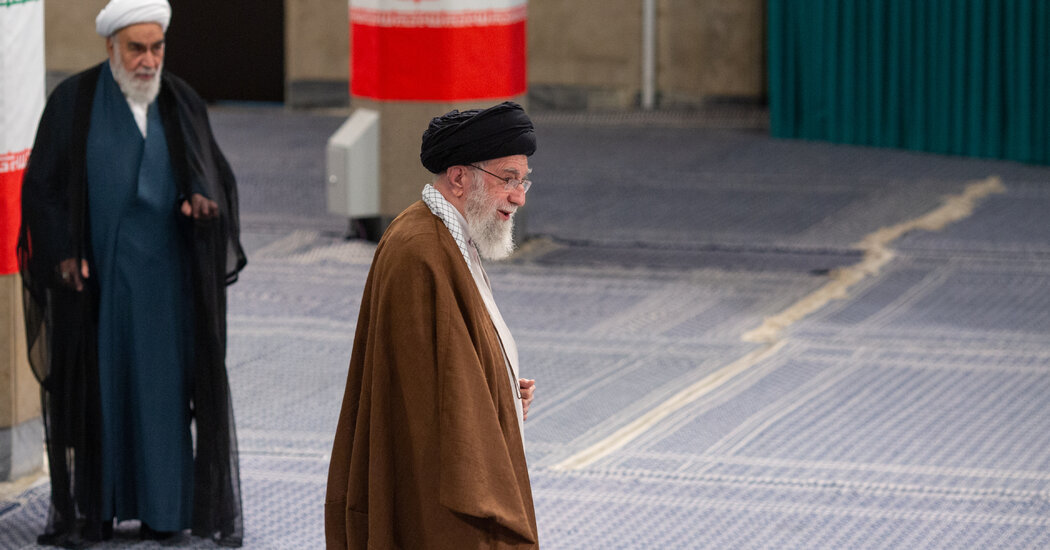

In a recent development, Iran has indicated a willingness to engage in discussions with the United States regarding its nuclear program if such talks focus solely on military concerns. This announcement came just a day after Iran’s Supreme Leader, Ayatollah Ali Khamenei, appeared to dismiss President Donald Trump’s overture for dialogue. A statement from Iran’s mission to the United Nations, shared on social media, suggested that negotiations aimed at addressing potential militarization aspects of Iran’s nuclear activities could be considered.
The context surrounding these comments is somewhat ambiguous, particularly following Ayatollah Khamenei’s vehement response to Trump’s previous offer to resume talks. In his message, Khamenei criticized certain “bullying governments” attempting to impose restrictions on Iran. While his remarks did not explicitly mention Trump or his proposal, they underscored a deep-seated skepticism towards engaging in negotiations, especially with the United States.
The core of the tension hinges on Iran’s nuclear capabilities. Experts contend that Iran is on the brink of enriching sufficient uranium to potentially develop a nuclear weapon. However, Iran maintains that its nuclear ambitions are strictly for peaceful purposes. Iran’s U.N. mission made it clear that any negotiations aimed at dismantling Tehran’s “peaceful nuclear program” are out of the question.
These seemingly conflicting messages from Iranian leadership might hint at internal disagreements over whether to restart talks, especially after Trump retracted the U.S. from the nuclear agreement crafted during Barack Obama’s presidency. Some Iranian officials, notably President Masoud Pezeshkian, who assumed office last year, have expressed interest in reopening discussions. Nonetheless, Ayatollah Khamenei has the ultimate authority and harbors a deep mistrust of the United States, complicating the prospect of dialogue.
President Trump’s renewed offer arises amidst a strategic shift in Iran’s regional dynamics. Israel has substantially weakened two of Tehran’s influential allies, Hezbollah and Hamas, and has successfully eliminated most of the air defenses protecting Iran’s nuclear sites. Additionally, the downfall of Syrian leader Bashar al-Assad, a key ally of Iran, suggests a challenging environment for Tehran’s geopolitical maneuvers. This change has led some senior Israeli figures to advocate that the current circumstances present an optimal chance to target Iran’s main nuclear facilities.
In this complex geopolitical scenario, both Iran and the U.S. face pivotal decisions about how to proceed. With Iran at a critical juncture in its nuclear development and regional stability increasingly precarious, the potential for dialogue focused on military concerns might offer a diplomatic opening. However, deep-seated mistrust and lingering suspicions on both sides pose significant hurdles. As these developments unfold, the international community closely monitors the situation, grappling with the implications for regional and global security.
This article explores critical issues surrounding Iran’s nuclear discussions, reflecting vital themes of international diplomacy, regional stability, and nuclear non-proliferation. Keywords like “Iran nuclear talks,” “Khamenei,” “Trump,” and “nuclear program” ensure relevance and accessibility for audiences seeking insights into this pivotal geopolitical theme.
Original Source: https://www.nytimes.com/2025/03/10/world/europe/iran-nuclear-trump-us.html
Category : Iran,Khamenei, Ali,Nuclear Weapons,Trump, Donald J
Tags:
Publish Date: 2025-03-10 17:21:00