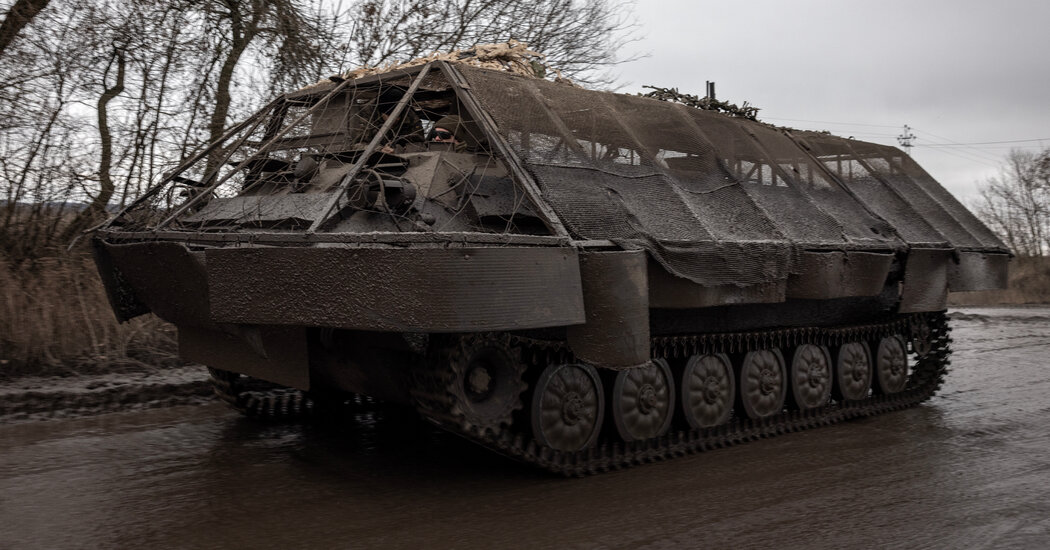

In recent days, a significant battlefield development has unfolded in the Kursk region of Russia, where a coordinated effort by Russian and North Korean forces has put Ukrainian supply lines at risk. According to Ukrainian soldiers, military bloggers, and analysts, these forces have worked together, with an influx of North Korean soldiers and Russian drone units advancing under heavy artillery fire and airstrikes to reclaim important positions from Ukraine.
A Ukrainian communications commander named Oleksii admitted via phone, “It’s true; we can’t stop them,” highlighting the overwhelming force of groups of 50 North Korean soldiers against a much smaller Ukrainian contingent. This shift poses a potential setback for Ukraine, which had used its unexpected 2022 summer incursion into Kursk, strategically significant for its morale boost over Russian forces, as a bargaining chip in potential future peace talks. Should Ukrainian forces be compelled to withdraw from this area, it could weaken Ukraine’s negotiation position, particularly as international political figures, including former U.S. President Donald Trump, advocate for settlement discussions.
The offensive into Kursk was the first invasion of Russian territory by a foreign military since World War II, initially catching Russian troops off guard and allowing Ukraine to establish control over a 200-square-mile area near the town of Sudzha. Military analysts have been divided on whether this bold move was strategically sound or a misstep. Despite reclaiming two-thirds of the lost territory, Russian and North Korean forces sustained significant casualties, with Ukrainian and Western intelligence estimating at least 4,000 troops killed in action.
The offensive by Ukrainian forces served multiple purposes: deterring a Russian invasion into Ukraine’s Sumy region, challenging Western concerns over escalation, redirecting Russian resources from the Ukrainian frontlines, and garnering future negotiation leverage. Although Ukrainian forces have managed to stall Russian advances in eastern Ukraine, the recent gains by Russian and North Korean troops in Kursk raise new concerns.
North Korea’s contribution to Russian efforts has been substantial, providing not only soldiers but also artillery and ballistic missiles. After a withdrawal in January for regrouping, North Korean troops returned, demonstrating improved cohesion and tactics. Ukrainian drone commander Andrii noted that North Korean tactics are increasingly sophisticated, indicating better coordination with Russian troops and drone operators.
Ukrainian soldiers reported their lines being breached near Kurylivka, forcing a tactical retreat to maintain organizational integrity, though the enemy’s advance was momentarily halted. Russian forces, supported by North Korean artillery, have secured a significant advantage by employing fiber-optic drones, which are immune to radio jamming and allow for precise strikes on key Ukrainian supply routes.
Captain Oleksandr Shyrshyn of Ukraine’s 47th Mechanized Brigade acknowledged the advanced capabilities of the Russian drones, noting their extended range and effective deployment. The persistent attacks targeting Ukraine’s main supply route to Sudzha have become a critical challenge, intensifying the battlefield’s pressure.
Despite mounting difficulties and the strategic deployment of drones by the Russians, Ukrainian soldiers remain steadfast in holding their defensive positions. Andrii emphasized the enemy’s strategic focus on severing logistics, complicating defense efforts. Nevertheless, Ukrainian forces continue to fulfill their missions, determined to endure amid the intensifying conflict.
Reporting by Liubov Sholudko and Yurii Shyvala has contributed to this article, ensuring comprehensive coverage of the evolving military situation in Kursk, Russia.
This article provides insightful context on the complex interplay of international relations, highlighting the Russian invasion of Ukraine and the pivotal role of drones and fiber optics in modern warfare, while also touching on the broader geopolitical ramifications involving the United States, North Korea, and efforts for a peace process.
Original Source: https://www.nytimes.com/2025/03/08/world/europe/ukraine-russia-north-korea-kursk.html
Category : Russian Invasion of Ukraine (2022),Drones (Pilotless Planes),Fiber Optics,Defense and Military Forces,Putin, Vladimir V,Zelensky, Volodymyr,Kursk (Russia),Ukraine,North Korea,Sumy (Ukraine),Russia,Trump, Donald J,Embargoes and Sanctions,United States International Relations,International Relations,Peace Process
Tags:
Publish Date: 2025-03-08 10:31:00