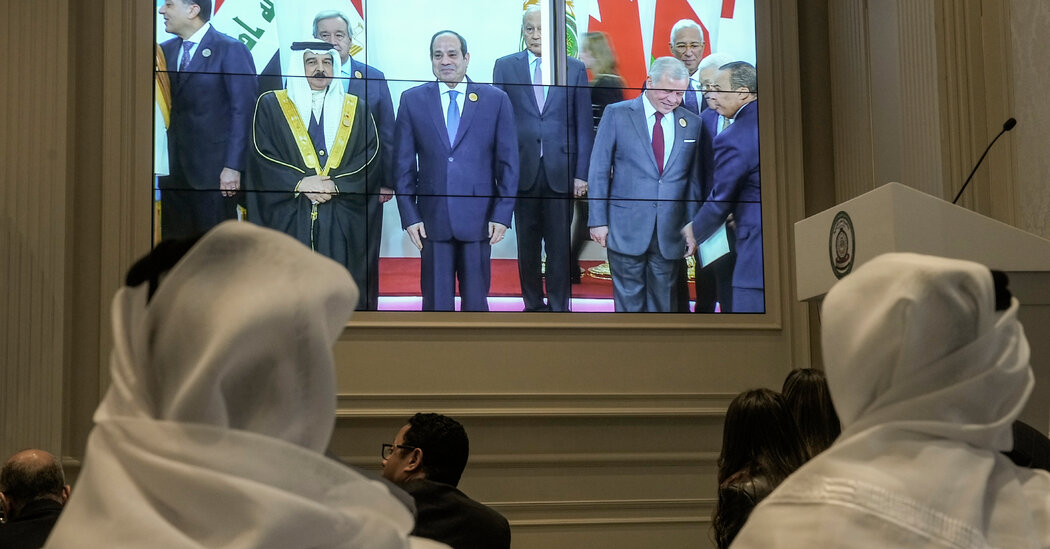

President Trump’s recent suggestion to relocate Gaza’s approximately two million residents to Egypt and Jordan, transforming the area into a tourist haven, has sparked sharp reactions among Arab leaders. In response, an emergency Arab summit in Cairo unveiled an alternative plan focused on rebuilding Gaza without displacing Gazans. The proposal aims to marginalize Hamas, the current rulers of Gaza, by instituting a committee of bureaucrats to govern for six months before transitioning control to the Palestinian Authority. The broader objective is to eventually reunite Gaza with the West Bank under a single Palestinian state, a vision supported by Palestinians and Arabs across the Middle East.
Despite a detailed reconstruction plan, estimated to cost $53 billion, key challenges remain unresolved. The Arab countries, while united in opposing forced displacement, lack the influence to break the deadlock between Israel and Hamas, especially with the Trump administration’s alignment with Israel’s interests. “With all respect, the plan was very technical, as if it came from an engineering consultancy,” commented Ghassan Khatib from Birzeit University. “And we need a political plan.”
The summit’s statement avoided addressing the critical issue of disarming Hamas, a sticking point for both Israel and the United States, given their security concerns. Yet, Arab nations like Egypt and Saudi Arabia, troubled by Hamas’s military capabilities, have no clear strategy to achieve demilitarization. Hamas, having welcomed the summit’s statement, shows no inclination to surrender its arms.
A significant barrier to progress is the enduring disagreement over Palestinian statehood. While Arab leaders advocate for a Palestinian state, Israel rejects the notion, viewing Trump’s “Gaza Riviera” as a viable solution. The Israeli foreign ministry endorsed the idea, framing it as an opportunity for Gazans to exercise free will. Meanwhile, Trump administration spokesperson Brian Hughes dismissed the Arab plan as unrealistic, noting Gaza’s current conditions as untenable for habitation.
Although the U.S. has not officially abandoned its historical support for a two-state solution, its actions under Trump’s administration suggest a shift towards Israel’s stance, provoking skepticism about its commitment to Palestinian sovereignty. Analysts like Paul Salem of the Middle East Institute argue that Trump, eyeing a normalization deal between Israel and Saudi Arabia, might pressure Palestinians into accepting a less favorable agreement given their weakened position.
While the Arab blueprint for rebuilding Gaza is ambitious, with calls for extensive international support, questions about funding linger. Though Gulf countries like Saudi Arabia and the UAE are typically financial backers for regional reconstruction, their absence at the Cairo summit raised doubts about their commitment. The European Union has expressed willingness to support but is yet to take concrete steps.
Today’s geopolitical landscape, underscored by regional power plays, pinpoints the complex realities of achieving peace and development in Gaza. As the international community grapples with finding a solution that balances the geopolitical tensions and humanitarian needs, the path forward remains fraught with uncertainty. Amid these challenges, the fate of Gaza and the prospect of a unified Palestinian state hang in the balance.
Original Source: https://www.nytimes.com/2025/03/05/world/middleeast/gaza-arab-leaders-plan.html
Category : Israel-Gaza War (2023- ),Arabs,Palestinians,Hamas,Gaza Strip,Egypt,Israel,Saudi Arabia,United Arab Emirates,United States International Relations
Tags:
Publish Date: 2025-03-05 21:51:00