
Bengaluru: Indian Scientists Develop Tool for Enhancing TMT’s Astronomical Imaging
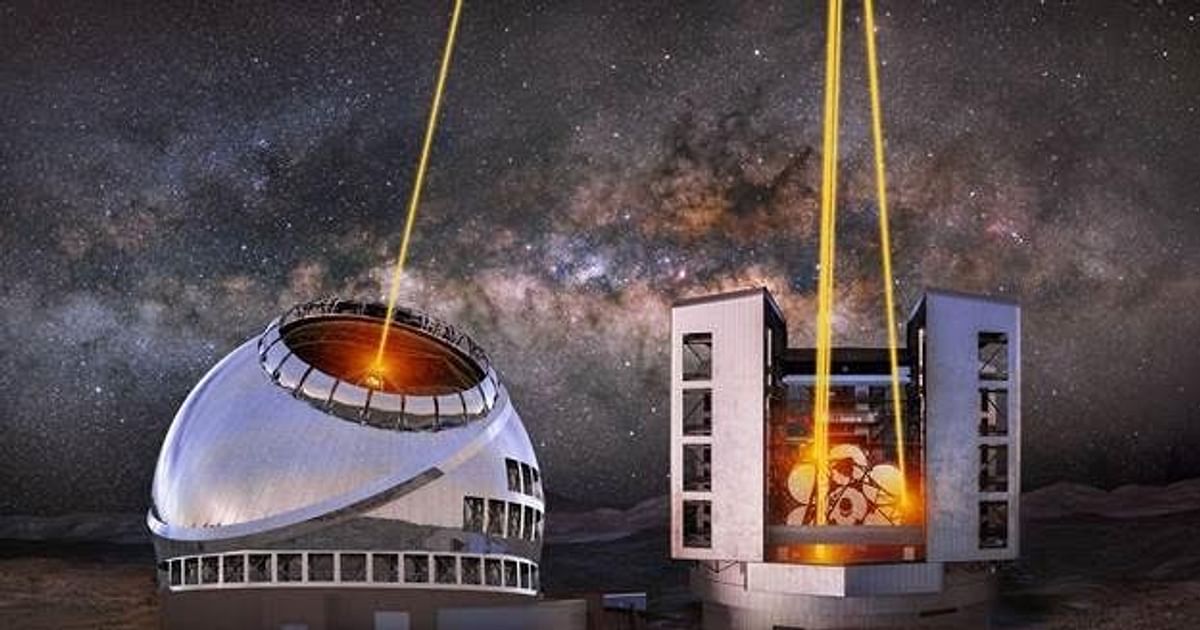
A research team led by the Indian Institute of Astrophysics (IIA) has created an innovative online tool to catalog stars, crucial for the Thirty Meter Telescope (TMT) in Hawaii. This catalog will help TMT produce high-quality images by addressing atmospheric distortions through an adaptive optics system (AOS). The findings, showcasing India’s significant contribution to the project, were conducted at the India-TMT Coordination Centre in Bengaluru and published in The Astronomical Journal.
TMT’s ground-based telescopes, noted for their extensive light-collection capabilities, face challenges from atmospheric interference. The AOS combats this by using laser guide stars. However, atmospheric turbulence hampers these laser beams, necessitating feedback from three real stars, known as natural guide stars (NGS). According to lead researcher Dr. Sarang Shah, the AOS needs three NGS, each as bright as 22 magnitudes in the near-infrared J waveband, within its field of view for optimal performance.
Since no comprehensive star catalog exists to provide NGS for all sky regions, IIA’s team developed an automated code to create this catalog. Co-author Smitha Subramanian explained that the code predicts near-infrared magnitudes of stars identified in optical sky surveys by using their optical magnitudes. The researchers validated their tool using data from the UKIDSS survey, achieving over 85% prediction accuracy.
The TMT, featuring a 30-meter diameter primary mirror composed of 492 aligned segments, aims to explore dark matter and study galaxy evolution. This international collaboration includes the California Institute of Technology, India’s Department of Science and Technology, the University of California, and institutions from Canada, China, and Japan. India’s involvement is led by IIA, with contributions from the Inter-University Centre for Astronomy and Astrophysics, Pune, and the Aryabhatta Research Institute for Observational Sciences, Nainital.
Published 10 July 2024, 04:30 IST
Original Story https://www.deccanherald.com/science/thirty-meter-telescope-indian-scientists-develop-tool-for-star-catalogue-3099506
Category :
Tags: