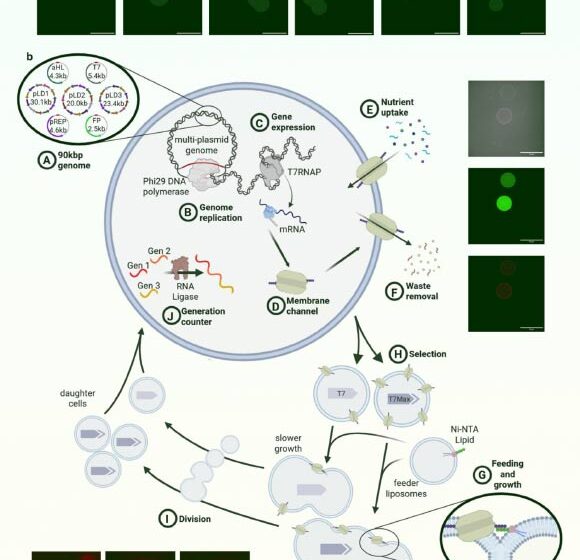

Biologists at the University of Minnesota report they have built a chemically assembled synthetic cell that can complete a full life cycle — take in nutrients, grow, copy its genetic material, divide and pass beneficial changes to offspring. The construct, called “SpudCell,” is described in a preprint posted on bioRxiv on July 2, 2026, and carries a compact 90,000–base‑pair genome distributed across seven or eight plasmids. According to the team, SpudCell represents a major step in synthetic biology because it was built entirely from nonliving chemical parts yet shows the core behaviors of living cells.
The researchers assembled SpudCell from defined components: fatty membranes formed into liposomes (small vesicles that mimic cell membranes), a stripped‑down protein‑production system, and the engineered genome designed to encode feeding, DNA replication, growth and division. “DNA is the programming for all living organisms,” said corresponding author Dr. Katarzyna Adamala. The team notes the SpudCell genome is smaller than prior estimates for a minimal living genome (previously speculated around 113,000 base pairs).
SpudCell feeds by fusing with smaller “feeder” liposomes that supply lipids, enzymes and small molecules. Fusion is triggered by a modified bacterial pore protein the synthetic cell produces; that protein displays a chemical tag that matches a tag on the feeder liposomes, allowing the two membranes to merge and deliver raw materials. DNA replication in the system used an enzyme borrowed from a bacterial virus, and mechanical splitting produced daughter cells.
The authors tracked a single lineage through five generations using a chemical marker in each feeder batch and found roughly 30% of surviving daughters retained a complete copy of the seven‑part genome, despite lacking a cellular skeleton or specialized DNA‑sorting machinery. To test selection, they engineered a version of the feeding protein with a stronger genetic promoter (a DNA element that increases expression). When faster‑ and slower‑feeding cells were mixed, the faster type rose from a 50:50 mix to as much as 61% after five generations; under scarce feeder conditions, fast growers outnumbered slow growers by more than two to one.
The team also built a division mechanism that does not rely on a cytoskeleton, instead using proteins crowding the membrane to pinch cells apart, and linked that division genetically to feeding advantage. “This is likely the most exciting project I’ve ever worked on,” Dr. Adamala said. The authors emphasize the work is an early proof of principle and call for international collaboration to make the system robust and practical. The full manuscript is available as a July 2, 2026 preprint on bioRxiv (Gaut et al., 2026).
Original Source: https://www.sci.news/biology/synthetic-cell-14890.html
Category:
Tags:
Publish Date: 2026-07-05 04:08:00