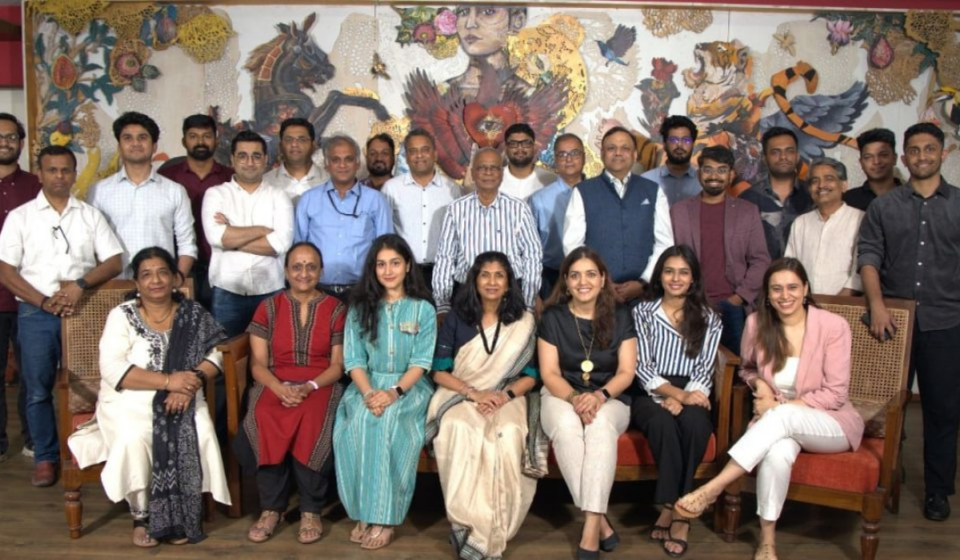
Architecting India’s Deeptech Future: Investing in Scalable AI Platforms

When senior operators move into venture capital, the signal is not just about money – it’s about operational horsepower entering the deal funnel. Over the last decade the most consequential bets in deeptech and AI have shifted from pure financial selection to active, operator-led value creation. Kalaari Capital’s appointment of Rajashree R as a venture partner to oversee deeptech and AI investments is another instance of that trend: experienced builders are being trusted to bridge the gap between lab prototypes and scalable products.
The signal in two sentences
Rajashree, with long stints at TCS and Tech Mahindra, joins Kalaari to focus on deeptech and AI – a role that mirrors a larger reshuffle across Indian VC, where seasoned executives are launching or joining funds and funds are sharpening their sector focus. Kalaari’s continued early-stage activity and recent rounds across SaaS and enterprise tech underline the increasing emphasis on commercialising technical advantage.
Why this matters for architecture and founders
I believe this shift matters because deeptech and enterprise AI are not solved by capital alone; they demand domain expertise, system design rigor, and patient orchestration. Deeptech companies face unique constraints: hardware-software co-design, long validation cycles, regulatory friction, and the need for industrial partnerships. AI startups, meanwhile, must reconcile research novelty with production constraints – data pipelines, model lifecycle management, explainability, and cost-efficient inference – before they can scale.
For CTOs and architects, the practical implications are clear:
- Design for reproducibility from day one. Production-grade ML systems need versioned data contracts, deterministic training pipelines, and testable model behaviour. Skipping these creates technical debt that kills scale.
- Adopt a modular, API-first architecture. Deeptech products often require integrating firmware, edge compute, cloud orchestration, and enterprise systems. Clear interfaces and bounded contexts reduce integration risk and shorten sales cycles.
- Prioritise observability and SRE practices. Models and hardware behave differently in production; robust telemetry, drift detection, and automated rollback are non-negotiable.
- Plan for commercialization, not just accuracy. Proofs-of-concept must include manufacturability, maintenance, and compliance paths if they are to attract operator-led capital.
How operator-led VC changes the playbook
Venture partners who have run large engineering organisations bring a different checklist to diligence: deployment readiness, engineering runway, and GTM partnerships often outweigh novelty. That’s both a constraint and an advantage. For founders it means earlier feedback on product-market fit challenges, faster introductions to enterprise customers, and hands-on support for building scalable technology stacks – but also higher expectations on delivery discipline.
A regional perspective (where relevant)
For India – and regions like the Northeast – this is an opportunity. Operator-driven capital can accelerate translation of locally relevant deeptech (agri-sensing, flood-resilience systems, low-power edge AI) into deployable solutions. The key is pairing technical proof with local deployment partners and pragmatic product design that tolerates connectivity and resource constraints.
Actionable takeaways
- Founders: bake production considerations into research projects. Investors now expect deployment-readiness metrics, not just benchmark numbers.
- CTOs: invest early in MLops, data contracts, and modular APIs to shorten sales and integration cycles.
- VCs and advisors: conduct technical diligence that stresses end-to-end operability – from hardware supply chains to model governance.
- Policymakers and incubators: support translational infrastructure (testbeds, validation labs, domain partnerships) that reduce commercialisation risk.
Closing thought
Capital is necessary; operator experience is catalytic. When VC teams bring builders into the decision loop, the real promise is faster, more reliable translation of deep science into products that serve people and enterprises – provided founders meet that higher bar of engineering and deployment readiness.
About the Author: Sanjeev Sarma is the Founder Director and Chief Software Architect at Webx Technologies. With a core focus on Generative AI integration, Cloud-Native Scalability, and Enterprise Software Architecture, he has spent over two decades driving digital transformation across Northeast India and beyond. Beyond his corporate leadership, Sanjeev is deeply invested in shaping the future of the IT industry. He serves as an Industry Expert on the Board of Studies for Assam Don Bosco University’s School of Technology, advises state technology committees, and actively mentors emerging tech startups at STPI. He brings a unique, dual perspective of high-level enterprise execution and future-ready academic curriculum development.