
The Ethics, Integrity and Aptitude paper (GS Paper IV) is often the most underrated but decisive component of the UPSC Civil Services Examination. Introduced in 2013 and worth 250 marks, the paper tests reasoning, judgement and presentation more than factual recall. For many aspirants the gap is not knowledge but application: while they can define concepts and name philosophers, they struggle to convert theory into structured, administration‑oriented answers. Satyajit Kumar — known as Satyajit Sir, co‑founder and faculty lead at SPM IAS Academy, Guwahati — is highlighted by students and the academy as a teacher who bridges that gap, and the academy cites measurable outcomes, including 16 UPSC qualifiers in 2024, an 83% selection rate in APSC CCE 2023, notable APPSC ranks, and claims that over 60 UPSC Prelims 2025 questions were traced to his daily newspaper analysis on YouTube.
Aspirants commonly trip over three challenges: the knowledge‑application gap, case studies designed to expose extremes, and the “reading loop” where revision replaces practice. High‑scoring answers go beyond definitions to link concepts — integrity, impartiality, empathy, emotional intelligence — with concrete governance examples, stakeholder analysis and balanced, implementable conclusions. Case studies reward nuance: identify stakeholders, weigh competing values, consider alternatives and justify a defensible decision rather than taking polar positions. Presentation and a repeatable answer structure are therefore as important as content.
What separates effective ethics instruction is a focus on thinking and writing as skills. Good teachers simplify philosophical frameworks without dumbing them down, teach models for answer structure, use systematic case‑study frameworks, integrate ethics with essays and other GS papers, and make emotional intelligence operational for administrators. They also connect current affairs daily to ethical frameworks so students build a living bank of examples.
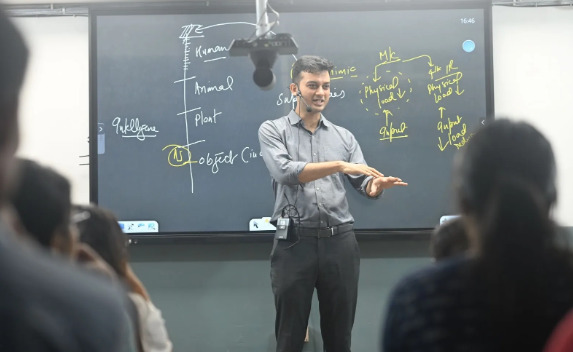
According to the source material, Satyajit Sir’s classroom combines a deontological emphasis on duty‑based reasoning with an integration of Indian and global philosophical traditions — from the Bhagavad Gita and Arthashastra to Kant and Rawls. He reportedly uses storytelling, mind maps, visual tools and real administrative scenarios to make abstract ideas practical. A repeated classroom phrase, “talk to yourself,” underlines his emphasis on self‑reflection and emotional awareness as tools for ethical decision‑making.
Northeast Indian aspirants face distinct constraints: limited local access to high‑quality coaching, the need to prepare for both UPSC and state PSCs, and regional cultural traditions that make contextualised ethics teaching especially valuable. The academy positions its online and offline offerings as designed to meet those regional needs and to build both competence and confidence.
Ethics, when taught as a method for thinking and clear presentation, can become a hidden scoring advantage that adds meaningful marks and shifts ranks. SPM IAS Academy invites aspirants to book a free counselling session via spmiasacademy.com or by calling +91 69012 59799. The views and claims in the original piece are those of the author and do not represent the editorial stance of The Assam Tribune.
Original Source: https://assamtribune.com/article/who-is-the-best-ethics-teacher-for-upsc-key-factors-to-consider-1611883
Category: Article
Tags:
Publish Date: 2026-05-21 16:20:00