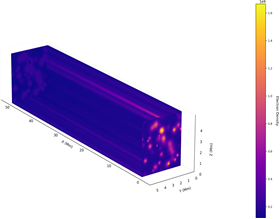

Researchers at ARIES Nainital and IIT Delhi report a new method to reveal hidden turbulence in the Sun’s outer atmosphere that could shed light on why the corona is millions of degrees hotter than the visible solar surface. Using advanced three-dimensional magnetohydrodynamic (MHD) simulations and forward modeling, the team shows that propagating transverse MHD waves-often called Alfvénic or kink waves-can produce measurable, alternating red–blue asymmetries in coronal spectral lines, a signature previously attributed mainly to upflows or jets. The study, led by PhD student Ambika Saxena and Prof. Vaibhav Pant, appears in The Astrophysical Journal.
The researchers simulated an open-field coronal region containing transverse density inhomogeneities and drove transverse waves from the lower boundary. As the waves moved upward along the structured magnetic plume, phase mixing created progressively finer-scale structure and wave-driven turbulence. Because the corona is optically thin, emission from many moving regions overlaps along the line of sight. The superposition of emissions with different velocities produces spectral lines that depart from simple Gaussian shapes, developing alternating blue and red wing asymmetries that vary in time and with height.
Forward-modeled observations in the Fe XIII 10749 Å coronal line showed these asymmetries can reach about 20 percent of the line peak intensity, with apparent secondary velocities of roughly 30–40 km s⁻¹. The alternating red–blue pattern itself propagates outward at speeds consistent with the driving wave. Importantly, the results indicate that nearly incompressible transverse waves alone-without invoking directed upflows-can generate systematic spectral asymmetries when cross-sectional inhomogeneity and turbulence are present.
The finding offers a new diagnostic for wave-driven dynamics in the corona and a potential way to detect turbulence that was previously hidden from standard analyses. With current and upcoming high spatial and spectral resolution instruments such as the Daniel K. Inouye Solar Telescope (DKIST), the study suggests these wave-generated asymmetries may soon be observable, enabling direct tests of wave-turbulence models and contributing to our understanding of coronal heating.
Original Source: https://dst.gov.in/new-study-paves-way-solving-mysteriously-high-temperature-solar-corona
Category:
Tags:
Publish Date: 2026-05-20 18:18:00