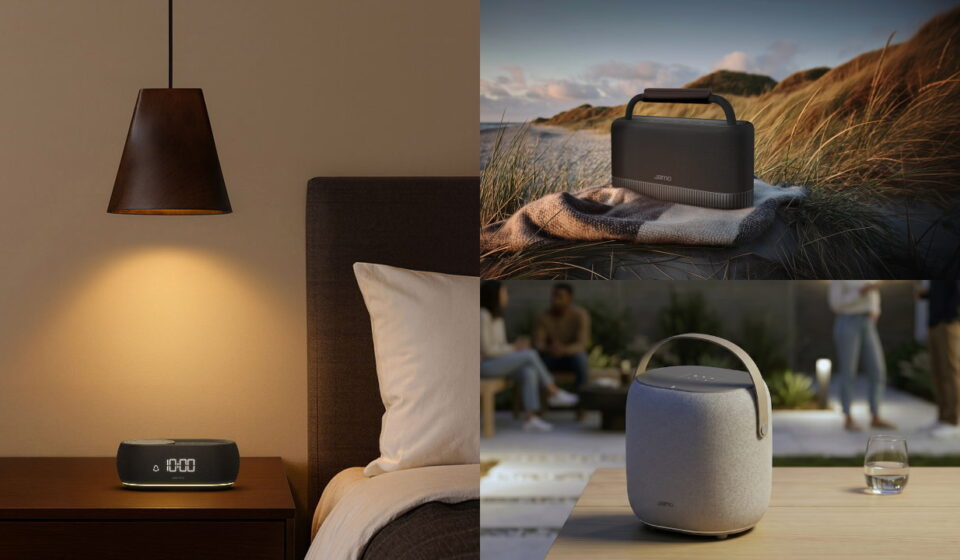

We’ve been conditioned to equate “smarter” with “more connected.” But sometimes product strategy is about choosing which connections to make – and which to leave out. Jamo’s HYG series is a reminder that product differentiation can be design-led and use-case driven, not just feature‑stack driven.
The signal: Jamo has repositioned itself with a three‑model Bluetooth lineup – Flex (room‑filling portable), Reflect (bedside clock + lifestyle features), and Flow (rugged, long‑battery portable) – emphasizing Scandinavian “hygge” design, Bluetooth 6.0/Auracast support, and straightforward UX while skipping Wi‑Fi, app control, and many high‑res codecs. Pricing ranges place Flex at the premium end and Flow/Reflect in the mid-range.
What this move means strategically
– Purposeful simplification as a market play: Jamo isn’t trying to out‑Sonos Sonos. It’s choosing a value position: high‑design, tactile lifestyle products that “just work” over multiroom, cloud‑driven ecosystems. For many buyers – particularly those who prize aesthetics and simplicity – that’s a legitimate differentiation. As architects we often forget: product simplicity reduces integration friction and can lower support costs if the scope is tightly controlled.
– Standards vs. ecosystems: Auracast and LC3-capable Bluetooth represent interesting infrastructure bets – they enable novel broadcast and multi‑speaker experiences without a cloud. But standards-only strategies are double‑edged: they reduce vendor lock‑in for users yet depend heavily on broad hardware and OS support. For a brand like Jamo, leaning into standards can accelerate adoption if the ecosystem converges; otherwise, it risks being a compelling feature only for a niche early adopter cohort.
– Build vs. buy (or rather: build vs. partner): Jamo’s omission of Wi‑Fi and app control eliminates the heavy investments in cloud services, account management, and app ecosystems. That lowers time‑to‑market and total cost of ownership for the product lineup. The trade‑off is that you surrender control over long‑term engagement, recurring revenue, and fine‑grained telemetry. Companies must decide whether to invest in an owned digital layer (firmware OTA management, companion app, cloud services) or optimize for retail sales and third‑party channel support.
– Software lifecycle and security: Even with a Bluetooth‑first product, firmware matters. Security updates, OTA firmware delivery, and privacy controls are the unsung elements of product trustworthiness. Any vendor that ships hardware without a reliable update channel – or without a clear support promise – accepts technical debt that compounds post‑launch. For architects advising hardware teams, a minimal-but-robust update and incident response plan is non‑negotiable.
Actionable advice for founders and CTOs
– Define the ecosystem you realistically intend to own. If your differentiator is design and simplicity, avoid feature creep; instead, invest in quality of core features (battery life, materials, sound tuning) and after‑sales support.
– If adopting newer standards (Auracast, LC3), map the device landscape and partner with chipset/phone OEMs or certified accessory programs to ensure real-world interoperability.
– Prioritize a lightweight but secure firmware update mechanism from day one – it’s cheaper than a recall and essential for brand reputation.
– Consider hybrid engagement: if you skip a full cloud stack, build modular touchpoints (optional companion app, marketplace partnerships) so you can expand services later without re‑engineering hardware.
– For markets with price sensitivity and diverse device ecosystems (including India), local distribution, warranty, and easily accessible repair/service options are as important as headline specs.
Closing thought
Design-led products can win where ecosystems overreach – but only when that design promise is matched by durability, clear interoperability choices, and the operational discipline to support the device lifecycle.
About the Author
Sanjeev Sarma is the Founder Director of Webx Technologies Private Limited, a leading Technology Consulting firm with over two decades of experience. A seasoned technology strategist and Chief Software Architect, he specializes in Enterprise Software Architecture, Cloud-Native Applications, AI-Driven Platforms, and Mobile-First Solutions. Recognized as a “Technology Hero” by Microsoft for his pioneering work in e-Governance, Sanjeev actively advises state and central technology committees, including the Advisory Board for Software Technology Parks of India (STPI) across multiple Northeast Indian states. He is also the Managing Editor for Mahabahu.com, an international journal. Passionate about fostering innovation, he actively mentors aspiring entrepreneurs and leads transformative digital solutions for enterprises and government sectors from his base in Northeast India.