
We obsess over sensors, compute and clever control algorithms – and for good reason. But the most stubborn bottleneck in creating lifelike machines has often been overlooked: the actuator. If actuators continue to be heavy, rigid, or mechanically complex, the rest of our “intelligent” stack will keep compensating with more sensors, more compute, and more mechanical scaffolding. That’s why a material-first approach to muscle – where motion is programmed into the filament itself – is worth paying attention to.
Context
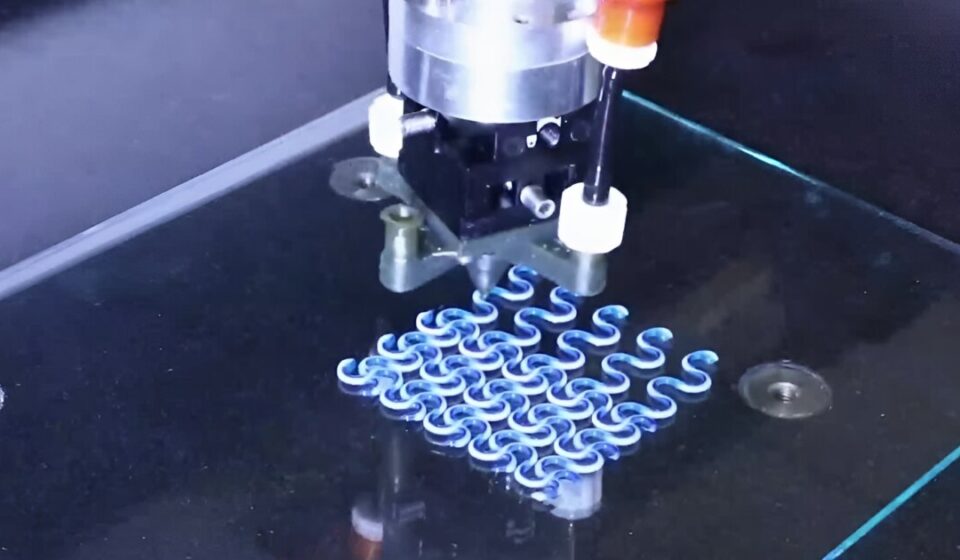
I recently came across an elegant piece of research from Harvard SEAS demonstrating 3D-printed filaments that combine an active liquid crystal elastomer and a passive elastomer to produce programmed bending, twisting and gripping when heated. The team prints side-by-side materials through a rotating nozzle so the molecular alignment is written directly into the structure, producing motion without separate motors, gears or joints.
Analysis – What this really means for architecture and product strategy
There are three architectural shifts here that matter to CTOs, founders and systems architects:
1) Actuation moves from “component” to “material.” When movement is embedded in printed geometry and molecular alignment, mechanical integration becomes additive rather than integrative. That dramatically reduces part-count, simplifies assembly lines, and enables bespoke, on-demand actuators – ideal for rapid prototyping and for low-volume, high-variance production runs.
2) Software must move closer to materials science. Control used to mean PID loops for motors; now it will include thermal management, material hysteresis, lifecycle degradation and multi-physics simulation. Product teams should budget for new tooling: digital twins that model soft-material behavior, test rigs for thermal cycling, and data pipelines that correlate control inputs to long-term material fatigue.
3) Trade-offs are real and immediate. Heat-activated actuation today implies slower response, significant energy cost, and limits on continuous-duty, high-force tasks. For enterprise-grade automation (warehouse forklifts, industrial presses), traditional electric or hydraulic actuators will remain essential. But for delicate manipulation, adaptive interfaces, wearable exoskeletons and medical devices, these soft actuators unlock possibilities that rigid systems cannot match.
Actionable guidance for leaders
– Prototype early and cross-disciplinarily: pair materials scientists, mechatronics engineers and controls software teams from day one.
– Treat manufacturability as a first-class design constraint: consider local 3D-printing capacity, material supply chains, and post-processing needs.
– Run hybrid designs: combine soft-material muscles for compliance and delicate work with traditional actuators for gross motion and power.
– Plan for certification and safety: especially if you aim at biomedical or consumer-facing products, regulatory testing for material biocompatibility and fatigue is non-negotiable.
– Monitor energy economics: thermal activation is expensive; evaluate whether embedded heating, environmental triggers, or alternate stimulus (light, magnetic fields, electroactive polymers) are more appropriate for your use-case.
A pragmatic Bharat / Northeast lens (brief, intentional)
For India – and regions like the Northeast where localized manufacturing and frugal innovation matter – printable soft actuators are compelling. They can enable locally-produced prosthetics, agricultural grippers for delicate fruits, and adaptive fixtures for small-scale manufacturing where buying expensive rigid robots is infeasible. The ability to iterate designs with low tooling cost aligns well with maker labs, regional skill centres and DPI-adjacent manufacturing initiatives.
Takeaways
– Material-programmed actuation is a strategic complement, not a wholesale replacement, of existing actuators.
– Invest in simulation and cross-functional prototyping to understand lifecycle and control dynamics.
– Explore hybrid architectures that combine soft compliance with hard-power actuation.
– Consider localized 3D manufacturing as a route to affordable, tailored products in emerging markets.
Closing thought
We are moving toward a world where motion can be designed as a property of matter, not just as a function of mechanics. That shift will change how we design systems, source components, and think about the boundary between machine and material.
About the Author
Sanjeev Sarma is the Founder Director of Webx Technologies Private Limited, a leading Technology Consulting firm with over two decades of experience. A seasoned technology strategist and Chief Software Architect, he specializes in Enterprise Software Architecture, Cloud-Native Applications, AI-Driven Platforms, and Mobile-First Solutions. Recognized as a “Technology Hero” by Microsoft for his pioneering work in e-Governance, Sanjeev actively advises state and central technology committees, including the Advisory Board for Software Technology Parks of India (STPI) across multiple Northeast Indian states. He is also the Managing Editor for Mahabahu.com, an international journal. Passionate about fostering innovation, he actively mentors aspiring entrepreneurs and leads transformative digital solutions for enterprises and government sectors from his base in Northeast India.