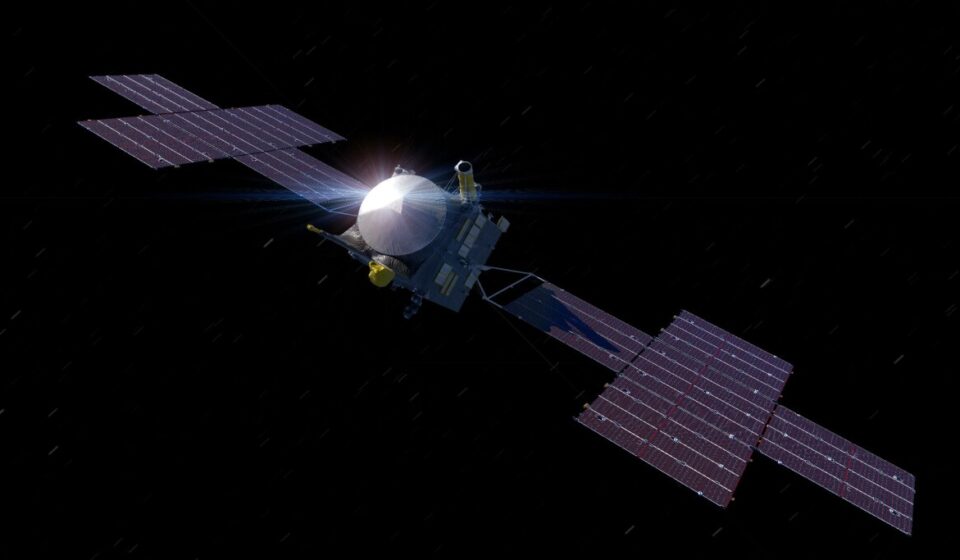

We often celebrate the dramatic milestones – a spacecraft’s flyby, a successful product launch, or a funding round – without pausing to study the choreography behind them. The Psyche spacecraft’s gravity-assist flyby of Mars on May 15, 2026 is one of those elegant, low‑fuel moves that should give every technologist and leader pause: real acceleration often comes from clever alignment, not brute force.
Context
NASA’s Psyche mission, launched on October 13, 2023, used a carefully timed pass 4,500 km above Mars to change speed and tilt its trajectory toward the metal‑rich asteroid Psyche, due in 2029. The manoeuvre also served as an opportunity to calibrate instruments and rehearse operations under real flight conditions.
What this means for architects and founders
There are three strategic lessons here that translate directly into enterprise architecture and product strategy.
1) Leverage external momentum – the “gravity assist” of business
Psyche didn’t burn more propellant to get faster; it borrowed momentum from Mars. In product and platform strategy, the analogue is partnering, standards adoption, and platform integration. Smart organisations look for accelerants – APIs, DPI components, cloud economies, or strategic alliances – that change trajectory without proportional investment. But leverage introduces coupling: reliance on a partner’s availability, API stability, or commercial terms. The trade-off is clear – rapid advancement versus operational dependency – and must be intentionally managed.
2) Use real-world rehearsals before the main event
Psyche’s flyby was both mission-critical and a rehearsal to calibrate instruments. Similarly, staged, production‑adjacent experiments (pilot folds, blue‑green releases, dark launches) let you validate telemetry, failure modes, and user impact before committing fully. Architects should build “calibration windows” into roadmaps – limited-scope runs that exercise full operational flows and observability under realistic conditions.
3) Telemetry as the single source of truth
Mission teams will rely on the Doppler shift to definitively confirm trajectory changes. The lesson is: objective, high‑fidelity telemetry beats opinion and intuition. For cloud‑native systems, this means tracing, metrics, and signals that answer the essential questions: Is the system doing what we expect? Is performance within SLA? What changed after a configuration or dependency update? Design systems where the data tells the story.
Operational trade-offs: speed vs. resilience
Psyche’s manoeuvre is an optimistic example of efficiency, but it also highlights timing risk: planetary assists require narrow windows and near‑perfect execution. In software, the equivalent is pushing aggressive integrations or migrations during constrained windows. A CTO must balance the desire for fast gains against resilience: maintain rollback plans, define strict acceptance criteria, and ensure isolation where possible.
A brief note on frugal engineering (why this matters to India)
There is a distinctly Indian – and especially Northeast – resonance in the idea of doing more with less. Leveraging existing infrastructure and partnerships to amplify impact is the essence of frugal innovation. For public digital stacks (DPI) or constrained enterprises, identifying high‑leverage integrations can accelerate service delivery without equivalent capital outlay. But the same governance and observability principles apply: transparency, clear SLAs, and contingency planning.
Practical takeaways for leaders
– Treat strategic partnerships like orbital assists: quantify expected gains and the failure modes they introduce.
– Build calibration runs into every major deployment – short, observable, reversible.
– Invest in end‑to‑end telemetry; make actionable signals the primary method for decision‑making.
– Balance “leap” opportunities with contingency architecture (feature flags, circuit breakers, blue‑green).
– Plan for long horizons; momentum compounds, but timelines require sustained engineering stewardship.
Closing thought
Precision and patience combine to produce outsized results. Whether you’re nudging a spacecraft toward an asteroid or steering a platform through market inflection, the smartest accelerations are those that borrow momentum wisely – and instrument the journey so the data never lies.
About the Author Sanjeev Sarma is the Founder Director of Webx Technologies Private Limited, a leading Technology Consulting firm with over two decades of experience. A seasoned technology strategist and Chief Software Architect, he specializes in Enterprise Software Architecture, Cloud-Native Applications, AI-Driven Platforms, and Mobile-First Solutions. Recognized as a “Technology Hero” by Microsoft for his pioneering work in e-Governance, Sanjeev actively advises state and central technology committees, including the Advisory Board for Software Technology Parks of India (STPI) across multiple Northeast Indian states. He is also the Managing Editor for Mahabahu.com, an international journal. Passionate about fostering innovation, he actively mentors aspiring entrepreneurs and leads transformative digital solutions for enterprises and government sectors from his base in Northeast India.