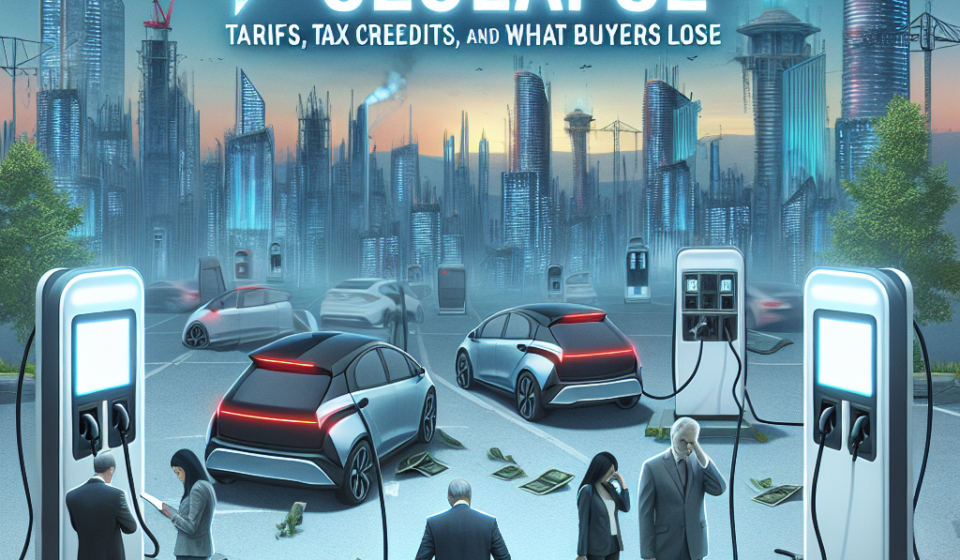

We often treat product discontinuations as engineering failures or transient market noise. But the recent wave of EV model retirements in the US – where several well-reviewed electric cars were paused, discontinued, or never launched in 2026 – exposes a different lesson: policy and supply-chain economics can be the architect of market outcomes just as decisively as technology or consumer preference.
Context
I recently read an analysis documenting that numerous established EV models were removed from the U.S. market in 2026. The proximate causes were not battery problems or safety recalls but a compound policy effect – steep import tariffs, punitive levies on certain origin countries, and the removal of consumer tax incentives – which together reshaped what was commercially viable to sell.
Analysis – why this matters to architects and builders
This is a classic systems-design problem writ large. Technology choices (battery chemistry, software, drivetrain) don’t exist in a vacuum; they sit inside ecosystems of trade policy, manufacturing geography, incentives, and distribution economics. A few principles follow that should inform how we build enterprises, platforms, and products today:
– Policy is a non-functional requirement. Trade rules, tariffs, and subsidies behave like latency or throughput constraints: they change trade-offs between centralized scale vs. localised flexibility. A model that is optimal under free trade can be unviable after a tariff shock. Architects must therefore treat regulatory scenarios as first-class constraints during product planning.
– Platform modularity reduces geopolitical coupling. Companies that can separate hardware, software, and manufacturing platforms (e.g., multiple factories able to produce the same architecture) can shift production quickly. The firms that survived had onshore factories or truly global, flexible production footprints. For software-led products, decoupling from specific hardware suppliers buys time and optionality.
– Short-term incentives create long-term fragility. The expiration of an EV tax credit exposed how dependent product economics had become on subsidies. When business models rely on temporary policy support, the organization accumulates strategic debt that manifests as abrupt discontinuations when incentives change.
– Domestic production is a heavy lift, not a magic bullet. Shifting to local build solves tariff pain but requires capital, suppliers, and a workforce. The cost of “build local or exit” is often paid in consumer choice and price. Policymakers should expect trade-offs; product teams should plan for multi-year transitions.
What should CTOs, founders and product leaders do?
– Model policy scenarios as part of TCO: include tariff, subsidy, and compliance scenarios in product NPV and go/no-go decisions.
– Invest in platform portability: design platforms that multiple factories (or contract manufacturers) can produce with minimal retooling.
– Hedge markets, not just suppliers: diversify launch markets so a single jurisdictional shock doesn’t kill a program.
– Prioritise software differentiation: when hardware margins compress, software and services (OTA, subscriptions, fleet features) preserve value.
– Build partnerships with policymakers: participate in industry consortia so product roadmaps and public policy evolve with mutual visibility.
– Develop talent pipelines near manufacturing hubs: training and local supplier development shorten ramp times and reduce capital risk.
A Bharat lens (brief, practical)
India is accelerating EV manufacturing through localisation incentives and Production Linked Incentive (PLI) schemes. The U.S. case is a cautionary mirror – protectionist moves can create domestic industry but also narrow consumer choice and raise prices if local capacity and supply ecosystems aren’t mature. For Indian policy-makers and industry, the priority should be balanced: nurture local manufacturing while aggressively building supplier ecosystems, worker skills, and R&D so localisation delivers durable competitiveness, not temporary shelter.
Closing thought
Technology is necessary but not sufficient. The health of any digital-physical product depends equally on policy architecture, supply-chain resilience, and platform design. Successful organisations will be those that think like systems architects – designing for code, chemistry, and geopolitics together.
About the Author
Sanjeev Sarma is the Founder Director of Webx Technologies Private Limited, a leading Technology Consulting firm with over two decades of experience. A seasoned technology strategist and Chief Software Architect, he specializes in Enterprise Software Architecture, Cloud-Native Applications, AI-Driven Platforms, and Mobile-First Solutions. Recognized as a “Technology Hero” by Microsoft for his pioneering work in e-Governance, Sanjeev actively advises state and central technology committees, including the Advisory Board for Software Technology Parks of India (STPI) across multiple Northeast Indian states. He is also the Managing Editor for Mahabahu.com, an international journal. Passionate about fostering innovation, he actively mentors aspiring entrepreneurs and leads transformative digital solutions for enterprises and government sectors from his base in Northeast India.