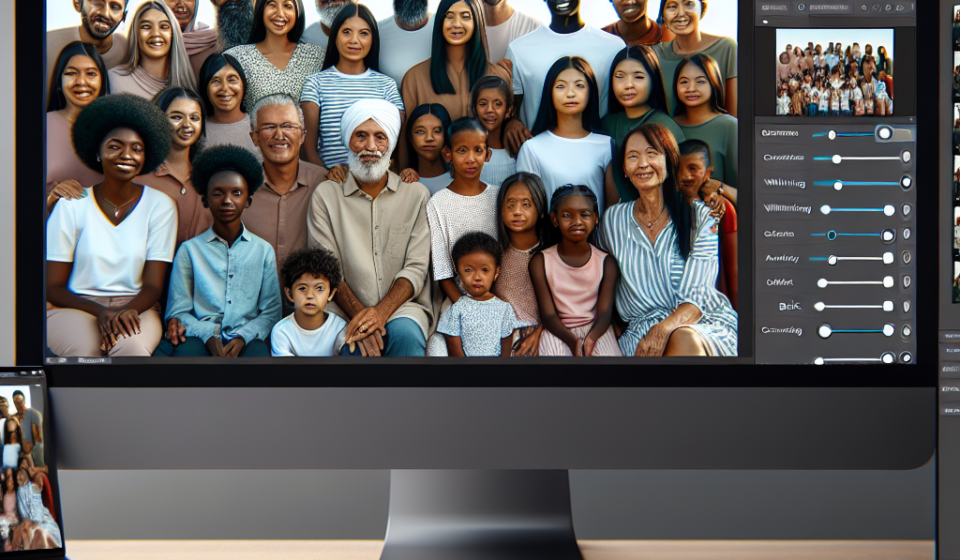

We prize convenience and polish in the images we share – but when platforms bake advanced portrait retouching directly into a mass-market photo app, the conversation must move beyond “pretty” to “practical, ethical and architectural.” Google Photos’ recent addition of per-face touch-up tools is a small product change with outsized implications for how platforms shape visual truth, user expectations and developer trade‑offs.
The signal: a major consumer app now offers integrated face-specific editing (skin smoothing, under-eye correction, teeth whitening, iris brightening, and more) with per-face selection and intensity sliders – all applied post-capture, on-device when hardware permits. That shifts a capability that used to be a camera-time affordance into the photo library itself.
What this means for product and platform leaders
– Democratization changes the guardrails. When powerful retouching moves from niche editing apps to the default gallery, almost every user will expect quick, context-aware enhancements. That raises UX and policy questions: should the default be subtle? Should edits be reversible or flagged visibly? Designers and product managers must treat retouching as a first-class privacy and trust surface, not merely a cosmetic toggle.
– Build vs. buy considerations intensify. Embedding ML-based image manipulation demands investment in model lifecycle management, on-device optimization, and QA across skin tones, lighting and occlusions. Startups and enterprises must weigh licensing third‑party models versus developing in-house – not just on cost but on responsibilities for bias testing, explainability and compliance.
– Device heterogeneity matters – especially in markets like India. Requiring Android 9+ and ~4GB RAM leaves a material portion of users with older hardware behind, so a pragmatic rollout should include lightweight model variants, graceful fallbacks, and offline-first modes. In regions with intermittent connectivity and diverse devices, prioritizing small, efficient models and local processing reduces latency, protects privacy and widens reach.
– Trust and provenance become a product requirement. As editing becomes ubiquitous, so does ambiguity about whether an image represents reality. For enterprises that rely on imagery (newsrooms, ecommerce, HR, telemedicine), provenance metadata, edit histories and optional visible indicators will be essential to preserve credibility. Standards like content provenance and cryptographic signing deserve attention from any engineering org building image pipelines.
– New misuse vectors appear. Per-face edits in group photos reduce “bleeding” of effects, which is technically impressive – but it also makes targeted manipulation easier. Moderation systems must evolve: detection of manipulated imagery, audit trails, and policy enforcement (consent for editing other people’s likenesses) should be integrated into platform design.
Actionable guidance for CTOs and product leads
– Define your default stance: conservative by default (low intensity, reversible edits) preserves user trust while allowing power users to push further.
– Invest in model evaluation: test across diverse skin tones, ages and eyewear; log bias metrics and remediation steps.
– Prioritize on-device & progressive enhancement: ship compact model variants and enable cloud fallback for premium devices or server-side heavy lifting.
– Expose provenance and reversibility: store edit steps in metadata, provide “original” restore, and consider optional visual flags for heavily altered images.
– Align policies with consent and legal frameworks: editing another person’s face in shared images should be governed by clear UX prompts and audit logs.
Closing thought
We are entering a phase where everyday apps will invisibly reshape how people present themselves and perceive others. That places a dual responsibility on technologists: to deliver delightful, low‑friction experiences – and to bake-in transparency, fairness and resilience. As architects, our choices today will determine whether the next decade’s visual culture is empowering or erodes trust.
Takeaways
– Treat image retouching as a trust and provenance problem, not just a UX feature.
– Design defaults conservatively; make edits reversible and auditable.
– Optimize for device diversity and privacy – especially in markets with heterogeneous hardware.
– Build bias testing and governance into the ML lifecycle from day one.
About the Author
San jeev Sarma is the Founder Director of Webx Technologies Private Limited, a leading Technology Consulting firm with over two decades of experience. A seasoned technology strategist and Chief Software Architect, he specializes in Enterprise Software Architecture, Cloud-Native Applications, AI-Driven Platforms, and Mobile-First Solutions. Recognized as a “Technology Hero” by Microsoft for his pioneering work in e-Governance, Sanjeev actively advises state and central technology committees, including the Advisory Board for Software Technology Parks of India (STPI) across multiple Northeast Indian states. He is also the Managing Editor for Mahabahu.com, an international journal. Passionate about fostering innovation, he actively mentors aspiring entrepreneurs and leads transformative digital solutions for enterprises and government sectors from his base in Northeast India.