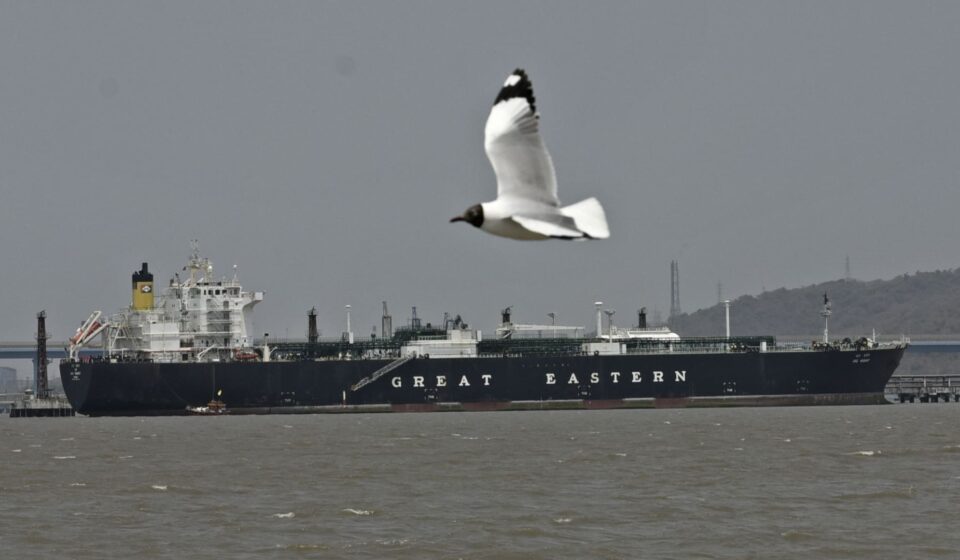

The Indian-flagged tanker Jag Vasant, transporting liquefied petroleum gas (LPG) after navigating the Strait of Hormuz during the Middle East conflict, recently docked at an offloading terminal in Mumbai on April 1, 2026. The ongoing unrest in Iran has significantly impacted India’s merchandise exports, causing a decline of over 7% in March and stifling hopes for recovery in a year already stressed by U.S. tariffs. Experts project that the situation may worsen before it gets better.
According to the commerce ministry’s recent data, India’s goods exports plummeted to $38.9 billion last month, a stark drop from $42.1 billion the previous year. Key markets experienced pronounced declines, with shipments to the United Arab Emirates-India’s second-largest export destination-falling nearly 62% year-on-year. Exports to the United States, India’s largest market, decreased by 21%.
A report from global brokerage Nomura highlighted broad weaknesses across major export categories, noting declines in agricultural goods, textiles, chemicals, electronics, and gems and jewelry. For the financial year ending March 2026, India’s goods exports barely rose by less than 1% to $441.78 billion, underscoring the detrimental effects of U.S. tariffs, which soared to 50% from August until early this year. In February, the U.S. lowered tariffs on Indian goods to 18%.
Ajay Sahai, the director-general and CEO of the Federation of Indian Export Organizations, addressed CNBC’s “Inside India,” stating, “U.S. tariffs were a bigger drag on Indian exports this year,” noting that the conflict in Iran has added another layer of uncertainty for exporters. Sahai warned that multiple factors have curtailed export growth, making it unlikely that India will meet its $2 trillion export target by 2030, potentially delaying it by two years.
Set in 2022, this ambitious target included both goods and services. While merchandise exports reached a record $451 billion in the financial year ending March 2023, they have struggled to maintain that level since then. Nomura further warned that Indian exporters are facing a “troika of headwinds” as the Iran conflict exacerbates cost inflation, elevates shipping and insurance costs, and dampens global demand.
Sahai echoed the sentiment, explaining that outside the Middle East, exporters have shouldered much of the increased freight costs, with only partial transfers to importers. He emphasized that liquidity issues remain a major concern, prompting calls from the industry for government assistance. “Even if there is a settlement in the Middle East in April, it will likely take at least two months to fully recover from the impact of the conflict,” Sahai remarked.
The March trade figures reveal that the Iran war has affected exports more severely than imports, with India’s imports declining 6.5% to $59.59 billion. This drop was largely attributed to reduced oil imports amid supply disruptions linked to the ongoing conflict, bringing down oil import costs to $12.2 billion-the lowest in 13 months, according to a Citi report. Analysts also noted that the effects of rising crude prices will surface in trade data with a one-month delay.
As a result of these economic pressures, India’s benchmark indexes, Nifty 50 and BSE Sensex, dipped 0.3% on Thursday, reflecting the market’s response to the troubled export landscape.
Original Source: https://www.cnbc.com/2026/04/16/india-goods-exports-march-drop-more-pain-ahead.html
Category :
Tags:
Publish Date: 2026-04-16 12:31:00