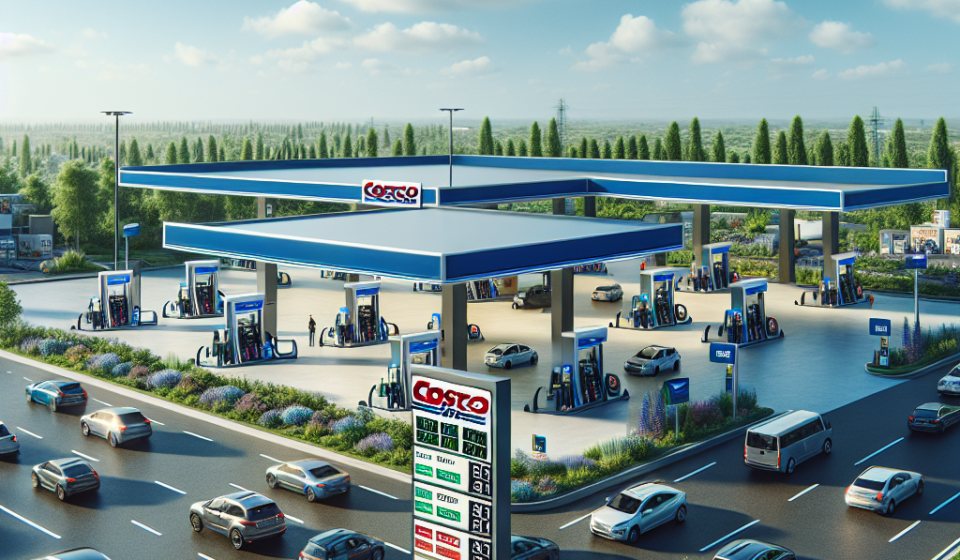

We often reduce retail innovation to product lines and promotions, but the most consequential innovations are usually operational: how a business shapes the flow of people, inventory, and information. Costco’s experiment with standalone gas stations – members-only pumps, staffed operations, app-driven pricing and hours designed to spread demand – is a simple idea with outsized architectural lessons for any organization thinking about scale, friction, and platform strategy.
The signal: Costco is piloting standalone fuel stations separate from its warehouse footprint, requiring membership authentication at the pump while preserving non-member access via alternate payment cards. The move is intended to ease on-site congestion, extend capacity, and preserve the company’s low-price value proposition enabled by bulk procurement and supplier relationships.
What this means for enterprise architects and founders
1. Decouple services to reduce systemic friction
Costco’s separation of fuel from retail floors is an architectural decision applied to the physical world: decoupling a high-throughput, low-margin service from the core shopping experience to reduce cross-system contention (parking, queues, checkout). Digital architectures need the same discipline. When a capability (e.g., authentication, payments, inventory) becomes a bottleneck, consider extracting it into its own service boundary with dedicated scaling and observability.
2. Membership is identity + policy, not just revenue
Making pumps members-only is shorthand for “policy enforced at the edge.” That requires robust, low-latency authentication, graceful fallbacks for guests, and clear UX for exceptions. For platform builders, this highlights the need to treat identity as a first-class API: consistent tokens, auditable access policies, and retryable offline flows where network latency is a reality.
3. Operational decisions encode competitive advantage
Costco’s fuel pricing advantage stems not from marketing but supply-chain architecture: centralized procurement, predictable demand, and margin transparency. Enterprises often chase differentiation in features; rarely do they focus on operational models (procurement, scheduling, staffing) that create defensible economics. As architects, challenge product teams to map feature changes to operational levers – what staffing, supplier, or capacity change is required to sustain customer promises?
4. Use pilots to validate systemic impact
A standalone station is a classic “small experiment with systemic readouts”: traffic patterns, staffing models, failure modes at peak times, and how app-based pricing influences behavior. Technical leaders should mirror this: instrument canary deployments that capture both functional metrics and business KPIs, and use those to iterate.
5. Edge security and payments cannot be an afterthought
Enforcing membership at physical pumps means exposing identity and payment flows to edge devices. This raises requirements for secure device provisioning, tamper detection, encryption-in-motion, and reconciliation. For any company moving services to the edge – physical kiosks, retail terminals, or IoT-enabled infrastructure – design with Zero Trust principles and robust monitoring from day one.
A short note for the Indian context
The principle here is universal: decouple high-frequency, high-concurrency services from general-purpose storefronts to reduce friction. In Indian cities where last-mile congestion is endemic, separating high-turnaround services (fuel, quick-serve banking, express pickup) from larger retail footprints can materially improve throughput and customer satisfaction. However, regulatory and supply-chain realities differ – pilots should focus on campus environments, malls, and industrial parks where operating models can be tightly controlled before broader rollout.
Takeaways for CTOs and Founders
– Map your product features to operational systems; identify the top two bottlenecks and consider service extraction.
– Treat identity as a platform: design edge-friendly, offline-capable auth flows with auditable policies.
– Instrument pilots for both technical and business metrics; iterate quickly and protect core SLAs.
– Invest in edge security and payment reconciliation early – retrofitting at scale is costly.
– Use operations as a source of competitive advantage, not just a cost to minimize.
Closing thought
Innovation that changes the flow of people and goods is often quieter than flashy product launches, but it reshapes the economics of a business. As architects, our job is to see those flow constraints and design systems – technical and operational – that turn friction into advantage.
About the Author
Sanjeev Sarma is the Founder Director of Webx Technologies Private Limited, a leading Technology Consulting firm with over two decades of experience. A seasoned technology strategist and Chief Software Architect, he specializes in Enterprise Software Architecture, Cloud-Native Applications, AI-Driven Platforms, and Mobile-First Solutions. Recognized as a “Technology Hero” by Microsoft for his pioneering work in e-Governance, Sanjeev actively advises state and central technology committees, including the Advisory Board for Software Technology Parks of India (STPI) across multiple Northeast Indian states. He is also the Managing Editor for Mahabahu.com, an international journal. Passionate about fostering innovation, he actively mentors aspiring entrepreneurs and leads transformative digital solutions for enterprises and government sectors from his base in Northeast India.