Transforming Space Exploration: NASA’s Bold Nuclear-Powered Interplanetary Spacecraft Set for December 2028 Launch!

NASA is poised to make a groundbreaking leap in space exploration with its announcement of the Space Reactor-1 (SR-1) Freedom mission, set to launch in December 2028. This ambitious initiative marks the first use of a nuclear fission reactor for propulsion beyond Earth’s orbit, a feat no nation has achieved in over six decades of spaceflight. With SR-1, NASA aims to carry a groundbreaking payload-a trio of Ingenuity-class helicopters-on a mission to Mars, laying crucial groundwork for future exploration.
Why nuclear fission? As NASA continues to push the boundaries of space, conventional solar power has its limitations, particularly on celestial bodies like the Moon and Mars. While solar energy is reliable close to Earth, its effectiveness diminishes with distance and environmental challenges. On the Moon, for example, certain polar areas experience prolonged periods of darkness, and the permanently shadowed craters harbor inaccessible ice. Mars presents similar hurdles; dust storms can obscure sunlight for weeks at a time. To establish a long-term presence on the Moon, facilitate crewed missions to Mars, and venture into the outer solar system, NASA recognizes the need for a power source that’s not reliant on the Sun. Nuclear fission emerges as a potent solution, providing a robust energy source capable of supporting missions in the harshest environments, including those beyond Jupiter.
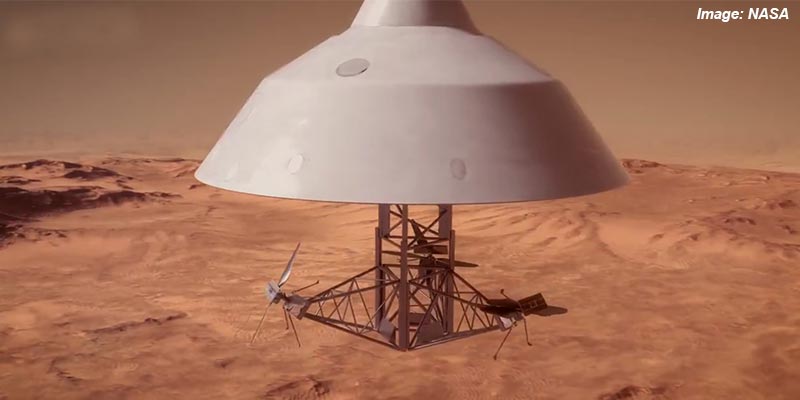
The implementation of the SR-1 Freedom mission is meticulously designed for success. Following its launch, the spacecraft will break free from Earth’s gravitational pull and activate its nuclear fission reactor within 48 hours, harnessing electricity to power electric thrusters. This nuclear electric propulsion system will navigate the spacecraft to Mars, where it will deploy the Skyfall payload. Each of the three Ingenuity-class helicopters onboard will be equipped with advanced technology, including cameras, ground-penetrating radar, and radio communication systems, aimed at surveying potential human landing sites, searching for subsurface water, and relaying vital navigation data for subsequent landers.
SR-1 Freedom is not just a standalone mission; it serves as a pivotal stepping stone towards a future that includes the Lunar Reactor-1 (LR-1), a fission surface-power system designed to sustain lunar bases through periods of darkness and in areas where solar power is ineffective. By flying a reactor in space prior to its deployment on the lunar surface, NASA can mitigate nuclear flight risks, stimulate and qualify the supply chain, and cultivate a skilled workforce necessary for these advanced technologies.
Moreover, SR-1 Freedom is expected to set important precedents in regulatory frameworks and launch protocols while activating the industrial base for future fission-powered systems across various missions and applications. Partnering with the U.S. Department of Energy, NASA aims to unlock the capabilities essential for sustained exploration beyond the Moon and facilitate future manned journeys to Mars and the outer solar system.
Through the pioneering efforts of the SR-1 mission, NASA is not only taking a monumental step towards advanced deep space exploration but also laying the foundation for a future where nuclear propulsion could transform how humanity explores the cosmos. As we stand on the brink of this new era in space exploration, the implications for science, technology, and human presence beyond Earth are immense, heralding a future ripe with possibilities.
Original Source: https://www.manoramayearbook.in/current-affairs/world/2026/03/26/nasa-nuclear-powered-spacecraft.html
Category :
Tags:
Publish Date: 2026-03-26 13:29:00