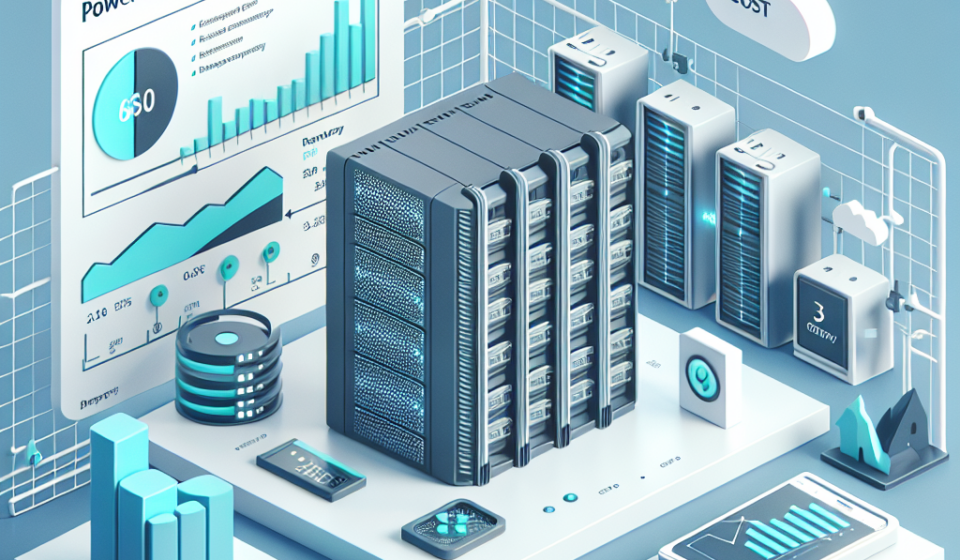

We live in an era where organisations applaud raw throughput and headline storage capacity – but often miss the more powerful lever: data efficiency. The case for measuring storage platforms by how little physical hardware they require to hold the same usable data is becoming as important as IOPS and latency, because efficiency directly affects cost, resilience and sustainability.
Context
A recent vendor-commissioned comparison found meaningful differences in data reduction behaviour between two enterprise arrays: one platform delivered a much higher effective data reduction ratio (DRR) in tests than the other. The practical upshot claimed was fewer drives required for the same logical capacity, with consequent reductions in floor space, power draw and cooling demand.
Analysis – why DRR matters beyond the marketing headline
DRR (data reduction ratio) is an amplifier: a higher DRR reduces the amount of NAND/flash or disk you must buy, maintain and power. For an architect, that flows into three concrete domains:
– Total cost of ownership (TCO): fewer drives cut capital expenditure, but the savings compound through lower power consumption, reduced cooling need, smaller racks and lower recurring maintenance and support. Over a three-to-five-year lifecycle this can shift vendor comparisons dramatically.
– Operational footprint and resilience: smaller physical footprints are easier to replicate for DR, faster to rebuild after failures, and less likely to be constrained by data centre space or power limits – an asset for organisations with limited infrastructure ceilings.
– Sustainability and compliance: lower energy use directly reduces operational carbon and can support corporate ESG targets. For enterprises measuring scope 2 emissions, storage efficiency is not just accounting – it’s strategy.
But a few essential cautions for decision-makers:
– Synthetic tests and vendor guarantees are a starting point, not a conclusion. Data compressibility and deduplication effectiveness are workload-dependent. Databases with already-compressed payloads, encrypted data, media assets and telemetry streams behave very differently from office documents or VM images.
– DRR can hide trade-offs. Inline deduplication and compression consume CPU cycles and can affect latency under peak loads. Snapshot frequency and retention policies influence usable savings. Encryption at rest may reduce deduplication ratios.
– End-to-end architecture matters. Efficient backend storage won’t compensate for a poorly designed data lifecycle: cold data kept on primary storage, or over-retention without tiering, negates the advantages of a high-DRR array.
What CTOs and architects should do next
– Start with data profiling, not product brochures. Run a short PoC using representative datasets – including encrypted and frequently changed volumes – and capture both DRR and performance metrics under load.
– Model full TCO. Include capital costs, power (kWh), cooling, rack space, support contracts and the operational impact of rebuilds and firmware patches over the product lifecycle.
– Combine storage efficiency with lifecycle policies. Use aggressive tiering, object archiving and retention governance to multiply savings. High DRR is most valuable when it’s paired with intelligent data placement.
– Assess operational trade-offs. Measure latency and CPU/load impact of inline reduction features. If performance is critical, consider hybrid designs: fast, lower-DRR flash for hot data; high-efficiency tiers for warm/cold data.
– Preserve mobility and vendor choice. Prefer solutions that support non-proprietary data export and clear portability paths; efficiency gains should not create long-term vendor lock-in.
A pragmatic Bharat lens (where relevant)
In India – and in many parts of Northeast India where power budgets, cooling capacity and data hall space can be tight – the arithmetic of DRR becomes a strategic lever. Lower operational load can reduce the need for expensive power upgrades and make local data centres viable. For public sector and MSME deployments, efficient storage can be the difference between an affordable modern stack and deferred modernization.
Takeaways
– Treat vendor DRR claims as hypotheses to validate with your data.
– Model TCO holistically: capital, power, cooling, space and operational risk.
– Pair efficient arrays with robust data lifecycle and tiering policies.
– Remember the latency and CPU trade-offs of inline reduction features.
Closing thought
Efficiency in storage is no longer a niche optimisation – it is a lever that connects economics, operational resilience and sustainability. The right choice emerges when architects translate vendor promises into validated, workload-specific outcomes.
About the Author
Sanjeev Sarma is the Founder Director of Webx Technologies Private Limited, a leading Technology Consulting firm with over two decades of experience. A seasoned technology strategist and Chief Software Architect, he specializes in Enterprise Software Architecture, Cloud-Native Applications, AI-Driven Platforms, and Mobile-First Solutions. Recognized as a “Technology Hero” by Microsoft for his pioneering work in e-Governance, Sanjeev actively advises state and central technology committees, including the Advisory Board for Software Technology Parks of India (STPI) across multiple Northeast Indian states. He is also the Managing Editor for Mahabahu.com, an international journal. Passionate about fostering innovation, he actively mentors aspiring entrepreneurs and leads transformative digital solutions for enterprises and government sectors from his base in Northeast India.