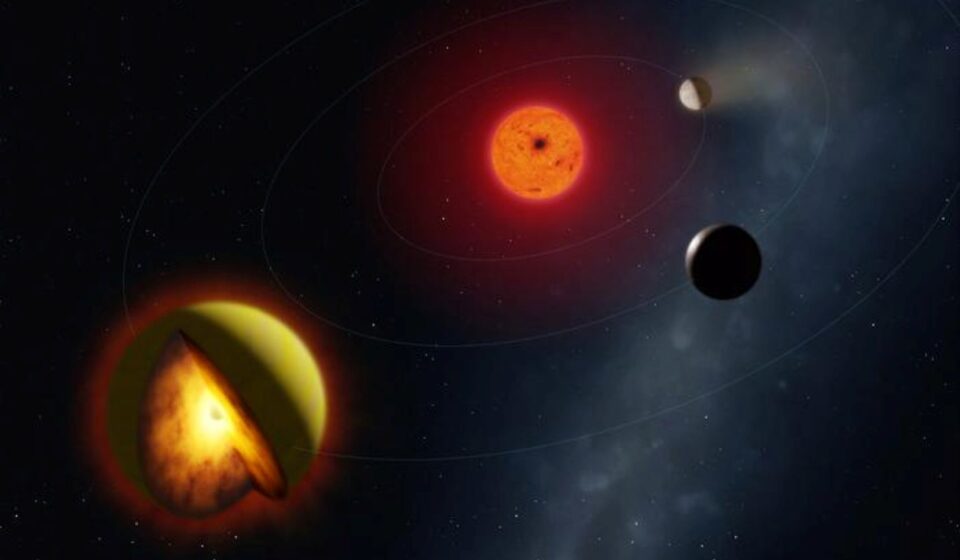

Astronomers have made a groundbreaking discovery of a new class of exoplanet positioned outside our Solar System, revealing a massive ocean of molten rock beneath its surface. This remarkable finding challenges existing classifications of distant planets and suggests a wider diversity of planetary types in our galaxy.
The newly identified planet, named L 98-59 d, resides approximately 35 light-years away, orbiting a small red star. Researchers employed data from the James Webb Space Telescope alongside advanced computational modeling to unveil this celestial body’s composition. Notably, L 98-59 d holds significant reserves of sulfur deep beneath a global magma ocean, an indication of its unique geological characteristics.
The study was spearheaded by astronomers from the University of Oxford, who argue that this discovery points to the potential existence of many other exotic planetary types yet to be found. Lead author Dr. Harrison Nicholls emphasized the implications of this find, stating, “This discovery suggests that the categories astronomers currently use to describe small planets may be too simple.”
Traditionally, small exoplanets have been categorized into two main groups: rocky planets with thin atmospheres and oceanic worlds entirely covered by water. However, L 98-59 d defies these classifications and appears to represent a new category of sulfur-rich planets with molten interiors.
Measuring approximately 1.6 times the size of Earth, L 98-59 d has a surprisingly low density. The research team conducted intricate simulations tracing the planet’s evolution over nearly 5 billion years, linking telescope observations with detailed models of its atmosphere and internal structure. These efforts unveiled vital processes occurring deep within the planet.
Notably, scientists detected sulfur-containing gases like hydrogen sulfide in L 98-59 d’s atmosphere. The planet’s molten interior harbors a superdeep ocean of silicate rock, which serves as a reservoir for sulfur, gradually releasing it into the atmosphere over vast time spans. This magma ocean contributes to a thick hydrogen-rich atmosphere; without it, the star’s X-ray radiation could erode the atmosphere over time.
While L 98-59 d is unlikely to support life as we know it, Dr. Nicholls remarked on the diverse character of planets beyond our Solar System, raising the intriguing question of what other uncharted planet types may exist.
The researchers’ work integrated telescope data with detailed planetary evolution simulations to reconstruct the planet’s history. They also explored how radiation from L 98-59 d generates chemical reactions in its atmosphere, producing sulfur gases, further adding to the planet’s enigmatic profile.
The study indicates that the current classification of exoplanets may be overly simplistic, concealing a broad spectrum of planets with distinct chemical and physical characteristics. Gaining a deeper understanding of magma oceans is crucial, as they represent key stages in rocky planet formation, including that of Earth.
Sophisticated simulations suggest that L 98-59 d may have initially possessed a substantial amount of volatile substances, potentially resembling a larger sub-Neptune. Over time, the planet cooled, shed parts of its atmosphere, and contracted.
Co-author Professor Raymond Pierrehumbert highlighted the significance of using computer models to reveal the concealed interiors of planets that are beyond our reach. He stated, “Although astronomers can only measure a planet’s size, mass, and atmospheric composition from afar, this research shows it is possible to reconstruct the deep past of these alien worlds.”
This significant discovery opens the door to identifying entire populations of similar sulfur-rich worlds throughout the galaxy. With ongoing observations from the James Webb Space Telescope, scientists aim to further explore and understand the dynamic diversity of planets beyond our Solar System and shed light on their formation and evolution.
Journal Reference:
Nicholls, H., Lichtenberg, T., Chatterjee, R.D. et al. Volatile-rich evolution of molten super-Earth L 98-59 d. Nat Astron (2026). DOI: 10.1038/s41550-026-02815-8
Original Source: https://www.techexplorist.com/astronomers-discover-new-planet-type-vast-magma-ocean/102346/
Category :
Tags:
Publish Date: 2026-03-17 23:28:00