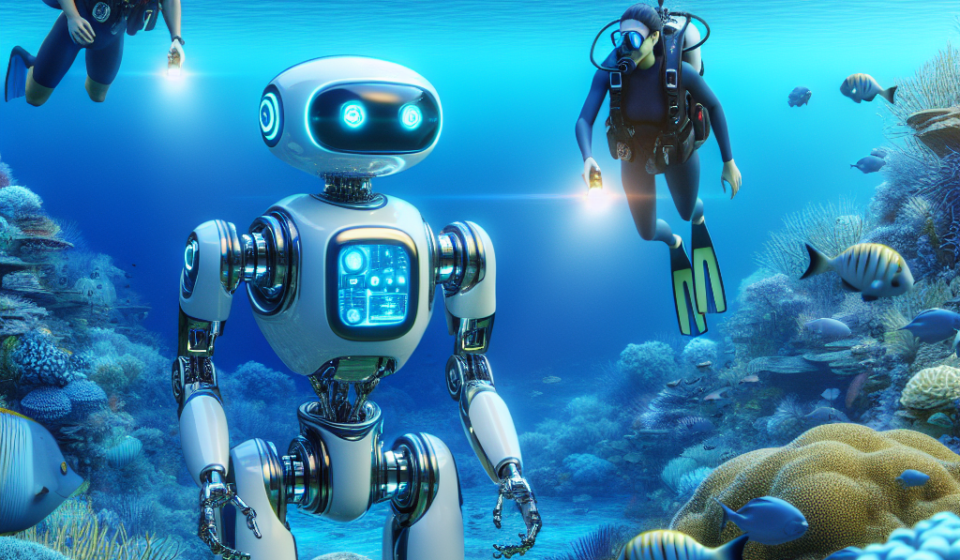

At the end of every autonomy stack is a human making a trust decision – and nothing accelerates trustworthy autonomy like throwing an algorithm into the real world and watching it survive (or fail) with a person at the other end of the tether.
Context
I recently read about an undergraduate intern’s work at MIT Lincoln Laboratory where she developed and field-tested an algorithm enabling collaborative navigation between a human diver and an underwater vehicle in GPS‑denied environments. The project moved quickly from lab to field trials across the Atlantic, the Charles River and Lake Superior during the summer research program in 2025 – a compact case study in turning algorithmic research into operational capability.
Analysis – why this matters to architects and CTOs
The technical headline – solving navigation without GPS – is important, but it’s a symptom of a broader set of engineering and organisational challenges that every enterprise building physical‑world AI must face.
1. The GPS‑denied problem is everywhere. Underwater, underground, indoors and in dense urban canyons, reliance on a single global positioning service creates brittle systems. Robust autonomy requires sensor fusion, relative localization, and explicit design for intermittent absolute fixes. For enterprise architects that means designing systems that can gracefully degrade, re-synchronize and reason about uncertainty at every layer.
2. Simulation is necessary but insufficient. The internship’s rapid move to field tests reinforces a perennial truth: sim‑to‑real gaps are real, and only realistic field trials reveal hidden failure modes – communication latency, sensor occlusion, environmental perturbations, human behaviour. Operational readiness must include progressively realistic trials, hardware‑in‑the‑loop (HIL) testing and clear acceptance criteria before scale.
3. Human‑in‑the‑loop is a feature, not a bug. Collaborative autonomy – where a diver and vehicle share situational awareness – shifts the product problem from “replace the human” to “augment and protect the human.” This imposes requirements for explainability, low‑latency feedback, predictable fail‑safe behaviours and ergonomics of the human‑robot interface. Architectural decisions must prioritise transparent state reporting and simple, trustworthy intervention pathways.
4. The mentorship and ownership model matters. Giving a student lead responsibility in a live program isn’t just educational theatre; it’s a force multiplier for innovation. Treating junior engineers as owners shortens feedback loops and surfaces practical, maintainable solutions faster than ivory‑tower design cycles. Product organisations should institutionalise such apprenticeship pathways.
5. Trade‑offs are design constraints. Underwater systems face severe power, compute and comms restrictions. This forces trade‑offs: lightweight algorithms vs higher accuracy; edge inference vs episodic cloud aggregation; aggressive autonomy vs conservative safety envelopes. CTOs must bake these trade‑offs into roadmap decisions – speed vs stability and capability vs cost – rather than treating them as implementation surprises.
Actionable guidance for leaders
– Design for degraded modes: build relative-localization primitives and reconciliation logic for when absolute fixes return.
– Invest in HIL and staged field testing early – not as a final checklist but as a continuous integration pipeline for physical systems.
– Prioritise human‑robot interface design and explainability; make it trivial for a human to understand and override autonomy.
– Create apprenticeship programs tied to live projects to accelerate operational learning and talent pipelines.
– Partner with research labs and local stakeholders to reduce regulatory friction and access testbeds.
A Northeast India / Bharat angle
For regions like Northeast India, with complex riverine systems (Brahmaputra, Barak) and flood-prone geographies, these lessons are highly applicable. Autonomous and semi‑autonomous underwater platforms could accelerate river bathymetry, sediment monitoring, flood forecasting and fisheries management – but only if solutions are designed for intermittent connectivity, low‑cost deployment and local operational skill development. Frugal, resilient autonomy is not just a technology preference there – it’s a necessity.
Takeaways
– Real‑world trials convert fragile algorithms into dependable systems.
– Human‑centred autonomy reduces risk and increases adoption.
– Architectural planning must include uncertainty, degraded modes and lifecycle data pipelines.
– Talent ownership models (interns-as-owners) are strategic investments, not charity.
Closing thought
The rush to bench‑mark scores and publish algorithms is understandable – but the companies that win the next decade will be those that master the unglamorous work of operational engineering: thoughtful trade‑offs, relentless field testing, and building autonomy that people can trust.
About the Author
Sanjeev Sarma is the Founder Director of Webx Technologies Private Limited, a leading Technology Consulting firm with over two decades of experience. A seasoned technology strategist and Chief Software Architect, he specializes in Enterprise Software Architecture, Cloud-Native Applications, AI-Driven Platforms, and Mobile-First Solutions. Recognized as a “Technology Hero” by Microsoft for his pioneering work in e-Governance, Sanjeev actively advises state and central technology committees, including the Advisory Board for Software Technology Parks of India (STPI) across multiple Northeast Indian states. He is also the Managing Editor for Mahabahu.com, an international journal. Passionate about fostering innovation, he actively mentors aspiring entrepreneurs and leads transformative digital solutions for enterprises and government sectors from his base in Northeast India.