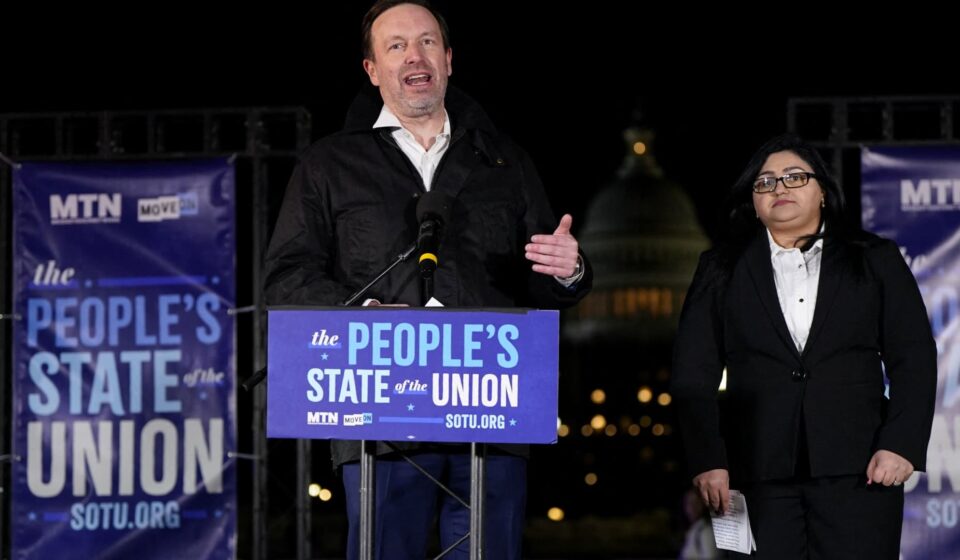

Democratic Senator Chris Murphy of Connecticut has sparked a significant debate over prediction markets following the reported death of Iranian leader Ayatollah Ali Khamenei during a recent bombing. Speaking at the “People’s State of the Union” event, alongside Afghan refugee Fereshteh Ganjavi, Murphy expressed outrage on social media, declaring, “It’s insane this is legal,” in response to individuals profiting from wagers on Khamenei’s downfall. He announced his intention to introduce legislation aimed at banning such markets, highlighting the troubling intersection of profit and human tragedy.
The topic has gained traction in Congress, particularly after lawmakers voiced their concerns regarding how these markets operate in light of international conflict. Representative Mike Levin, a Democrat from California, echoed Murphy’s sentiments on X, stating, “Prediction markets cannot be a vehicle for profiting off advance knowledge of military action.” Levin emphasized the need for “answers, transparency, and oversight” in light of recent events.
Adding to the growing scrutiny, a newly-formed trade group, “Gambling Is Not Investing,” led by former White House Chief of Staff Mick Mulvaney, aims to impose stricter regulations on prediction markets. This initiative stems from fears that these markets undermine traditional sports betting operations that many states have worked to regulate systematically, capitalizing on tax revenues to support their budgets. Mulvaney underscored the importance of adherence to established state and tribal laws, stating, “Rebranding sports wagering as ‘trading’ or ‘investing’ misleads consumers and weakens the protections in place to safeguard public interests.”
The controversy is compounded by specific concerns regarding operators like Kalshi, which recently faced criticism for allowing markets related to Khamenei’s power. In a statement to CNBC, Kalshi sought to clarify its policies, asserting it “doesn’t allow markets directly tied to death.” The firm refunded users involved in such markets, citing regulatory standards that prohibit wagering on death, and emphasized that their rules were clearly communicated from the outset.
In a direct response to Murphy, Kalshi’s CEO Tarek Mansour pointed out that the market in question was not regulated and operated offshore. Furthermore, NPR reported that on another prediction platform, Polymarket, users have seen windfalls, with one individual cashing in $553,000. This raises further questions about the ethics and regulation of such speculative ventures, especially in times of crisis.
As lawmakers like Murphy and Levin rally for greater oversight, the prediction market landscape remains a contentious topic, balancing the allure of financial gain against the ethical implications of profiting from global conflicts. With concerned voices mounting and calls for legislation growing louder, the future of prediction markets hangs in the balance, marking a critical juncture in the ongoing dialogue about gambling, investment, and moral responsibility in today’s economy.
Original Source: https://www.cnbc.com/2026/03/02/prediction-markets-iran-strikes-khamenei.html
Category :
Tags:
Publish Date: 2026-03-02 23:24:00