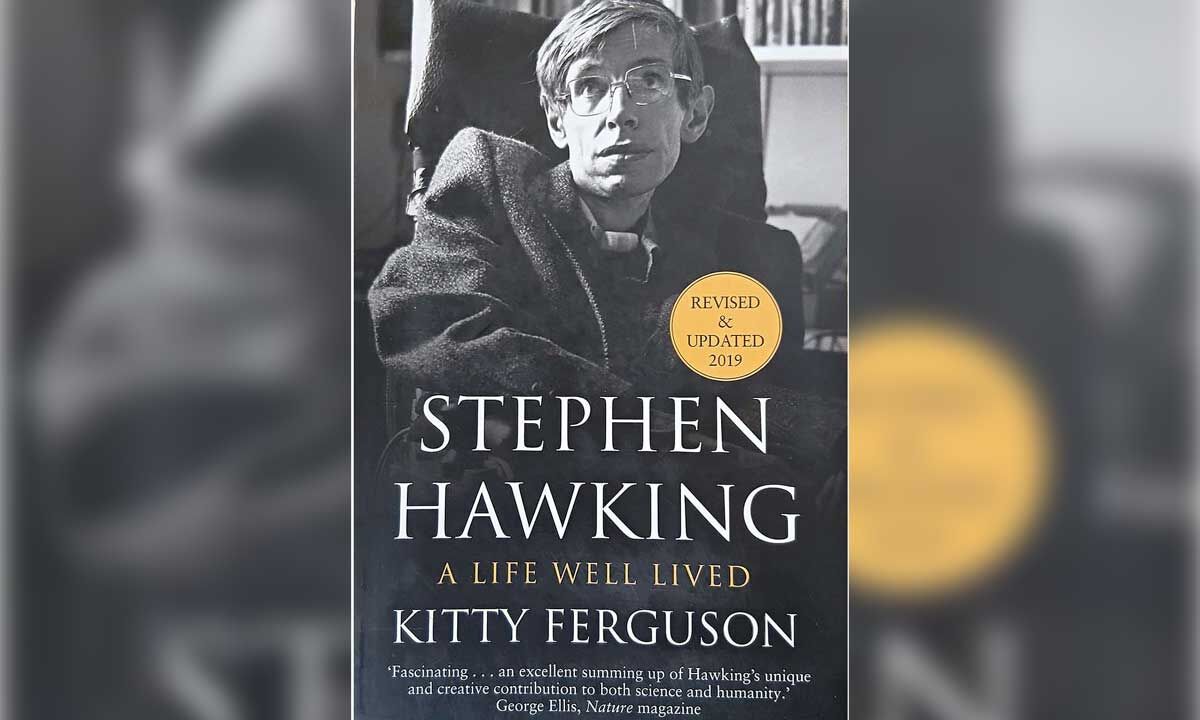
Unlocking the Secrets: The Man Who Saw the Invisible Universe and Transformed Our Understanding

The origin of the universe and humanity’s role within it are profound questions that have captivated thinkers for centuries. Ancient texts, such as the Rigveda’s Nasadiya Sukta, ponder these mysteries, contemplating whether the creator of this vast cosmos exists and understands its intricacies. Science, however, provides answers grounded in empirical evidence. Albert Einstein famously remarked on the universe’s incomprehensibility, highlighting its paradoxical nature of being both complex and knowable.
Renowned cosmologist Stephen Hawking expanded upon this understanding, unraveling the universe’s secrets through works like “A Brief History of Time” and “The Theory of Everything.” Kitty Fergusson’s biography, “Stephen Hawking: A Life Well Lived,” paints a vivid portrait of his journey and contributions to human knowledge. Born on January 8, 1942, in the UK, Hawking’s life took a dramatic turn when, in 1962, he was diagnosed with a debilitating Motor Neuron disease. Despite the progressive loss of muscle control, he maintained his mental acuity and went on to marry Jane Wilde-her father’s conditional consent underscoring the urgency perceived due to Hawking’s prognosis. Living until the age of 76, he defied expectations, leaving behind three children and a legacy of groundbreaking science upon his death on March 14, 2018.
Hawking made pivotal contributions to our understanding of time and its implications for the universe. He demonstrated that time operates in three distinct directions: the thermodynamic arrow, which denotes increasing disorder; the psychological arrow, representing our perception of time; and the cosmological arrow, indicating the universe’s relentless expansion. His research indicated that potential intelligent life could not exist in a contracting universe and that the cosmic speed limit prohibits any travel into the future.
Significantly, Hawking showed how Einstein’s general theory of relativity implies that the universe originated at the Big Bang, approximately 13.8 billion years ago. He challenged the notion that black holes are completely “black,” proving they emit radiation, and expressed a willingness to revise his ideas in light of new evidence. Notably, he wagered against the likelihood of observing Higgs boson particles, which ultimately earned the 2013 Nobel Prize in Physics for demonstrating how fundamental particles acquire mass.
In 1963, Hawking counteracted the steady-state theory of the universe proposed by Fred Hoyle and Jayant Narlikar, advocating for an ever-expanding cosmos. His insights contributed to the 2011 Nobel Prize awarded for the discovery of the universe’s accelerating expansion, affirming that while the universe began with a Big Bang, it is destined to continue expanding indefinitely.
On the relationship between science and spirituality, Hawking remarked, “I think the universe was spontaneously created out of nothing, according to the laws of science.” He grappled with the theological implications of existence, suggesting humanity’s minuscule significance in a vast universe that largely operates beyond our comprehension. Hawking posited that prior to the Big Bang, time as we know it did not exist, making causality moot.
His advice resonates deeply: “Look up at the stars and not down at your feet. Be curious. And however difficult life may seem, there is always something you can do and succeed
Original Source: https://www.thehansindia.com/featured/sunday-hans/the-man-who-could-see-the-invisible-universe-1042141
Category :
Tags:
Publish Date: 2026-01-25 12:45:00
