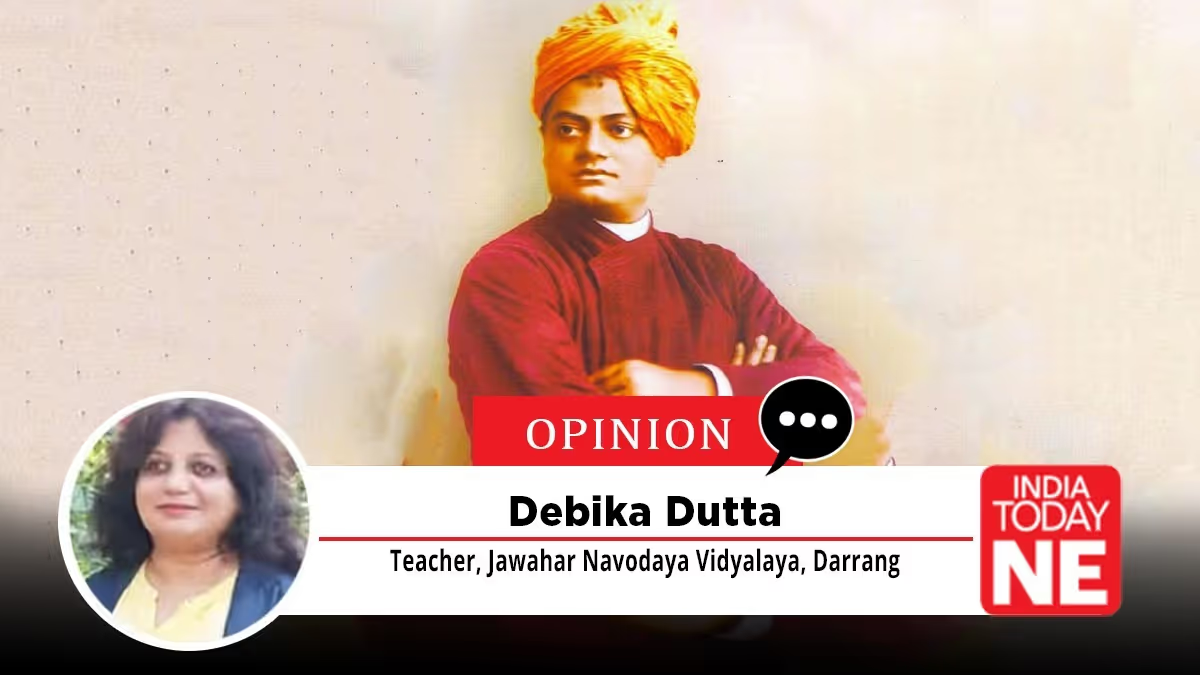

Every year on January 12, India observes National Youth Day in honor of Swami Vivekananda, a reformer who challenged complacency in a society struggling with confidence. While many celebrate him with inspiring quotes, Vivekananda himself was not a figure of comfort; he urged a revival of courage and strength. His message remains relevant today, as the nation grapples with its identity and purpose.
Vivekananda engaged with youth not by romanticizing India’s past but by placing the weight of responsibility on their shoulders. He famously asserted that “strength, strength is what the Upanishads speak,” emphasizing that humility and tolerance should not be equated with weakness. In his view, acknowledging weakness was a historical liability, not a virtue.
Central to Vivekananda’s teachings was a vision of education. He opposed an education system that produced “a mass of clerks,” critiquing it not only as a failing of colonial administration but also as a lack of cultural grounding. He believed that true education should cultivate citizenry, not mere functionaries detached from their roots. Today, with India producing graduates in unprecedented numbers, there persists a discourse anxious about ethics, social cohesion, and institutional integrity. Vivekananda warned that knowledge devoid of character risks sharpening intelligence while blunting judgment.
Many misunderstand his idea of “man-making education,” often misconstruing it as hyper-masculinity. Rather, he called for inner courage-moral strength, intellectual independence, and spiritual confidence. According to him, true strength lies in confronting reality, including the ability to reform one’s society.
In this spirit, Vivekananda’s nationalism was deeply cultural. He believed a nation could not rely solely on borrowed ideas or models, arguing that political freedom without cultural self-awareness leads to imitation instead of true independence. He viewed India as a civilization held together by shared philosophy, ethics, and spirituality. Denying this heritage for modernity, he felt, was a form of self-erasure.
His views often lead to criticisms, especially concerning the potential legitimization of majoritarian impulses. Yet, his Hinduism was broad-minded, emphasizing critical reflection on caste rigidity and social stagnation rather than exclusion. He opposed the fossilization of tradition while also rejecting its outright dismissal, arguably making his ideology more complex than portrayed.
Vivekananda’s support for pluralism should also be recognized. He did not seek uniformity but rather promoted confidence in diverse identities. His address at the World Parliament of Religions in Chicago was not a plea for acceptance but a bold assertion of India’s presence as a contributor to the global discourse.
In today’s context fraught with cultural anxiety, this distinction is crucial. Genuine dialogue necessitates self-respect; a civilization unsure of its own foundations cannot engage others as equals. Critiques of Vivekananda’s rhetoric surrounding strength and masculinity often miss that his call was ethical, aimed at personal mastery, not domination over others.
He famously stated, “They alone live who live for others,” underscoring that true service (seva) arises from strength. The work of the Ramakrishna Mission in various social sectors stands as proof that his vision of nationalism transcended rhetoric; it was marked by community engagement.
The fusion of spirituality and service is one of Vivekananda’s lasting contributions. He rejected the notion that faith should be kept separate from public life, arguing that spirituality without service becomes escapism, while service devoid of spirit becomes mechanical.
As we commemorate National Youth Day, it is essential to engage with Vivekananda’s legacy meaningfully. Rather than merely celebrating him ceremonially, we must confront challenging questions: Are we preparing young Indians to compete or to contribute? Are we nurturing not just skilled professionals but responsible citizens? Are we confident participants in the world, or merely anxious imitators?
Vivekananda offers no easy answers. He presents a challenging vision of strength rooted in values, confidence tempered by compassion, and nationalism grounded in civilizational respect. True remembrance of Vivekananda requires acknowledging the responsibilities he placed on our shoulders. It is up to us to decide whether we are ready to embrace that challenge.
Original Source: https://www.indiatodayne.in/assam/story/vivekananda-and-the-burden-of-strength-1330107-2026-01-12?utm_source=rssfeed
Category:
Tags:
Publish Date: 2026-01-12 15:09:00