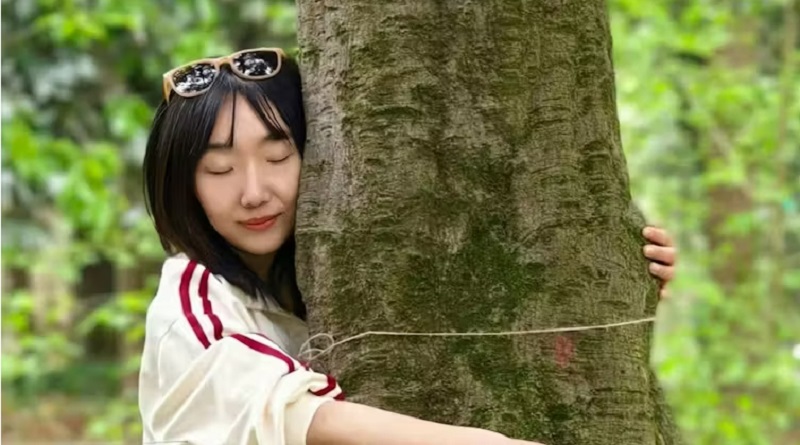

In central Beijing, trees flourish in abundance, found in parks, lining roads, and nestled within private courtyards. While some of these trees have flourished for centuries, many have been planted only in recent decades. These ancient trees, with their broad trunks, invite touch; you can embrace them with a friend, trace your fingers over the bark, or even press your ear against the trunk to hear the tree’s pulse. The act of hugging a tree, while seemingly simple, is an art form that requires practice.
“Hugging trees is a way of having touch in one’s life,” explains Xiaoyang Wong, a 35-year-old leader of a forest therapy community in Beijing. After feeling isolated during the COVID pandemic, Wong retrained as a forest therapist, embracing a practice that had initially disturbed her. Many newcomers to tree hugging experience initial awkwardness, but under Wong’s guidance, participants are encouraged to connect with the tree’s ecosystem, observing the insects scurrying in the bark’s texture.
It is only after engaging with a tree’s world that participants feel comfortable touching or hugging it. “I had only learned to hug trees by watching others,” Wong shares, noting the transformation this experience can bring.
In Beijing, ancient trees are often fenced off to prevent damage, but newer ones remain accessible, inviting people to gather and connect. On weekends and evenings, one can witness individuals of all ages-friends, couples, and families-leaning against trunks or wrapping their arms around the trees, seeking respite from the pressures of daily life.
These stresses have intensified, especially post-pandemic, where feelings of loneliness have become widespread. As young women in China increasingly challenge traditional notions of marriage, many are seeking deeper friendships and new pathways to fulfillment. Scholars note that trees foster a sense of connection, making young people feel “rooted” and “alive.” In ongoing research involving interviews with over 25 young individuals, it was revealed that more women than men participate in forest therapy, aiming to forge connections with both trees and fellow humans.
Wong has infused forest therapy with innovative practices, such as “plant enactment,” where participants adopt the name of their favorite tree for a day. They embody the characteristics of their chosen plants, sharing movements that mimic their tree’s essence. Wong often collaborates with women who, like her, have exchanged high-pressure careers for roles that nurture both the environment and community well-being.
In one therapy session, Florian Mo, a 28-year-old, shared his struggles with love, attributing his difficulties to societal stigmas around young love in China. Despite grappling with a recent breakup, he believes that had he learned to love during his youth, he could navigate heartbreak more easily today.
For individuals like Wong and Mo, trees represent spaces for self-exploration and connection. While narratives around China’s urbanization often revolve around pollution, young people like them depict a different story: one where they actively seek to mend their urban environment through nurturing relationships with trees and fostering connections with one another.
Original Source: https://nenow.in/neighbour/china/why-so-many-young-people-in-china-are-hugging-trees.html
Category: China,Neighbour,Top News
Tags:
Publish Date: 2025-12-27 23:12:00