
NASA has unveiled stunning new images of 3I/ATLAS, an interstellar comet believed to predate the solar system. Captured by over a dozen NASA spacecraft and telescopes, these visuals provide the most detailed view yet of this cosmic visitor, which traveled from beyond our solar neighborhood.
The comet was first identified in July by an ATLAS telescope located in Rio Hurtado, Chile. Its hyperbolic trajectory confirmed that it did not originate within our solar system. In response, NASA initiated an extensive observation campaign, deploying cameras from Mars, Earth orbit, and even solar observation missions to observe the comet.
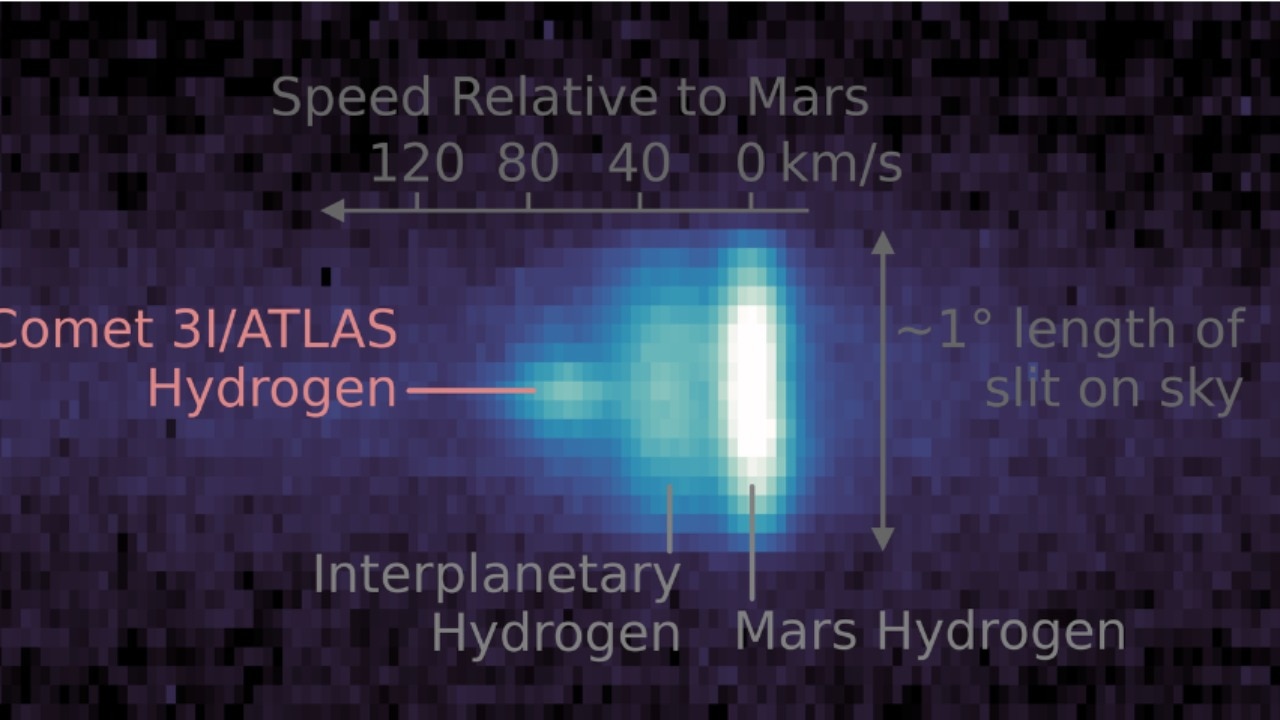
According to NASA, some of the most striking images came from Mars. As 3I/ATLAS skimmed within 19 million miles of the planet earlier this fall, the Mars Reconnaissance Orbiter provided one of the closest views available. The MAVEN orbiter produced ultraviolet images that showcased the comet’s chemical composition, while the Perseverance rover offered a faint but significant glimpse from the Martian surface.
NASA’s STEREO and the collaborative ESA-NASA SOHO mission captured clear images as the comet positioned itself behind the Sun from Earth’s vantage point-an interval during which ground-based telescopes were unable to observe it. Newly released images from NASA’s PUNCH mission revealed the comet’s tail extending across the heliosphere.
This marks the first occasion that NASA’s solar-oriented missions have purposely photographed an object from beyond our solar system. The asteroid-bound Psyche spacecraft also contributed, taking four images over eight hours from approximately 33 million miles away. Meanwhile, the Lucy mission provided additional photographs from 240 million miles, with composite images highlighting detailed structures in the comet’s coma and tail.
Renowned telescopes such as Hubble, the James Webb Space Telescope, and the SPHEREx mission added high-resolution and spectral images in August, solidifying 3I/ATLAS as one of the most extensively documented interstellar objects in history.
3I/ATLAS is expected to make its closest approach to Earth on December 19, arriving at a distance of about 170 million miles. Scientists anticipate further images as the comet traverses the solar system, eventually passing beyond Jupiter’s orbit in spring 2026.
Original Source: https://www.indiatoday.in/science/story/nasa-interstellar-comet-3i-atlas-images-mars-solar-missions-glbs-2822802-2025-11-20
Category:
Tags:
Publish Date: 2025-11-20 03:07:00