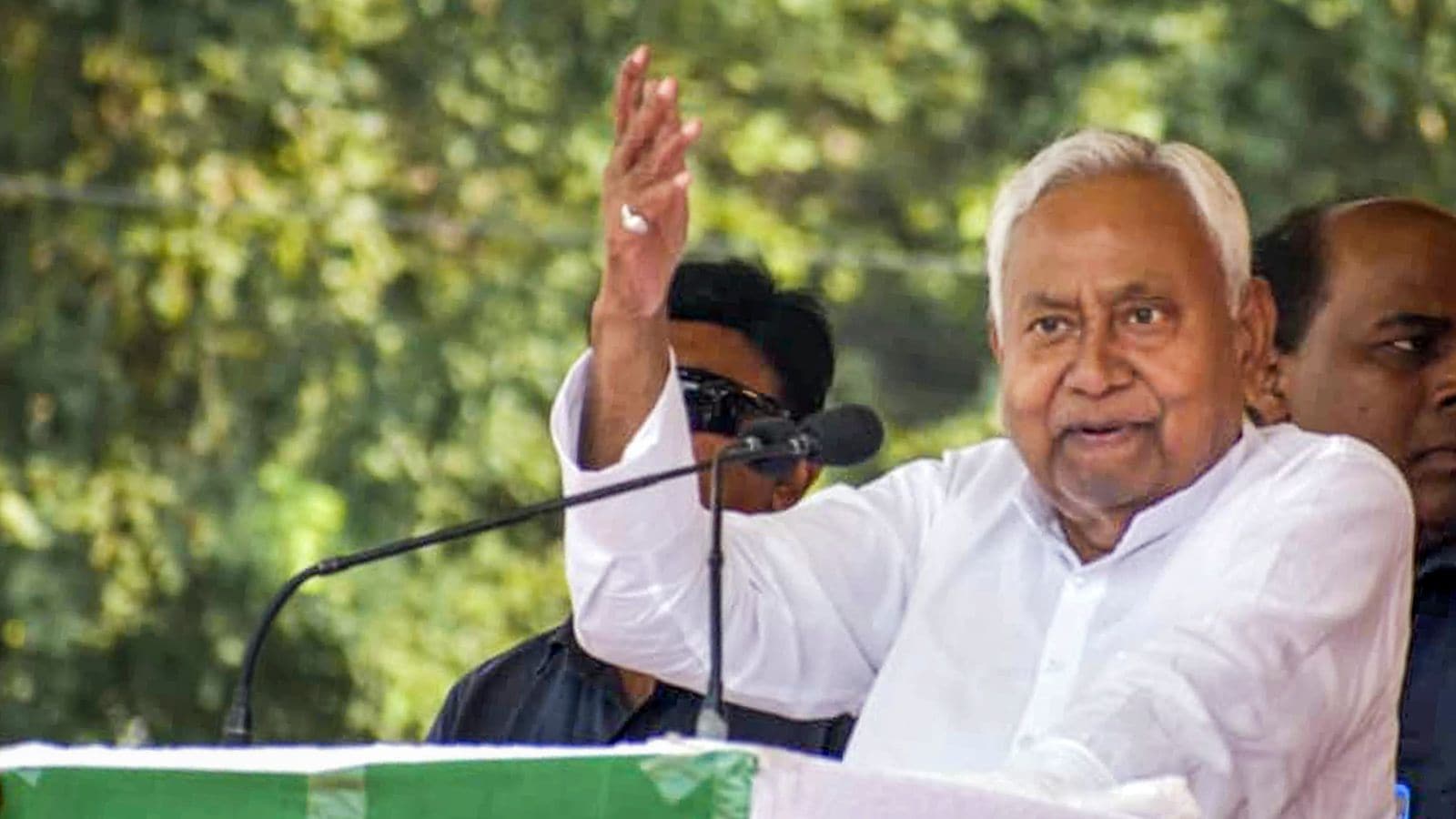

Amid the political landscape shaped by the Jayaprakash Narayan movement, Nitish Kumar of the JD(U) has defied expectations by leading his party to a remarkable victory in the recent Assembly elections, nearly doubling its seats compared to 2020. This win secures his position as Bihar’s longest-serving Chief Minister, marking a 20-year unbroken tenure.
Leading up to the elections, speculation about Nitish’s future was rampant. His government initiated several schemes, such as providing free electricity for up to 125 units and introducing the Mukhyamantri Mahila Rojgar Yojana, which deposited ₹10,000 into the accounts of over one crore women as an initial installment. Critics interpreted these actions as signs of desperation, questioning his commitment to opposing free handouts and expressing concerns about his health, as well as the BJP’s ambitions in the region.
However, supporters of Nitish asserted that such perceptions were misguided. A source connected to the Chief Minister’s office highlighted his contributions to initiatives, including advocating for solar panels under the electrical subsidy scheme. As the campaign progressed, he became increasingly active, addressing 84 public meetings, which shifted attention away from health concerns to expressions of support for the 74-year-old leader.
Women, in particular, emerged as strong supporters, benefiting significantly from Nitish’s schemes. Even those dissatisfied with employment prospects acknowledged his contributions. His most significant achievement was steering Bihar away from the “jungle raj” era marked by Lalu Prasad’s regime. Upon assuming office in 2005, he prioritized fundamental improvements in law and order, infrastructure, and public services such as schools and hospitals.
This strategic focus allowed him to carve out a unique niche in a state defined by caste politics, where his community, the Kurmis, comprises less than 4% of the population. He also garnered support from Extremely Backward Classes, women, and Mahadalits, collectively representing over 20% of voters.
A JD(U) leader described women as Nitish’s “caste-neutral constituency,” citing various initiatives such as free bicycles for girls, 50% reservations in local governance, and a prohibition policy. Women turned out in record numbers this election, surpassing male voter participation and defying predictions stemming from concerns about missing female voters during the Special Intensive Revision drive.
There were worries about how a younger generation, lacking memories of the Lalu-Rabri governance, would vote and whether Nitish could convince them of his continued relevance. In response, the JD(U) highlighted several government measures, such as establishing an engineering college in each district and a monthly allowance for young adults, to engage the youth demographic.
Provisional analysis of voter turnout suggests that Nitish’s outreach succeeded, retaining support from the Extremely Backward Classes despite recent losses of key leaders in that demographic. As he prepares for a 10th term in office, there are visible signs of him slowing down, with a once-vibrant political presence now marked by occasional pauses mid-sentence. His media interactions have notably diminished since 2019, with a growing reliance on trusted advisors like Sanjay Kumar Jha, a former BJP member.
Regarding his relationship with the BJP, which pressured JD(U) to share seats evenly, sources indicate that Nitish remains secure in his position. JD(U) leaders report that the BJP has learned from previous electoral failures, such as when the Modi wave of 2014 faltered in Bihar during the 2015 elections.
Having returned to the NDA after navigating various political switches, a JD(U) source noted that Nitish has ensured the BJP understands its dependency on his leadership. Despite conceding 101 seats, Nitish has managed to sidestep undesirable constituencies and place restrictions on the influence of Chirag Paswan of the LJP (RV).
Ultimately, the decision about his future leadership lies entirely with Nitish, who may choose to continue or appoint a successor as health challenges arise. One shopkeeper in a Seemanchal village remarked, “In the Mahabharata, Bhishma Pitamah was blessed with ichha mrityu (death at one’s will); in Bihar, Nitish has the blessing of iccha shashan (ruling Bihar as long as he wants).” For now, it appears that the Bhishma Pitamah continues to reign.
Original Source: https://indianexpress.com/article/political-pulse/nitish-once-more-bihars-bhishma-pitamah-strikes-back-10366345/
Category: Political Pulse
Tags:
Publish Date: 2025-11-14 22:28:00