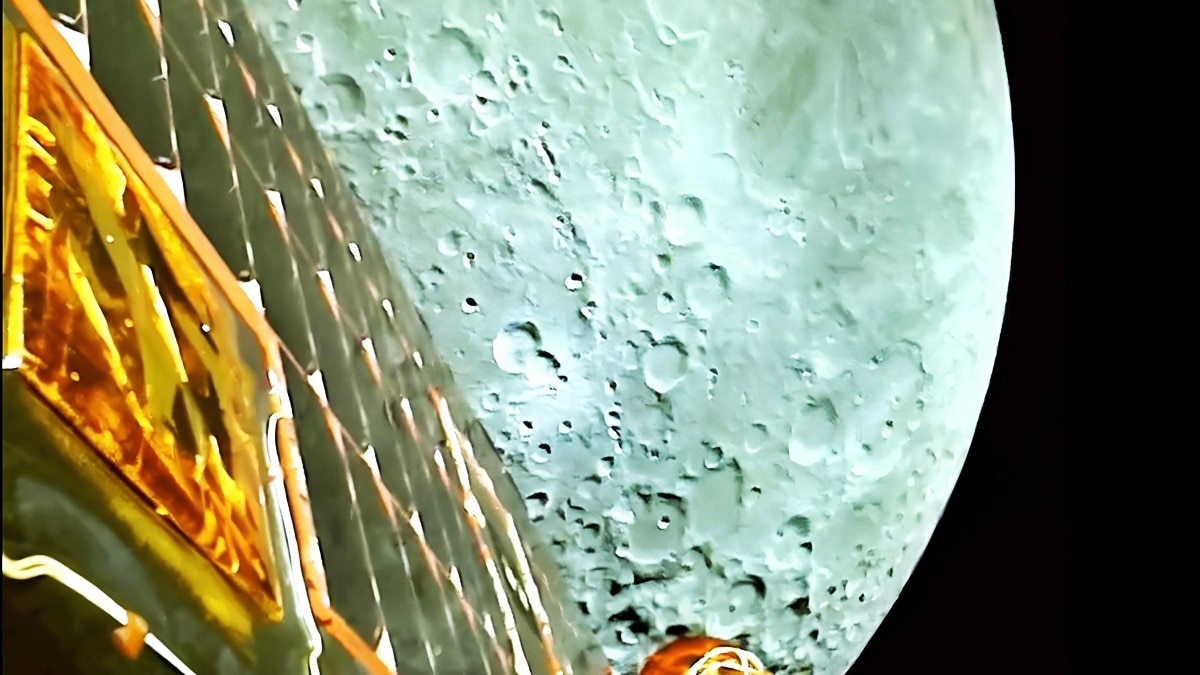

Chandrayaan-3’s Propulsion Module (CH3-PM) has marked a significant milestone by re-entering the Moon’s sphere of influence (SOI) for a series of lunar flybys, more than two years after the successful soft landing of its lander and rover in August 2023. This crucial development has provided the Indian Space Research Organisation (ISRO) with invaluable operational data that enhances our understanding of spacecraft navigation and orbital mechanics.
Launched on July 14, 2023, aboard an LVM3 rocket from Sriharikota, the Chandrayaan-3 mission was designed primarily to demonstrate safe lunar landing techniques, enable rover operations, and conduct essential in-situ scientific experiments. The mission comprises three key modules: the Lander, the Propulsion Module, and the Rover. After achieving its primary objectives on August 23, 2023, the lander and rover began their historic journey across the Moon’s rugged terrain, while the propulsion module remained in lunar orbit at approximately 150 km, facilitating ongoing communications and scientific data collection.
In October 2023, ISRO executed trans-Earth injection (TEI) maneuvers, repositioning the Propulsion Module into a high-altitude Earth-bound orbit. For over two years, its trajectory has been delicately influenced by the gravitational forces of both Earth and the Moon. This complex orbital maneuver culminated on November 4, 2025, when the module re-entered the Moon’s SOI, marking a pivotal moment where lunar gravity began to dominate its path.
The first recorded lunar flyby took place on November 6, 2025, at a distance of 3,740 km from the lunar surface, although it was outside the visibility range of the Indian Deep Space Network (IDSN). A closely monitored second flyby occurred on November 11, 2025, when the module passed within 4,537 km of the Moon, well within the observational capabilities of mission controllers. These flybys dramatically altered the satellite’s orbital parameters, expanding its orbit from 100,000 x 300,000 km to an impressive 409,000 x 727,000 km and adjusting its inclination from 34° to 22°.
Throughout these operations, ISRO’s Indian Space Research Organization Telemetry, Tracking and Command Network (ISTRAC) maintained vigilant oversight of CH3-PM, ensuring it remained safely distanced from other lunar orbiters while logging critical data on gravitational interactions and satellite dynamics. Mission controllers have confirmed that the spacecraft is in nominal condition, with no threats or collision risks reported.
These rare lunar flybys have invigorated planetary scientists and mission planners alike, underlining ISRO’s expanding expertise in post-landing spacecraft utilization. This advancement not only contributes to the current mission’s success but also broadens humanity’s knowledge base for future deep-space exploration endeavors.
As the exploration continues, the ongoing analysis of data collected during these flybys promises to yield further insights, enhancing our understanding of lunar dynamics and contributing to the broader body of knowledge essential for upcoming interplanetary missions. Chandrayaan-3 continues to exemplify the ambitious spirit of space exploration and India’s commitment to advancing its capabilities in this field.
Tags: Chandrayaan-3, ISRO, lunar flybys, space exploration, satellite dynamics, India.
Original Source: https://www.indiatoday.in/science/story/chandrayaan-3s-propulsion-module-enters-moons-sphere-of-influence-in-rare-flyby-2819313-2025-11-13
Category :
Tags:
Publish Date: 2025-11-13 21:21:00